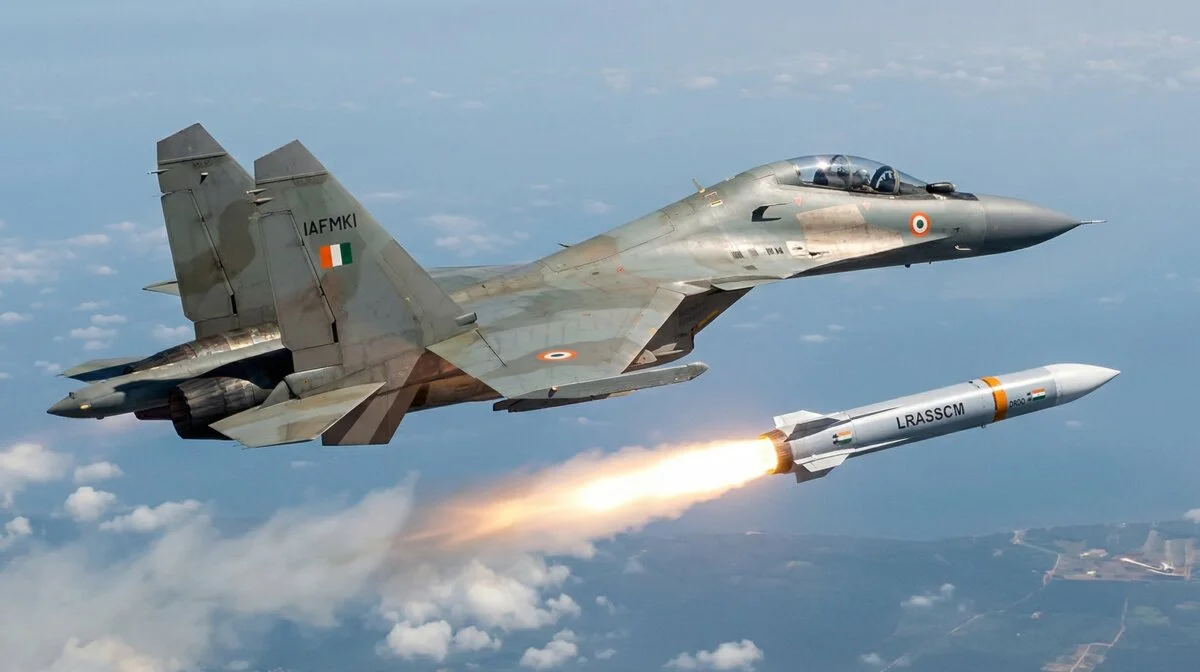
New Delhi: India is set to enhance its aerial strike capabilities with the development of the Long Range Air-to-Surface Supersonic Cruise Missile (LRASSCM), formally approved for production by the Defence Research and Development Organisation (DRDO).
Dr. Samir V. Kamat, Chairman of DRDO, confirmed that the project has received the Acceptance of Necessity (AoN), enabling the creation of a high-speed, precision-guided missile for the Indian Air Force (IAF).
Technical Features
The LRASSCM is designed to maintain supersonic speeds throughout its flight, reducing reaction time for adversaries and improving its ability to penetrate modern air defence systems. Analysts suggest the missile employs liquid-fuel ramjet propulsion, similar to the BrahMos missile, and offers an estimated standoff range of up to 1,000 kilometres. This allows the IAF to strike high-value targets from a safe distance beyond the reach of enemy surface-to-air missiles.
Integration with Su-30MKI
The missile will debut on the Sukhoi Su-30MKI, the IAF’s primary multirole fighter, chosen for its structural strength and payload capacity. Integration will follow a phased approach:

- Carriage Trials – verifying aerodynamic and physical fit
- Separation Tests – ensuring safe missile release
- Powered Flight Trials – testing engine and guidance systems
This initiative complements the ongoing Super Sukhoi upgrades, which include AESA radars and indigenous avionics, further enhancing the aircraft’s long-range strike capability.
Strategic Significance
The LRASSCM strengthens India’s Aatmanirbhar Bharat vision by reducing dependence on foreign systems. While initially exclusive to the Su-30MKI, future variants may be adapted for aircraft like the HAL Tejas Mk2 and Rafale, expanding the IAF’s precision-strike options across multiple platforms.