
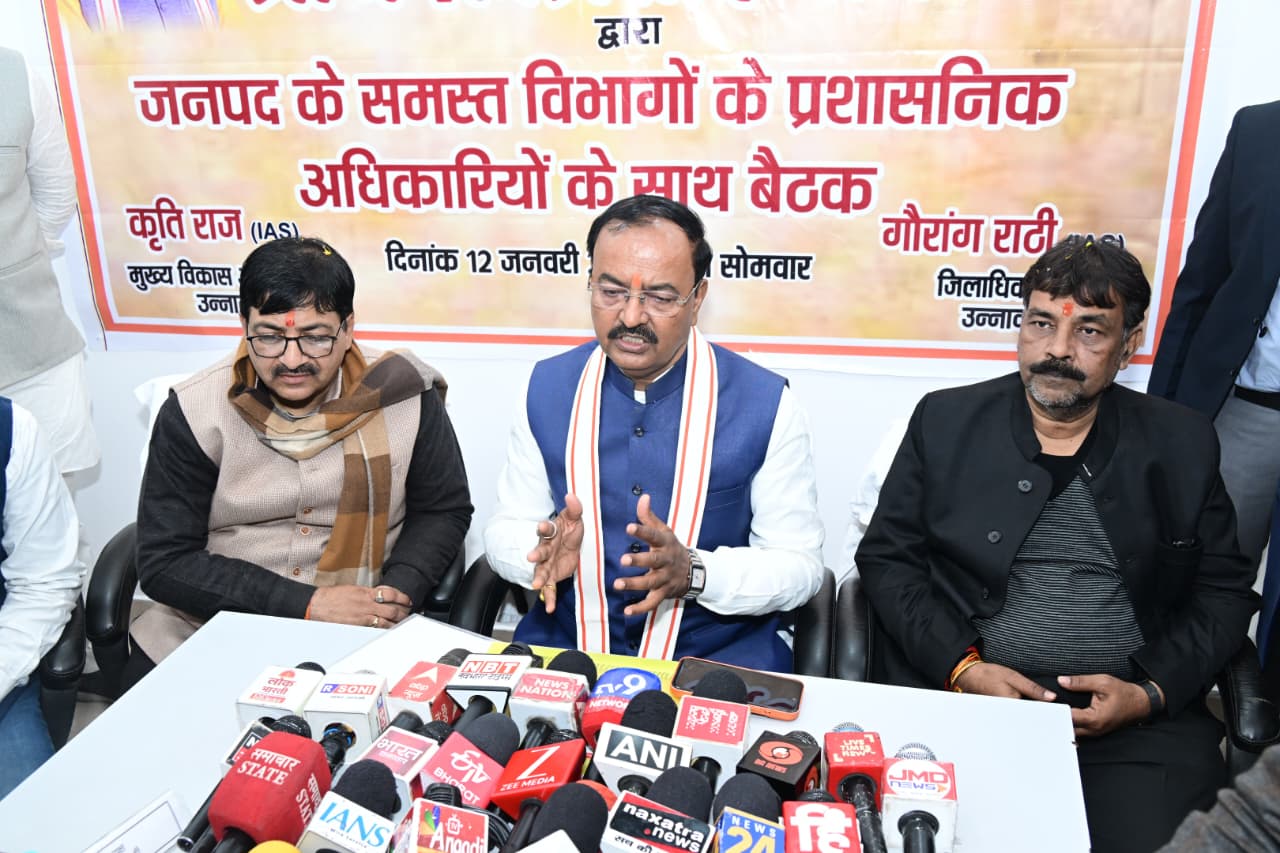
Lucknow/Unnao: Uttar Pradesh Deputy Chief Minister Keshav Prasad Maurya on Monday described the Viksit Bharat – Guarantee for Employment and Livelihood Mission (Rural) Act, 2025, popularly referred to as the ‘G RAM G’ Act, as a historic and transformative initiative that will decisively strengthen the foundation of rural India.
Interacting with the media at the Inspection House in Unnao, the Deputy Chief Minister said the Act provides a clear and robust roadmap for building a developed India, developed Uttar Pradesh and developed villages under the visionary leadership of Prime Minister Narendra Modi. He stated that the legislation would benefit nearly 70 percent of the country’s rural population by ensuring prosperity, self-reliance and a dignified life.
Maurya said that under the Act, guaranteed employment for rural workers has been increased from 100 days to 125 days with statutory backing. He added that the payment system would be fully transparent and time-bound, leaving no scope for fraudulent transactions. This, he said, would help curb migration of labourers and farmers from villages and contribute to the overall well-being of rural communities.
Highlighting the Act’s impact on livelihoods, the Deputy Chief Minister said rural workers who were earlier forced to migrate in search of employment would now find stable and dignified work within their own villages. He noted that village lanes would be developed on the lines of highways, and gram panchayats would be categorised into A, B and C grades based on development parameters to ensure equitable growth opportunities for all villages.
He further said that modern planning tools such as the PM Gati Shakti framework, GIS mapping and other advanced IT tools would be used for scientific and efficient rural development. Under the Act, job cards would be issued for a period of three years to ensure continuity and stability in employment.

Maurya said the Act would significantly strengthen rural infrastructure. While earlier provisions were limited to construction of boundary walls in schools, the new framework would also allow for the construction of kitchen sheds, laboratories and other essential facilities. Provisions have also been included to undertake necessary works related to disaster management in rural areas.
Emphasising transparency and corruption-free governance, the Deputy Chief Minister said the Act would leverage modern digital technologies such as biometric verification, GIS-based mobile applications and face recognition systems. He clarified that there would be no role for NGOs under the Act, ensuring strict control over government resources and preventing misuse.
The Deputy Chief Minister said the Viksit Bharat–G RAM G Act would lead to holistic village development by providing employment with dignity and social security to workers, while integrating rural India into the mainstream of national development. He described the Act as a milestone in rural development and a decisive step towards realising the vision of a developed India.
Maurya concluded by stating that Viksit Bharat is not merely a slogan but a national resolve to make India self-reliant, prosperous and a global leader by 2047 under the guidance of Prime Minister Narendra Modi. He added that due to the double-engine government, Uttar Pradesh has emerged as a leading state in expressways, medical colleges, airports and industrial investment, and the G RAM G Act is a revolutionary step towards translating this vision into reality at the grassroots level.