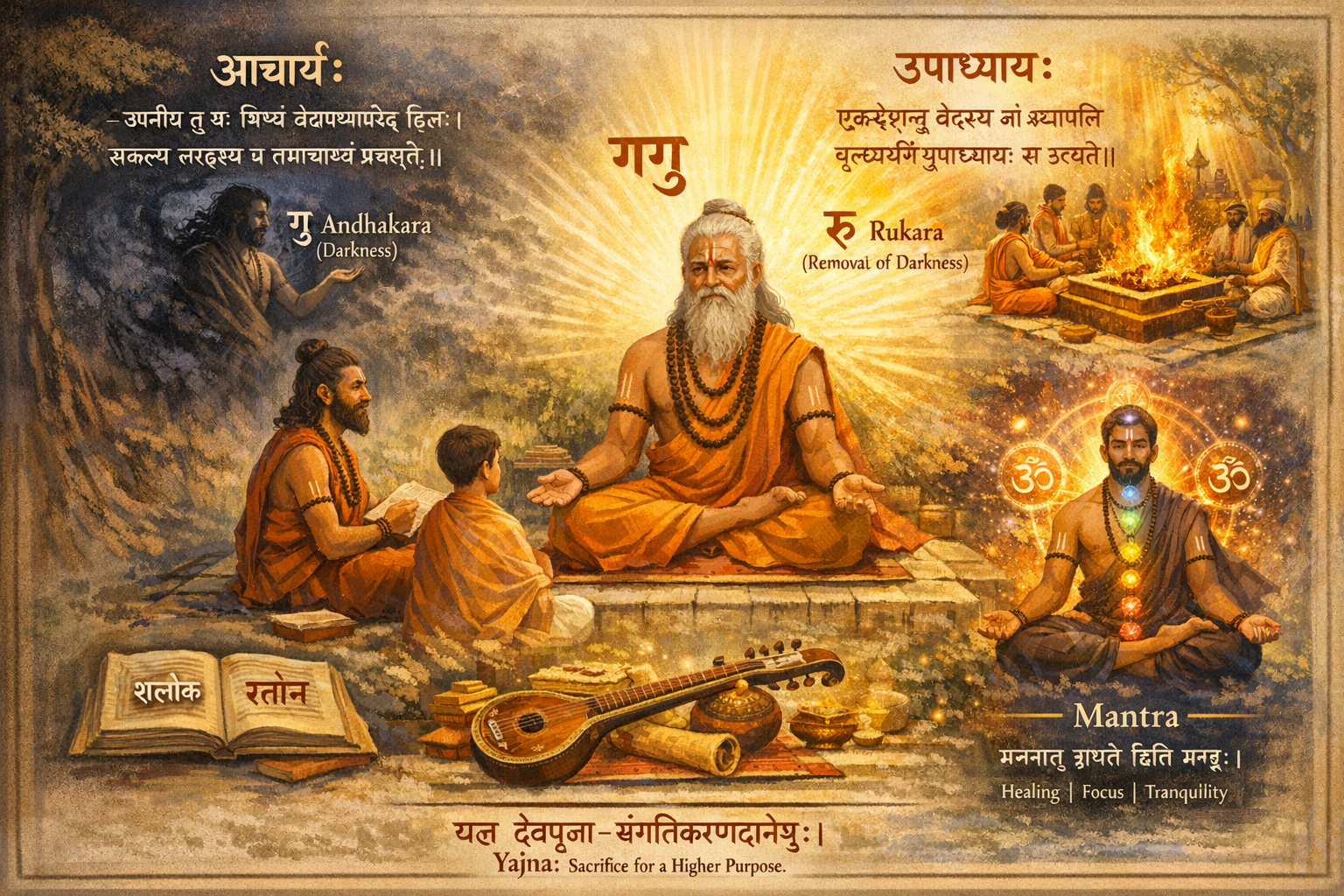
Lucknow: The syllable “Gu” in Guru stands for darkness and ignorance (andhakāra), the syllable “Ru” signifies eradication. Thus, whoever has the ability toeradicate darkness and thereby bring light into one’s life can be called a Guru.(Advaya Taraka Upaniṣad, Śukla-yajuveda, Verses 15,16)
The guru is seen as a sacred conduit for wisdomand guidance, essential for attainingself-realization. When a guru is also specialized in some chosen area of Śāstra, one may call him Ācārya.
आचार्यः – उपनीय तु यः शिष्यं वेदमध्यापयेद् द्विजः।
सकल्पं सरहस्यं च तमाचार्यं प्रचक्षते ॥ १४० ॥
The wise who, having initiated a pupil, teaches him the Veda along with the ritualistic and esoteric treatises,him they call, ‘Ācārya,’ or ‘preceptor’ (Manu Smṛti 2.140). Examples are Droṇācārya, Cāṇakya, Sāyaṇa, Śaṅkara, etc.
उपाध्यायः – एकदेशन्तु वेदस्य वेदाङ्गान्यपि वा पुनः।
योऽध्यापयति वृत्त्यर्थमुपाध्यायः स उच्यते॥ १४१ ॥
He is called “Upādhyāya,” who teaches, for a living, a part of the Veda, or Vedic subsidiary sciences.(Manu Smrti2.141)
Mantra – मननात् त्रायते इति मन्त्रः।
Mantra is that which protects the one who dwells on it; a string of seed sounds (or letters), which if chanted by a person in the proper manner has a profound effect as follows.
- Healing power of mantras: The vibrations induced by chanting of mantras stimulate the cells of specific organs, enhance blood circulation and improve gaseous exchange at the cellular level, thereby inducing vibrant health. The endocrine system gets stimulated and well-regulated by chanting specific mantras.
- Enhancing the potential of the mind: a mantra provides the mind with an anchor to focus upon. Regular practice brings about one-pointedness of the mind – it clears the clutter in the mind, improves focus, enhances power of concentration, sharpens memory, heightens clarity of thought and perspectives about situations become multi-dimensional, leading to better decisions.
- Mantras quieten the mind: Within our body, there exist various states of consciousness which vibrate at different frequencies (every cell of our physical body has a consciousness of its own). This leads to scattering of the pranic energy within. Regular practice of mantra-chanting induces vibrations which are strong enough to override the smaller disturbances. As a result, the chanting creates a state where the individual’s vibrations are completely in sync with those of the energy represented by the mantra. When all other disturbing vibrations are overcome and there is tranquillity.
- Mantra chanting is a great stress-buster: the vibrations induced have a soothing effect on the nervous system, leading to bliss.
Śloka – श्लोक्यते पद्यते रूपेण संहन्यते कविभिः।
Described, narrated with features by the poets is śloka.Literally, śloka refers to a poem set to a particular chandasor meter in Saṃskrit, oneexample of which is ‘Anuṣṭup’. Most of the ślokas (verses) in Bhagavad Gītāare set to this meter, which has eight syllables to a foot, or quarter portion of a verse.In general, śloka is a poetic description or an expression. It is considered as the classic basis for epic Indian poetry as its use is widespread intraditional Saṃskṛtam poems. Among the famous texts written majorly in ślokas are thePurāṇas, Kāvyas, Rāmāyaṇa and Mahābhārata.

Stotra – स्तूयते अनेन इति स्तोत्रम्।
A literary work of stutior praise.
What is Yajña?
The word yajña is derived from root “yaj” meaning exerting effort involving sacrifice for a higher purpose.यज देवपूजा-संगतिकरणदानेषु।
The root ‘yaja’ is used to mean consecration, joining (of the seeker with the thing sought), and offering. देवपूजाor consecration of the divine needs utmost dedication, दानेषुmeans offering or sacrificing or giving-up (for achieving the yajñaphalam – fruit of yajña – the higher purpose), संगतिकरणmeans gathering all the above elements together.
Yajña is an act of giving up near-term and narrow pursuits for achieving ahigher purpose. Donating, offering and sacrificing are differentmodes of yajña. As one proceeds towards advanced stages of self-experience,every action becomes yajña in the Vedic world-view, if done with the right attitude: breathing, eating, thinking,sleeping, walking, talking, observing, etc., , as any endeavour undertaken selflessly for the collective good of society.
Team Siddhanta Knowledge Foundation
https://siddhantaknowledge.org/