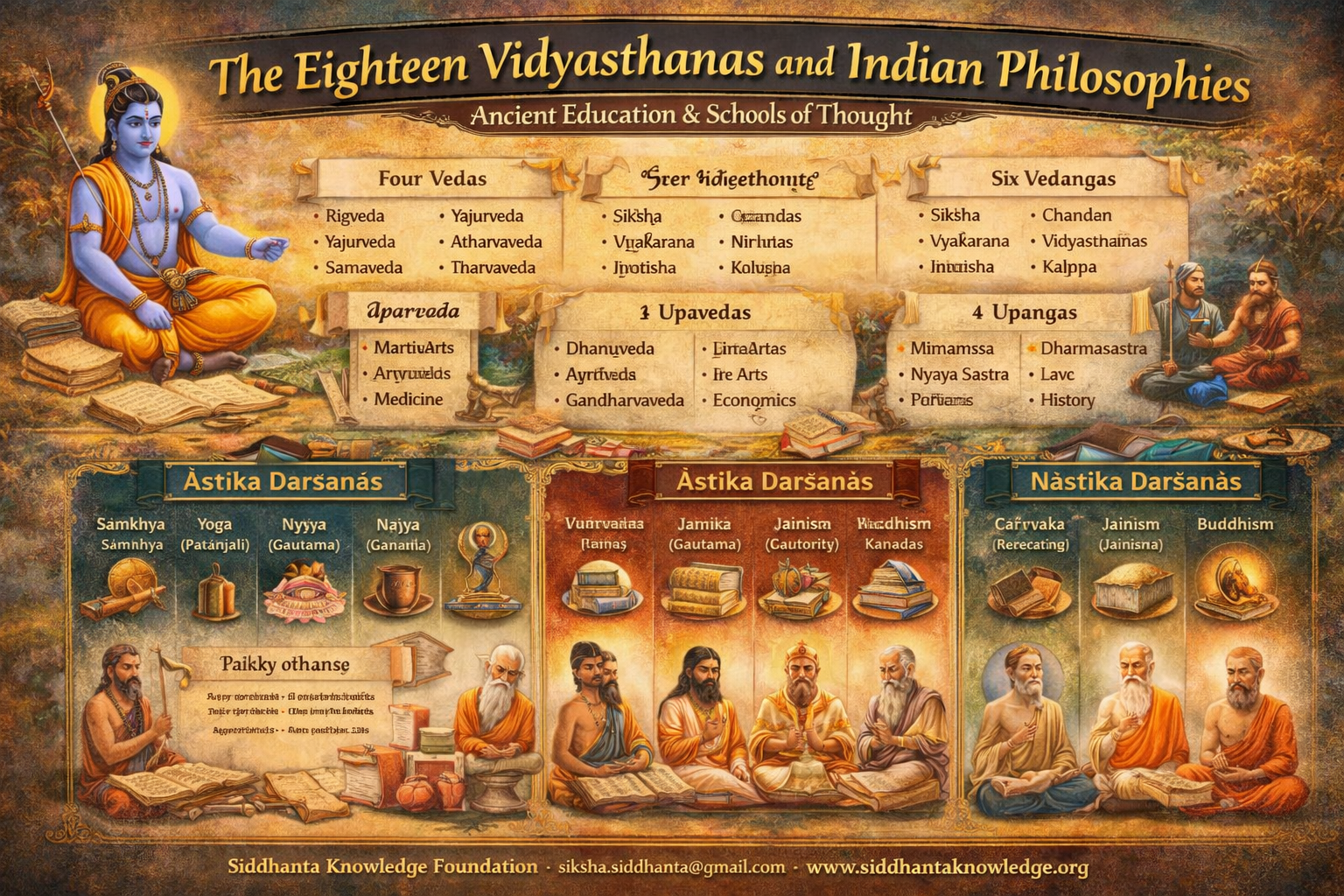
Lucknow: Sri Rama is extolled as being expert in all subjects – the sastras, sciences and the arts. Let us see the various subjects an accomplished person in ancient India was educated in. The 18 Vidyasthanas enlist all the sciences for a well-rounded education, particularly for kings and leaders who require broad vision and deep foresight to take the entire society forward. Four Vedas and six Vedangas make for the basic ten; then we have four Upavedas viz. Dhanurveda (martial arts), Ayurveda (medicine), Gandharvaveda (fine arts) and Arthasastra (economics and commerce). Following this in the list are four Upangas viz. Mimamsa (science of sentence interpretation), Nyaya Sastra (logic), Dharmasastra (law) and Itihasas and Puranas, which convey ancient lore, philosophical tenets and practical advice through stories. Familiarity with all these subjects enabled a person to have clarity of thought, wide grasp and keen decision making abilities, equipping him to face varied situations with confidence.
We also have a number of philosophies that have developed since ancient times, offering different perspectives based on different purpose of study that have been refined with logic and
What are Darśanās?
दृश्यते अनेन पदार्थानां मूलतत्त्वमिति दर्शनम्।
Darśana is that by which the truth about every entity is understood in its true form. The word is derived from the Sanskṛit root Dṛś, which means ‘to see’. Therefore, Darśana means the viewpoint through which the world (seen) and the seer are analysed and understood, giving a complete world-view that can offer answers to all questions. There are six Āstika Darśanās and three Nāstika Darśanās. Sāṃkhya, Yoga, Nyāya, Vaiśeṣika, Pūrva-Mīmāṃsā and Uttara-Mīmāṃsā are the Āstika Darśanās. Cārvāka, Jaina and Bauddha are the Nāstika Darśanās. The first six are called Āstika because they uphold the authority of the Vedas; the latter three are called Nāstika because they do not.
Nāstika Darśanās
The Cārvaka system represents the worldview closest (but not equivalent) to atheism and
materialism. It is not a dogmatic statement of opinions but an argued and reasoned system
of materialism, that yet proves the limitations of such a world view. Scientific empiricism and hedonistic ethics are the foundations of the system.
Buddhism – The sayings of Buddha were gathered into three sections, called piṭakas
(basket), namely (i) Abhidhammapiṭaka, (ii) Vinayapiṭaka and (iii) Suttapiṭaka. The
Abhidhammapiṭaka sets forth the metaphysical views of the Buddha, the Vinayapiṭaka sets
forth the rules of discipline i.e., the sādhana aspects of the religion. Suttas contain the stories,
parables and the teachings. They are the utterances of Buddha himself.
Jainism is an ancient, independent non-Vedic school of philosophy originating from the views of
twenty-three tirthankaras before Mahāvira. Its literature is in Ardhamāgadhī and Samskṛt.
The special features of Jainism are logic and ethics. The Jaina conception of reality is not

like that of the Buddhists, nor like the unchanging Brahman of the Advaita. It admits both,
permanence and change. The outlook focusses on ethical living and resisting the temptations of temporal life.
The Āstika Darśanās –
Nyāya system developed by Rishi Gautama gives a framework of logic, a tool for systematic analysis and epistemology. This is considered an essential subject for students to be able to explore all other topics.
Vaiśeṣikā system categorized all the entities of the whole universe by clear classification through language. By analyzing language, they analyzed thought. Rishi Kanada formulated the Vaisesika sutras, which for the first time in the world speak of all matter being made up of atoms.
Sāṃkhya of Kapila muni enquired into the source of the plural world of our experience
by positing Puruṣa and Prakṛti.
Yoga founded by Ṛṣi Patañjali enquired into our inner world to bring about
transformation in life leading to the ultimate goal of life viz. realizing one’s true nature.
Pūrva-mīmāṃsā of Ṛṣi Jaimini developed principles of sentence interpretation in the
context of Vedic rituals and show remarkable depth of analysis of language.
Uttara-mīmāṃsā founded by Ṛṣi Bādarāyaṇa interpreted the Upaniṣadic sentences to
build a system of Vedānta by using the principles of interpretation developed by Pūrvamīmāṃsā.
Uttara-mīmāṃsā is also known as Vedānta.
Epistemology refers to the process of cognition or gaining knowledge and ontology is the world view specific to a particular system of philosophy. Indian philosophy has developed a fascinating system of epistemology and ontology that sharpens the analytical thinking develops creative facility and is briefly illustrated in the table below.
Siddhanta Knowledge Foundation