
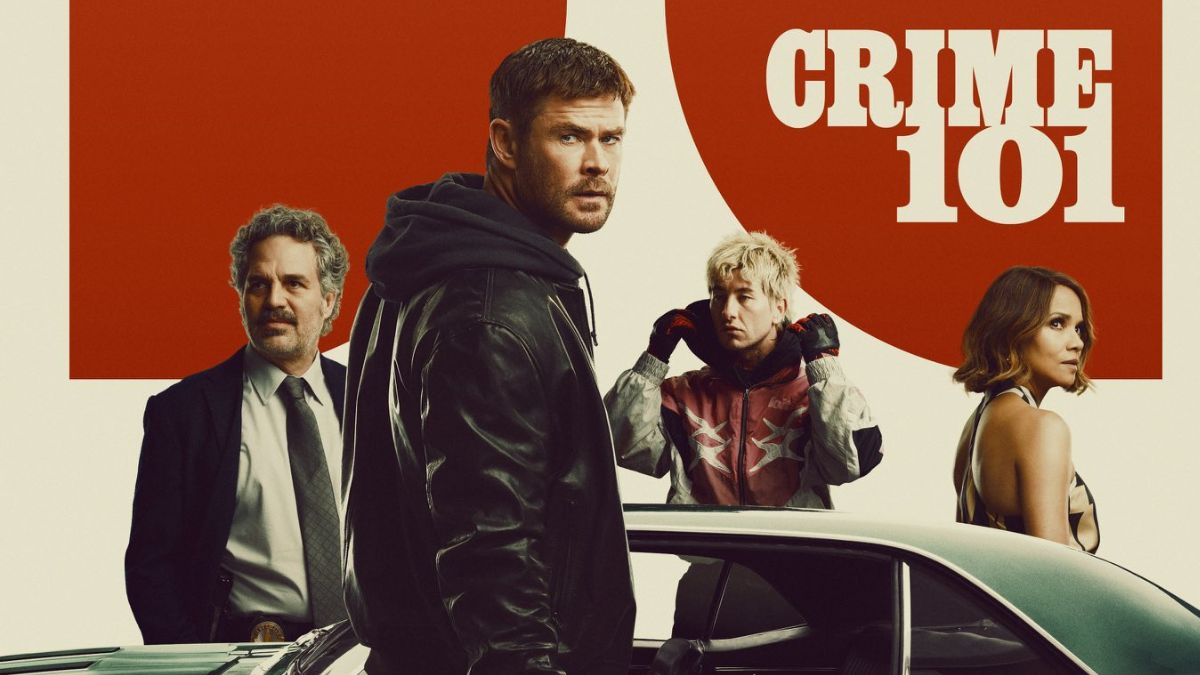
Washington: In the sun-bleached expanse of Los Angeles, where ambition and anonymity share the same smoggy skyline, Crime 101 arrives as a sleek, introspective crime thriller that trades bombast for brooding tension. Directed by Bart Layton—best known for the gripping docudramas The Imposter and American Animals—this adaptation of Don Winslow’s 2020 novella marks a confident step into more traditional narrative filmmaking. Though the film wears its influences proudly—most notably the shadow of Michael Mann and his genre-defining classics Heat and Thief—it ultimately forges its own identity through patient storytelling and emotionally grounded performances.
Set along the iconic 101 freeway, which becomes both a literal and symbolic through-line, the story centers on a meticulous jewel thief known to authorities as the “101 Bandit.” Played with simmering restraint by Chris Hemsworth, the character is a professional defined by precision and discipline. His crimes are surgical: high-value jewelry heists executed with minimal collateral damage and maximum efficiency. He abides by a personal code—avoid violence, stick to the plan, never get greedy. But when a multimillion-dollar diamond shipment tempts him with the promise of a final, liberating score, that code begins to erode.

Hemsworth delivers one of his most mature performances to date. Stripped of the charm and physical bravado that defined his tenure in blockbuster franchises, he leans into quiet intensity. His thief is thoughtful, observant, and faintly melancholic—a man who understands that the life he has chosen offers no soft landing. In moments of silence, Hemsworth conveys the exhaustion of someone who has spent years outrunning both the law and his own conscience. It’s a performance that signals continued evolution beyond action-hero archetypes.
Opposite him is Halle Berry as Sharon, an insurance executive tasked with calculating the mounting losses from the 101 Bandit’s string of robberies. On paper, Sharon could have been a standard genre figure—the sharp-tongued corporate foil or femme fatale—but Berry imbues her with emotional complexity. Recently divorced and professionally adrift, Sharon recognizes in the thief a kindred spirit: someone trapped by systems of their own making. Their interactions crackle with tension—not romantic in a conventional sense, but charged with mutual curiosity and unspoken longing. The film wisely resists melodrama, instead allowing their dynamic to simmer in ambiguity.
Meanwhile, Mark Ruffalo portrays Detective Lou Garrett, the weary yet dogged investigator who begins connecting the dots between a series of seemingly unrelated jewel thefts. Ruffalo brings a grounded authenticity to the role. His Garrett isn’t a cinematic supercop but a man worn down by bureaucratic inertia and personal regrets. He pieces together the 101 Bandit’s pattern not through flashy deductions but through persistence and intuition. Ruffalo’s performance lends credibility to the procedural aspects of the story, ensuring they never feel like mere exposition.
Adding volatility to the mix is Barry Keoghan as a twitchy underworld enforcer whose presence disrupts the thief’s carefully constructed equilibrium. Keoghan’s unpredictability injects genuine danger into the narrative; his scenes bristle with unease. Supporting turns from Nick Nolte as a fading crime boss and Monica Barbaro as an ambitious federal agent enrich the film’s ecosystem, creating a layered portrait of a city’s criminal and institutional machinery.
Stylistically, Layton demonstrates impressive control. Nighttime sequences glow with neon hues that evoke classic neo-noir aesthetics, while handheld camerawork during chase scenes lends immediacy without devolving into chaos. The freeway itself becomes a character—arterial, impersonal, endlessly moving. Aerial shots capture the hypnotic flow of traffic, underscoring themes of anonymity and escape. Unlike the hyperkinetic editing typical of contemporary action films, Crime 101 favors patience. Scenes stretch out, allowing glances and silences to communicate as much as dialogue.
At 2 hours and 19 minutes, the runtime may test viewers expecting relentless momentum. The pacing is deliberate, occasionally bordering on languid. Some plot developments—particularly the “one last job” setup and cat-and-mouse interplay—feel familiar within the genre. Critics may point to echoes of Mann’s cinematic blueprint, arguing that the film treads well-worn ground. And indeed, it does. But rather than imitating, Layton seems to be conversing with those influences, filtering them through his own interest in character psychology.

What elevates Crime 101 above routine heist fare is its emphasis on emotional cost. The film repeatedly returns to the notion of living by a code in a world that rewards opportunism. The 101 Bandit’s rules have kept him alive, yet they have also isolated him. Sharon’s corporate pragmatism has secured her success but left her morally adrift. Detective Garrett’s devotion to justice has estranged him from his family. Each character grapples with compromise—how much of oneself can be surrendered before identity dissolves?
The screenplay finds poignancy in these internal struggles. A quiet diner conversation between Hemsworth and Berry lingers longer than any gunfight, while a late-night freeway stakeout allows Ruffalo’s detective to confront his own weariness. Even the climactic heist, executed with technical precision, carries an undercurrent of dread rather than triumph. The film resists easy catharsis, favoring bittersweet resolution over explosive closure.
Visually lush and thematically reflective, Crime 101 may not reinvent the heist thriller, but it demonstrates how craft and performance can revitalize familiar material. The ensemble’s commitment ensures that even predictable beats feel earned. Hemsworth’s understated transformation, Berry’s layered vulnerability, and Ruffalo’s grounded resolve anchor a story that might otherwise drift into homage.
In an era crowded with disposable action spectacles, Crime 101 stands out for its restraint and humanity. It invites audiences not merely to admire the mechanics of crime but to consider the loneliness and longing that drive it. Like the endless lanes of the 101 at dusk, the film moves steadily forward—never rushing, never stalling—carrying its characters toward destinies shaped as much by choice as by chance.
Rating: 7.5/10
Strong performances and atmospheric direction make Crime 101 a compelling entry in the modern neo-noir landscape. Familiar yet finely crafted, it’s best experienced on the big screen, where its sweeping freeway vistas and quiet emotional beats can fully resonate.