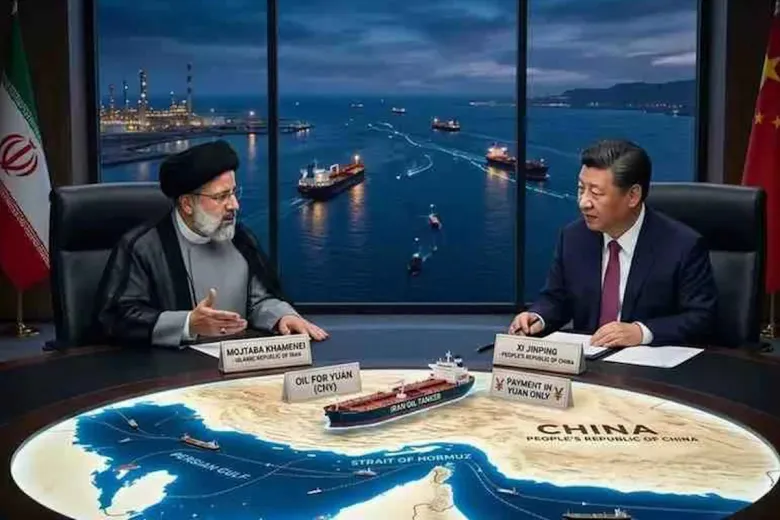
Tehran: Amid escalating tensions between the United States and Iran, analysts are closely watching China for what could be a significant geopolitical shift centered on the Strait of Hormuz—one of the world’s most critical energy corridors.
The strategic waterway, which handles nearly 20 percent of global oil supply, has faced major disruptions following recent military strikes involving the U.S. and Israel. These developments have triggered sharp increases in oil prices and created supply challenges worldwide.
Market expert Saurabh Mukherjea has suggested that China may be exploring deeper coordination with Iran to secure influence over the Strait. According to him, such a move could significantly enhance Beijing’s leverage in global energy markets, potentially reshaping supply dynamics.
China, the world’s largest crude oil importer, has steadily strengthened its ties with Iran in recent years. Despite international sanctions, Beijing has continued purchasing discounted Iranian oil, making Tehran a key supplier. A long-term strategic partnership agreement signed in 2021 further deepened economic and potential security cooperation between the two nations.
Adding to its regional footprint, China has invested heavily in infrastructure across Gulf nations, including port development, pipelines, and rail networks in countries like the UAE and Pakistan. These investments are seen as part of a broader effort to secure trade routes and reduce dependency on vulnerable chokepoints.

However, experts such as Abdulla Baabood caution that while China’s economic influence is expanding rapidly, it may not yet have the military capacity to replace the United States as the primary security guarantor in the region.
Analysts believe the evolving situation represents a longer-term power struggle over energy security rather than a short-lived conflict. Prolonged instability around the Strait of Hormuz could have far-reaching consequences, including higher oil prices, currency pressures, and economic challenges for import-dependent countries like India.
As geopolitical tensions continue to unfold, the global community remains watchful of how major powers position themselves in one of the world’s most strategically sensitive regions.