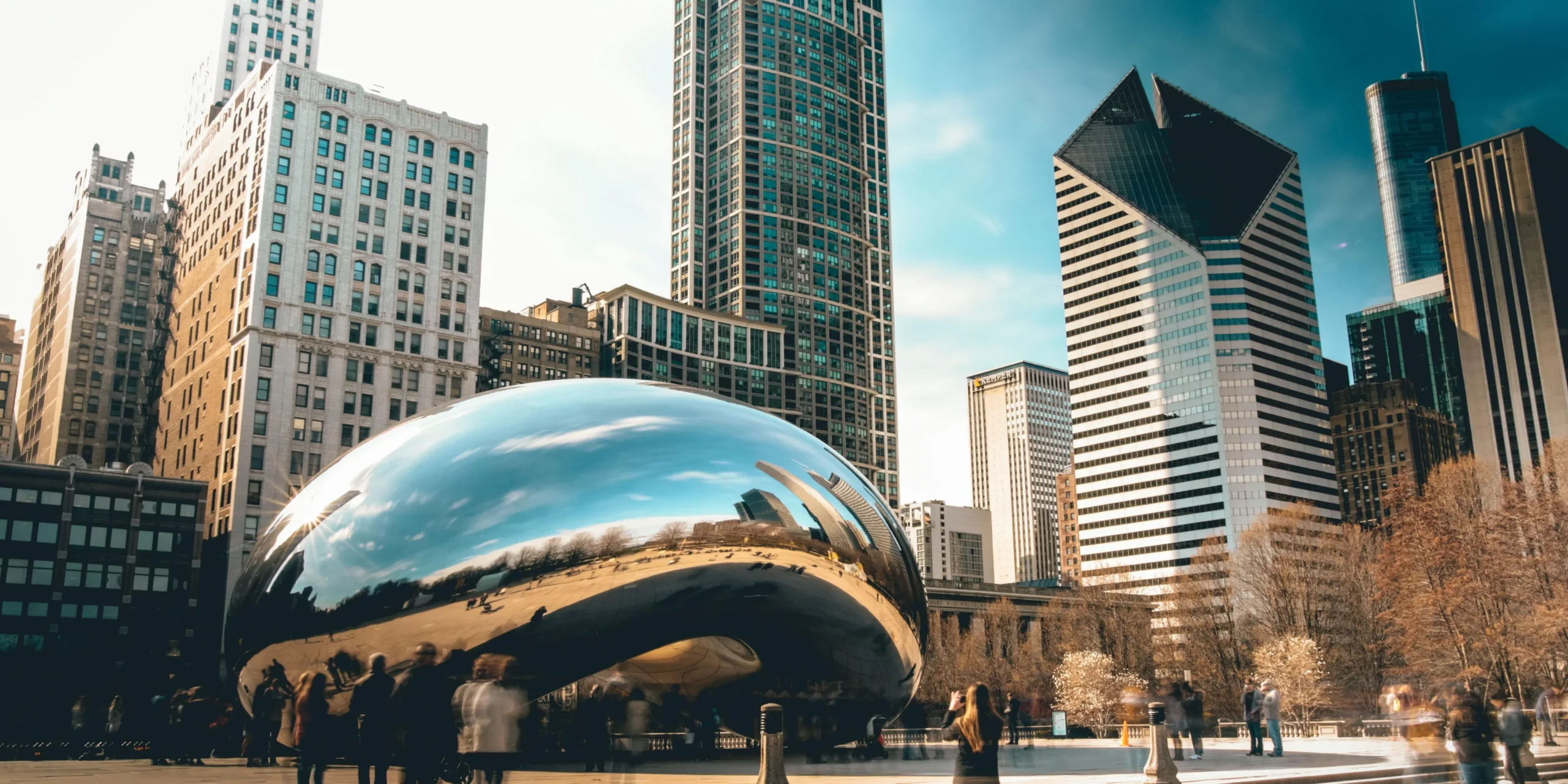
Chicago: Chicago does not seduce at first sight. It does not have the postcard perfection of Paris, the sun-drenched ease of Los Angeles, or the imperial swagger of New York. What it has instead is a stubborn, almost aggressive vitality—an industrial city that decided to become beautiful on its own terms. Travelers who return again and again rarely cite a single monument. They talk about the way the light fractures off the lake at 6 a.m., the smell of a Polish sausage dragged through the garden, the moment a blues guitarist bends a note until it breaks your heart in a bar the size of a living room. Chicago is a city you argue with, then fall for. It is a metropolis of necessary complexity, a place where profound historical weight meets relentless contemporary innovation, always pushing the boundaries of what a modern city can be.
Architecture That Rewrote the Sky
The first thing most visitors do is look up—and keep looking up. Chicago invented the skyscraper after the Great Fire of 1871 wiped the slate clean. William Le Baron Jenney’s Home Insurance Building (1885) was the first to use a steel skeleton; everything after was conversation. Today the skyline is a living textbook: Louis Sullivan’s ornamented terra-cotta, Mies van der Rohe’s glass austerity, Jeanne Gang’s rippling Aqua Tower. To understand Chicago is to understand its iron-and-steel spine. The grid system laid down after the fire allowed architects to experiment with structure, materials, and height in ways no European city, bound by centuries of tradition, ever could. This spirit of radical, functional innovation remains palpable in every glass facade and cantilevered cornice.
But the real revelation is the Chicago Architecture Center’s river cruise. Ninety minutes of 50+ buildings narrated by docents who speak like poets who happen to know load-bearing ratios. “Chicago didn’t just build tall,” says longtime guide Margaret Hicks, “it built expressive. Every tower is an argument about what a city owes the sky.” This river tour, an immersion in architectural history moving through the very heart of the city, provides an essential context for the urban experience. It highlights the city’s commitment to public spaces and aesthetic ambition. Stand on the Michigan Avenue bridge at twilight and watch the massive bascule bridges rise in sequence like mechanical swans. These historic movable bridges, essential to the city’s dual identity as a river port and a commercial hub, are functional art pieces. Travelers routinely call it one of the great free shows on earth, a powerful display of industrial elegance. The city’s form is, quite literally, its function.
A Museum Mile That Humbles Europe
Chicago’s commitment to culture is as monumental as its buildings. It gathers some of the world’s most significant institutions onto a single, accessible stretch, demonstrating a profound civic belief in the power of art and science. The Art Institute of Chicago, the second-largest art museum in America, owns Seurat’s A Sunday on La Grande Jatte, Grant Wood’s American Gothic, and more Picassos than some European capitals. Yet it never feels stuffy. It embraces its role as a democratic cultural center. On Thursday evenings it turns into a wine-fueled party where twenty-somethings pose for selfies in front of Edward Hopper’s Nighthawks, making canonical masterpieces part of the contemporary social landscape. The accessibility of high culture, without the intimidating solemnity found elsewhere, is a signature Chicago trait.
A mere two miles north, the Field Museum of Natural History shelters Sue, the most complete Tyrannosaurus rex ever found, a creature of awe and scale that embodies the city’s ability to house colossal narratives. Nearby, the Shedd Aquarium keeps beluga whales that flirt shamelessly with children through the glass, connecting the urban experience to the vast, wild world of the Great Lakes. Perhaps most emblematic of Chicago’s quirky, hands-on approach is the Museum of Science and Industry. It lets you walk inside a captured German U-boat and tour a coal mine—both underground, both inexplicably in the same building—a testament to the city’s industrial roots and its dedication to experiential learning. “People think culture means quiet,” says local artist Theaster Gates. “In Chicago, culture means volume. Our museums shout.” They are places of interaction, not merely observation.
Neighborhoods That Feel Like Different Countries
To claim a single, unified identity for Chicago is to miss the point entirely. The city is officially divided into 77 community areas, and every one has its own accent, bakery, and, crucially, its own history and demographic character. Ride the Red Line north to south and you pass through the equivalent of nine distinct countries in forty minutes. This patchwork of communities, each maintaining its own cultural integrity, is the true engine of Chicago’s vitality.
In Devon Avenue’s Little India, sari shops blast bhangra while Orthodox Jews buy samosas next door, a perfect picture of the city’s layered coexistence. Uptown still has the neon marquee of the Aragon Ballroom where Sinatra once crooned, and the Green Mill Cocktail Lounge where Al Capone’s favorite booth remains roped off “just in case,” preserving the echoes of its notorious past alongside contemporary life. Further south, Pilsen’s 16th Street murals are a riot of Aztec gods and low-riders, reflecting a deep, proud Mexican-American heritage; a block away, a Michelin-starred restaurant serves foie-gras tacos without irony, showing how high and low culture constantly intersect. The city allows for profound cultural specialization without demanding assimilation. Travel writer Pico Iyer wrote that Chicago “contains more cities than most countries do.” He wasn’t exaggerating; this multiplicity is its fundamental strength.
Food That Travels from Michelin Stars to Corner Stands
The Chicago food scene mirrors its architectural philosophy: build it big, make it unapologetic, and honor the foundation while pursuing the avant-garde. It is one of only six American cities with ten or more three-Michelin-star restaurants (Alinea, Smyth, Oriole, Ever, etc.), representing the pinnacle of culinary artistry and global ambition. Yet, in the same week, a resident or traveler can spend $400 on a 17-course molecular gastronomy meal and $4 on an Italian beef sandwich so good it should be illegal—dipped, hot, and messy, it’s a pure expression of working-class flavor.
The classics are secular religion, demanding fierce loyalty and specific rituals: deep-dish at Pequod’s (burnt-cheese crust is non-negotiable), Chicago-style hot dog at Portillo’s (never ketchup—locals will fight you), and rainbow cones at the Original Rainbow Cone in Beverly where five flavors are stacked like a technicolor Leaning Tower. These dishes are not merely food; they are badges of belonging. But the new wave is just as thrilling, reflecting the dynamic immigrant population. Kasama became the world’s first Michelin-starred Filipino restaurant in 2023; its walk-in bakery sells out of ube-hoppy pancakes by 9 a.m. In Hyde Park, Virtue’s smoked pork shoulder with Alabama white sauce makes Southern grandmothers weep, proving that the city can absorb and perfect external food traditions. “Chicago eats like it builds,” says chef Rick Bayless. “No apologies, no half-measures.” It is a cuisine built on density, flavor, and conviction.
Music That Bleeds From Every Crack
Chicago’s history can be traced through the bass lines and drum machines it birthed. It invented two of the world’s most influential sounds: electric blues and house music. The former, migrating north from the Delta during the Great Migration, gave voice to the city’s labor and struggle, turning acoustic sorrow into electric swagger. The latter, emerging from gay, Black, and Latin basement clubs in the 1980s, transformed disco into a global dance phenomenon, laying the groundwork for virtually all electronic dance music.

On any given night you can hear 85-year-old Buddy Guy rip the roof off his own club on South Wabash, then walk two blocks to Smart Bar and catch a DJ spinning Frankie Knuckles tracks in the basement where house was born. The juxtaposition is essential Chicago: raw heritage and restless futurism. The Chicago Symphony Orchestra is routinely ranked among the five best orchestras on the planet; its brass section can peel paint with its power and precision. Yet summer weekends belong to free, inclusive festivals: Blues Fest, Gospel Fest, World Music Festival, all on the same lakefront lawn where Grant Park once hosted the transformative 1893 World’s Columbian Exposition. “People think New York owns nightlife,” says house pioneer Derrick Carter. “New York parties. Chicago prays with rhythm.”
The Lake That Pretends to Be an Ocean
The defining natural feature of Chicago is not a river or a hill, but a sea. Lake Michigan is so vast that on cloudy days the opposite shore disappears and sailors swear they’re at sea. This natural boundary is the city’s greatest asset, and its access is a protected civic principle. Thirty miles of public lakefront—beaches, bike paths, bird sanctuaries—are protected by law since the 1836 city charter declared them “forever open, clear and free.” This mandate is one of the most successful pieces of urban planning in American history, giving everyone in the city unhindered access to nature and recreation.
North Avenue Beach has volleyball courts and a rooftop bar that looks like a cruise ship ran aground, a perfect urban playground. In winter, the same sand hosts polar plunges and ice sculptures, proving its year-round utility. At night, the magnificent skyline reflects in the water so perfectly that first-timers gasp out loud at the shimmering architectural canyon. “Most cities turn their back on their water,” says urban planner Lee Bey. “Chicago married the lake and still brings it flowers every morning.” The lakefront is the city’s breathing room, its collective backyard, and the powerful backdrop to all its endeavors.
Sports As Civic Religion
In Chicago, team loyalty transcends mere fandom; it is a civic religion, a bond that crosses the lines of class and neighborhood. Even non-sports fans get converted through the sheer weight of history and passion. Wrigley Field (1914) is baseball’s second-oldest park and the only one where the scoreboard is still changed by hand, a cathedral of nostalgia where the smell of ivy and hot dogs is sacred. A day game with a $10 bleacher seat and an Old Style beer is the closest thing America has to secular pilgrimage.
The Bulls of the 1990s made the United Center a global cathedral, the site of basketball’s greatest dynasty. Today the Blackhawks sell out every game despite a decade of mediocrity, speaking to the unwavering dedication of the fan base. And when the Cubs won the World Series in 2016—ending a 108-year drought—seven million people flooded the streets for the victory parade, the seventh-largest gathering in human history. This moment demonstrated the profound depth of communal feeling in Chicago; a shared emotional release that defined a generation. Chicago fandom is not about winning; it’s about endurance and a faith in eventual payoff.
A Grit That Became Charm
Chicago still has its problems—gun violence, segregation, brutal, soul-testing winters. But travelers sense something authentic in the struggle. This is not a city that airbrushes its scars. The viaduct walls are tagged with murals honoring murdered children. The L train rattles overhead like it has since 1892, sparks flying in the dark, a harsh, necessary soundtrack to the urban experience. Yet the same streets that birthed gangsters and political machines birthed Barack Obama’s community organizing, Studs Terkel’s oral histories of the working class, and Chance the Rapper’s free concerts for public-school kids. The city’s history is a relentless dialectic between corruption and idealism, hardness and charity. Writer Sandra Cisneros calls it “the city with broad shoulders and a broken heart that still dances.” Its charm is rooted in its refusal to be anything other than exactly what it is—tough, vast, and fundamentally decent.
The Verdict from Those Who Keep Coming Back
Ask repeat visitors why they return and the answers converge on a single paradox: Chicago is enormous yet intimate, freezing yet warm, impossible yet deeply human. It is a city that never stops challenging itself or its inhabitants. It has no time for the delicate vanity of other global capitals; it is too busy working, building, and creating.
As chef Stephanie Izard (Girl & the Goat, four-time James Beard winner) puts it: “New York wants to impress you. LA wants to relax you. Chicago just hands you a beer, points at the skyline, and says, ‘Yeah, we built that. You in or you out?’” Most people, against all logic, find themselves very much in. They find that the argument they started with the city quickly becomes a loving, lifelong conversation.