
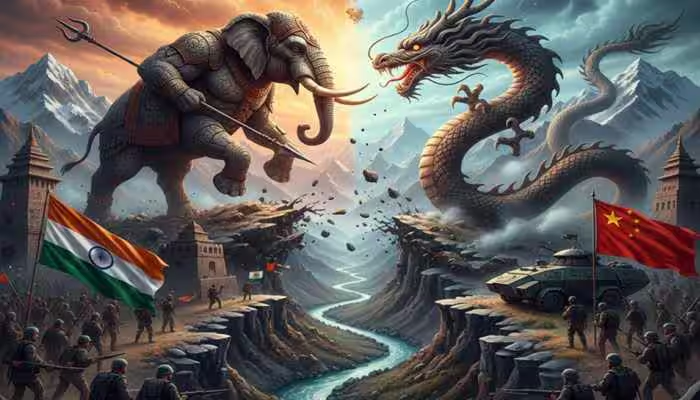
New Delhi: India’s growing trade engagement with China could offer strategic leverage in ongoing border negotiations, but experts say the reality is more complex. While India’s exports to China increased by $5.5 billion in 2025, the overall trade deficit remains significant, raising questions about how much economic influence New Delhi can realistically wield in diplomatic discussions.
According to data released by Chinese customs, Chinese exports to India surged 12.8% last year to $135.87 billion, while India’s exports climbed to $20.5 billion. This pushed total bilateral trade to a record $155.62 billion, despite lingering global trade tensions and tariff measures imposed during the Trump administration.
“India’s export growth is encouraging, but the trade gap continues to be a structural challenge. Using trade as leverage in border talks is possible, but it requires a calibrated strategy,” says Dr. Ramesh Pillai, an expert on Sino-Indian economic relations.
Rising Trade and Persistent Deficit
India’s trade deficit with China widened sharply in FY 2024–25 to a record $99.2 billion. Imports from China rose 11.5% to $113.5 billion, largely driven by electronics, electric batteries, solar panels, and intermediate goods for manufacturing. Meanwhile, exports to China grew only modestly, highlighting the asymmetric nature of the trade relationship.
“India’s growing exports indicate rising market access, but the gap remains too wide to provide strong economic leverage on its own,” notes Ananya Desai, senior trade analyst at the Observer Research Foundation.
Economists suggest that while India’s exporters are increasingly competitive in sectors like pharmaceuticals, chemicals, and specialty textiles, these gains are still overshadowed by the scale of Chinese exports dominating India’s consumer electronics and industrial supply chains.
Market Power as a Diplomatic Tool
Some analysts argue that India could use its market power selectively, targeting key sectors where Chinese dependence is high. Strategic restrictions, import diversification, or strengthening domestic production in critical industries could provide New Delhi with more negotiating space.
“Economic leverage in border diplomacy is not about total trade volume alone. It’s about identifying sectors where India can influence supply chains or pricing,” explains Dr. Pillai.

However, caution remains paramount. Abrupt measures could disrupt domestic markets or escalate tensions along the border, making gradual, carefully coordinated strategies more effective.
Broader Implications
The 2025 trade data underscores a paradox in India-China relations: rising interdependence alongside ongoing geopolitical friction. While India’s exports rose against the broader trend of declining regional trade, the scale of imports continues to give China structural advantages in the economic relationship.
Experts suggest that a combination of trade diplomacy, domestic production strengthening, and multilateral engagement could help India gain some leverage, but they warn that trade alone is unlikely to resolve long-standing border disputes.
“Trade can be a tool in negotiations, but it is not a substitute for sustained dialogue, infrastructure readiness, or strategic deterrence,” says Desai.
Looking Ahead
With the trade gap still near $100 billion and Chinese imports dominating critical sectors, India faces a dual challenge: boosting exports while reducing over-reliance on Chinese goods. Policy measures such as promoting “Make in India” initiatives, supply chain diversification, and sector-specific incentives may gradually enhance India’s negotiating position in border talks.
As 2026 progresses, how India balances economic engagement with strategic assertiveness will be closely watched by both domestic stakeholders and international observers.