Lucknow: The second day of the centenary celebrations of Bhatkhande Sanskriti Vishwavidyalaya turned deeply evocative as soul-stirring performances of Indian music and dance enthralled audiences. The three-day international conference and celebrations, being held from December 18 to 20, 2025, under the theme “Indian Cultural Traditions in Context of Viksit Bharat 2047,” continued to highlight the richness, relevance and future of India’s cultural heritage.
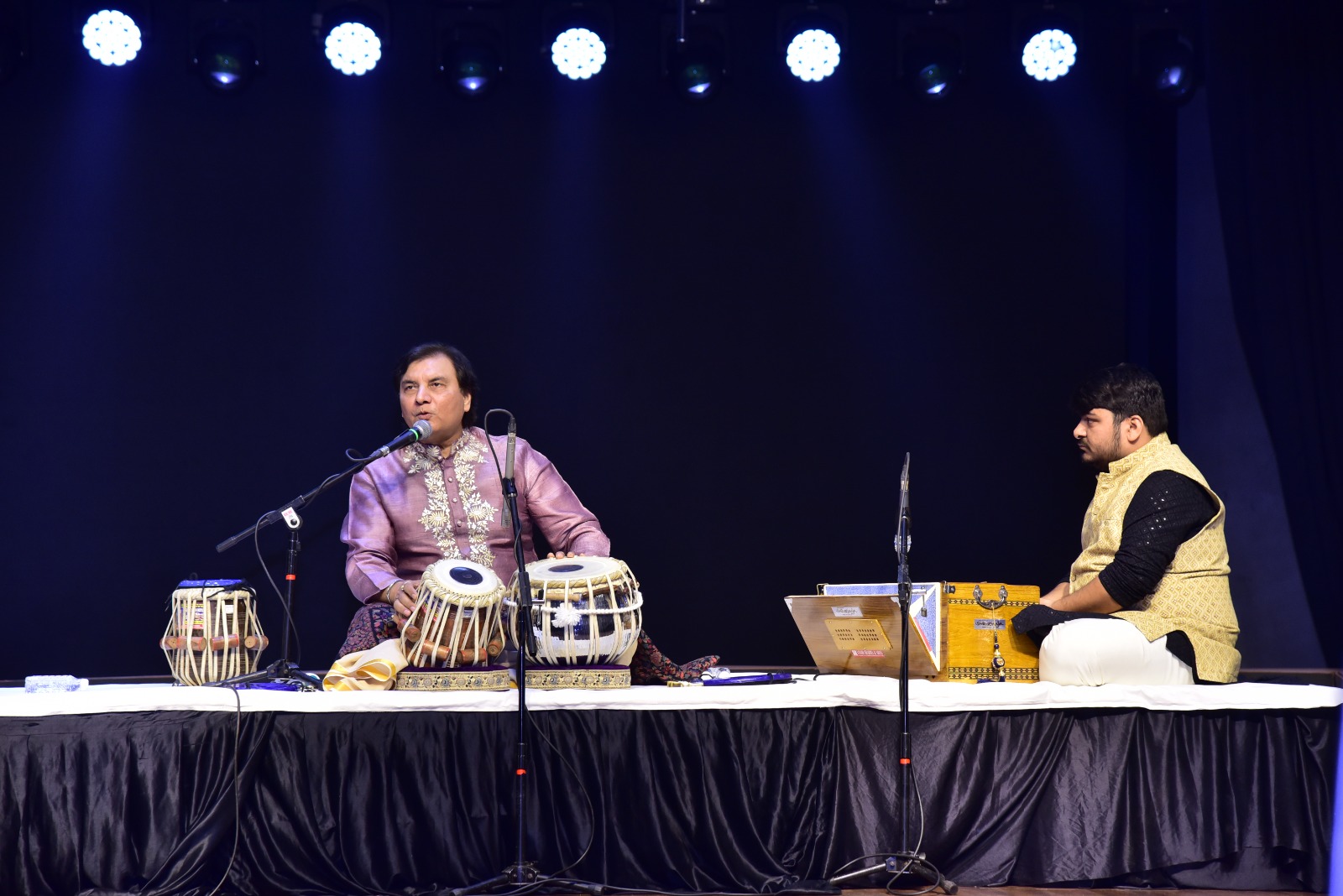
The day began with the inaugural session of the conference, marked by a powerful tabla recital by renowned tabla maestro Ustad Akram Ali Khan. During the interactive session, responding to questions posed by Prof. Srishti Mathur, Head of the Vocal Music Department, Ustad Akram Ali Khan emphasised that a successful tabla accompanist must possess not only a deep understanding of rhythm but also an awareness of the music and personality of the main performer. He stressed that equal proficiency in solo performance and accompaniment is essential for a complete tabla artist.
Speaking on the future of music in the context of Viksit Bharat 2047, Ustad Akram Ali Khan expressed strong optimism, stating that the solid foundation laid by the present generation would elevate Indian music to heights many times greater by 2047. His recital prominently showcased the Ajrada gharana tradition, including intricate Delhi-style kaidas and their elaborations, leaving the audience mesmerised.
The second performance of the day featured an enchanting Kathak recital by Pandit Tribhuvan Maharaj, son and disciple of Pandit Jaikishan Maharaj. A young torchbearer of the Lucknow gharana, Pandit Tribhuvan Maharaj began with Ganesh Vandana and went on to present a captivating sequence in Teentaal (16 beats), showcasing the gharana’s signature kasak-masak, graceful neck and torso movements, Shiva’s damru naad, Radha-Krishna leela, Braj taal (four-and-three-quarter beats) and an energetic conclusion in Teentaal. His refined technique and expressive storytelling earned sustained applause.
The third presentation saw Pandit Deepak Maharaj commence his Kathak recital with Guru Aavahan, followed by traditional Lucknow gharana elements such as upaj, that, paran and a rhythmic composition in Dhamar taal (14 beats). A highlight of his performance was the emotive abhinaya on the thumri “Jaane De Maika, Suno Ae Sajanwa,” composed by Pandit Bindadin Maharaj, which captivated the audience with its sensitivity and depth.
Adding further grandeur to the day, senior faculty member Pandit Ram Mohan Maharaj presented a classical Kathak performance. Beginning with a devotional composition in praise of Lord Krishna, “Jaaki Mahima Hai Sab Sukhdaayi,” he went on to demonstrate the traditional Lucknow gharana repertoire, including that, aamad, paran, uthaan, tihaiyan, gat-nikaas and expressive abhinaya. His portrayal of the thumri “Dagar Chalat Dekho Shyam Kar Gaihiyaan,” composed by Pandit Bindadin Maharaj, stood out for its emotional finesse.
All participating artistes and experts were felicitated by Vice-Chancellor Prof. Mandvi Singh, who honoured them with ceremonial shawls and mementoes, expressing gratitude for their invaluable contributions to the centenary celebrations.

Students attending the programme appeared deeply inspired by both the academic sessions and the live performances. Many remarked that such events provide a rare opportunity to learn the finer nuances of Indian art forms directly from masters.
Addressing the gathering, Prof. Mandvi Singh stated that the objective of the international conference is to initiate meaningful dialogue on the role, relevance and future direction of Indian cultural and artistic traditions in the vision of Viksit Bharat 2047. She noted that the participation of eminent artistes, scholars, researchers and art lovers from India and abroad has greatly enriched the event.
Registrar Dr. Srishti Dhawan added that the centenary conference and performances are not only strengthening academic discourse but are also serving as a vital bridge connecting the younger generation with India’s timeless artistic traditions.
The second day thus emerged as a memorable celebration of India’s living cultural legacy, reinforcing Bhatkhande Sanskriti Vishwavidyalaya’s pivotal role in preserving and promoting the nation’s artistic heritage.