
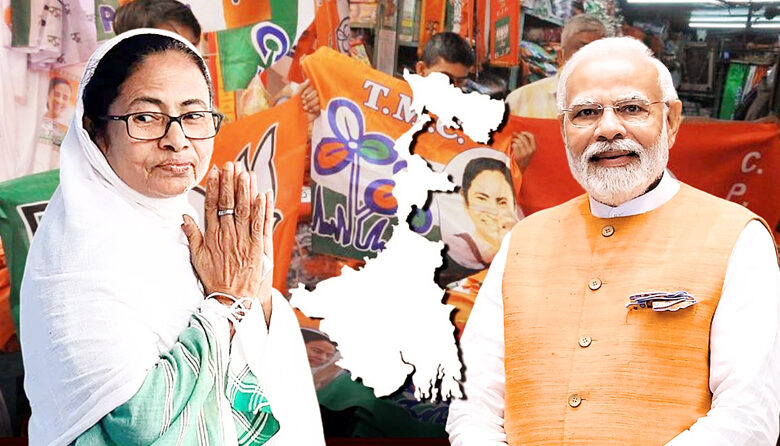
Kolkata: West Bengal’s politics is currently passing through a critical phase where power, conflict, law and public sentiment appear to be colliding with one another. This confrontation is not merely a political battle for supremacy between the Bharatiya Janata Party (BJP) and the Trinamool Congress (TMC), but a broader test of governance style, democratic norms and the development vision that will shape Bengal’s political future.
Chief Minister Mamata Banerjee, who for years successfully countered the BJP with the slogan “Khela Hobe”, now faces a far more complex and multi-dimensional challenge. With the upcoming Assembly elections, the eyes of the entire country are fixed on West Bengal, as the electoral outcome is expected to chart the state’s future direction.
On one hand, tensions between the Centre and the state have reached a peak; on the other, actions by central agencies, court observations and legal debates are increasingly dominating political discourse. Recent remarks by the Supreme Court have not only raised legal questions but have also underlined the limits of state interference in the functioning of central investigative agencies. Prolonged legal battles inevitably carry political consequences, especially when elections draw near and public attention shifts from governance achievements to allegations and counter-allegations.
Bengal’s political landscape has always been marked by intense ideological expression and emotional engagement. Mamata Banerjee’s rise after decades of Left Front rule was itself the result of a mass movement. She positioned herself as the voice of the poor, the marginalised and regional identity, winning public trust through welfare schemes and strong political communication. However, over time, allegations of centralisation of power, excessive organisational control and intolerance towards dissent have also gained ground.
The BJP has sought to capitalise on these perceived weaknesses. Since the 2019 Lok Sabha elections, it has steadily strengthened its organisational base in Bengal, pushing narratives of nationalism, Hindutva and anti-corruption. Although the TMC returned to power with a decisive mandate in the Assembly elections, the BJP has emerged as a permanent and significant force in Bengal’s politics. Despite the gap in seats, the BJP’s expanding social base keeps the door open for future political shifts.
Meanwhile, development-related issues appear to have taken a back seat amid continuous political confrontation. Concerns over industrial growth, investment and employment are often overshadowed by political noise. Persistent reports of electoral violence, attacks on political workers and questions over administrative neutrality have adversely affected the state’s image. Issues such as illegal infiltration from neighbouring countries, demographic changes in border areas and law-and-order challenges have also become part of the political debate. While the Mamata government often adopts a defensive stance, the BJP links these issues to national security and cultural identity to mobilise broader support.

The BJP’s recent successes in Maharashtra’s urban local body elections and Bihar have boosted its confidence. However, Bengal remains a politically complex terrain shaped by its unique social structure, cultural consciousness and historical memory. Mamata Banerjee’s strongest asset continues to be her grassroots connect and emotional appeal as a regional leader, distinct from the BJP’s centralised leadership.
The forthcoming Assembly elections will thus serve as a real test: will voters prioritise development, stability and law and order, or continue to respond to identity-based and emotional politics? Will Mamata Banerjee secure a fourth consecutive term by reinforcing her narrative of resistance to the Centre, or will the BJP succeed in convincing voters that political change is the path to stability and growth?
In recent years, West Bengal has also witnessed increasing concerns over communal polarisation and democratic backsliding, which critics argue have hampered development. Once regarded as an economic, industrial and intellectual hub—particularly Kolkata—the state today struggles with declining industrial confidence, capital flight and youth migration. Questions over the autonomy of democratic institutions, suppression of opposition voices and recurring electoral violence have raised serious concerns about the health of democracy in the state.
At such a juncture, public vigilance and democratic participation become crucial. Bengal’s identity is rooted in its rich intellectual heritage, cultural sensitivity, spiritual traditions and literary legacy—from Rabindranath Tagore to Swami Vivekananda. Restoring this legacy, many believe, requires peaceful, informed and fearless democratic engagement.
Ultimately, the final verdict rests with the people of West Bengal. The upcoming elections are not merely about power, but about safeguarding the state’s democratic self-respect, cultural identity and future direction. In this complex political chessboard of power and opposition, it is the voter who will decide the next decisive move.