New Delhi/Bengaluru | Chief of Army Staff General Upendra Dwivedi visited Hindustan Aeronautics Limited (HAL) in Bengaluru as part of the ‘Ran Samvad’ programme, where he reviewed India’s growing indigenous aerospace capabilities and ongoing Army Aviation projects.
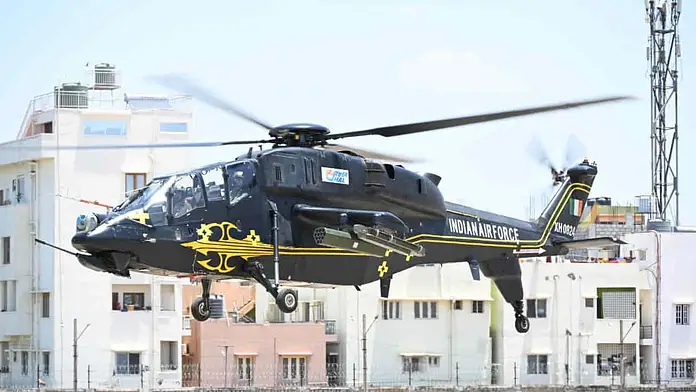
During the visit, the Army Chief closely examined the RUAV-200 (Rotary Unmanned Aerial Vehicle), an advanced helicopter-type drone designed for surveillance, reconnaissance, and target identification. He also undertook a sortie in the indigenously developed Light Combat Helicopter Prachand, assessing its operational performance, agility, and combat readiness.
What is RUAV-200?
The RUAV-200 is a rotary-wing unmanned system capable of vertical take-off and landing, similar to a helicopter, but operates without a pilot. Built for autonomous missions, it can perform intelligence gathering, continuous surveillance, and target tracking with high precision.
Equipped with advanced sensors and cameras, the drone can operate in both day and night conditions. Its network-centric capabilities allow seamless integration with other defence systems, enabling real-time data sharing with command centres.
Key Capabilities and Features
Weighing around 200 kilograms, the RUAV-200 can operate for up to 4.5 hours with a data link range of nearly 100 kilometres. It is capable of flying at altitudes of up to 6,000 metres, making it suitable for high-altitude operations, including mountainous border regions.
The drone can carry payloads of up to 30 kilograms (up to 80 kilograms at sea level) and reach speeds of approximately 100 km/h. It supports both portable and fixed ground control stations and provides real-time video and data feeds for operational decision-making.
Multi-Role Deployment
Designed for both land and maritime missions, the RUAV-200 can be used for border surveillance, target tracking, detection of IEDs and landmines, as well as mapping and reconnaissance. In maritime environments, it can assist in coastal surveillance, anti-piracy operations, and port monitoring.
It can also be deployed in disaster relief and rescue operations, highlighting its dual-use capability beyond combat roles.

Adaptable Mission Systems
One of the drone’s standout features is its modular payload system. It can be equipped with electro-optical and infrared sensors, synthetic aperture radar, electronic and communication intelligence systems, as well as LiDAR and hyperspectral cameras. Additional equipment such as searchlights and loudhailers further enhance its versatility across missions.
Built for Extreme Conditions
The RUAV-200 has been specifically designed for challenging environments, including high-altitude areas with thin air and extreme weather. It can operate in temperatures ranging from -35°C to +55°C and take off from elevations above 4,000 metres, making it ideal for deployment along India’s mountainous borders.
Prachand Helicopter Demonstration
During his visit, General Dwivedi also flew in the LCH Prachand, India’s indigenously developed light combat attack helicopter. Designed for high-altitude warfare, Prachand is capable of delivering precise strikes and providing close air support to ground forces.
With advanced avionics, modern weapon systems, and strong defensive features, the helicopter is fully operational and suited for a wide range of combat scenarios—from mountainous terrain to deserts and plains.
Focus on Modern Warfare
The visit underscored the Indian Army’s increasing focus on modern warfare capabilities, particularly in the ‘air littoral’ domain—low-altitude airspace where drones, helicopters, and loitering munitions play a decisive role. Recent global conflicts have highlighted the importance of dominance in this space, prompting armed forces to strengthen their capabilities accordingly.
The evaluation of RUAV-200 and Prachand reflects India’s push towards self-reliance in defence technology and preparedness for future battlefield challenges.