New Delhi: The evolving global security environment, marked by multiple conflicts and geopolitical rivalries, is significantly influencing India’s strategic, economic, and diplomatic landscape. From the Russia–Ukraine War to the ongoing Israel–Hamas War, and rising tensions in the South China Sea and Taiwan Strait, the world is witnessing a renewed era of great-power competition. These conflicts collectively form what many analysts describe as a “global theatre of war,” where regional crises intersect with global strategic interests. As a rising power and a key actor in the Indo-Pacific, India is inevitably affected by these shifts.
Below are the major ways in which the global security environment is shaping India’s national interests.
1. Strategic and Military Implications
One of the most direct impacts of global conflicts on India is the increasing emphasis on military preparedness and strategic deterrence.
India faces a complex security environment with two nuclear-armed neighbors—China and Pakistan. Tensions with China along the Line of Actual Control remain unresolved since the 2020 Galwan Valley clash, while Pakistan continues to maintain a hostile posture along the western border.
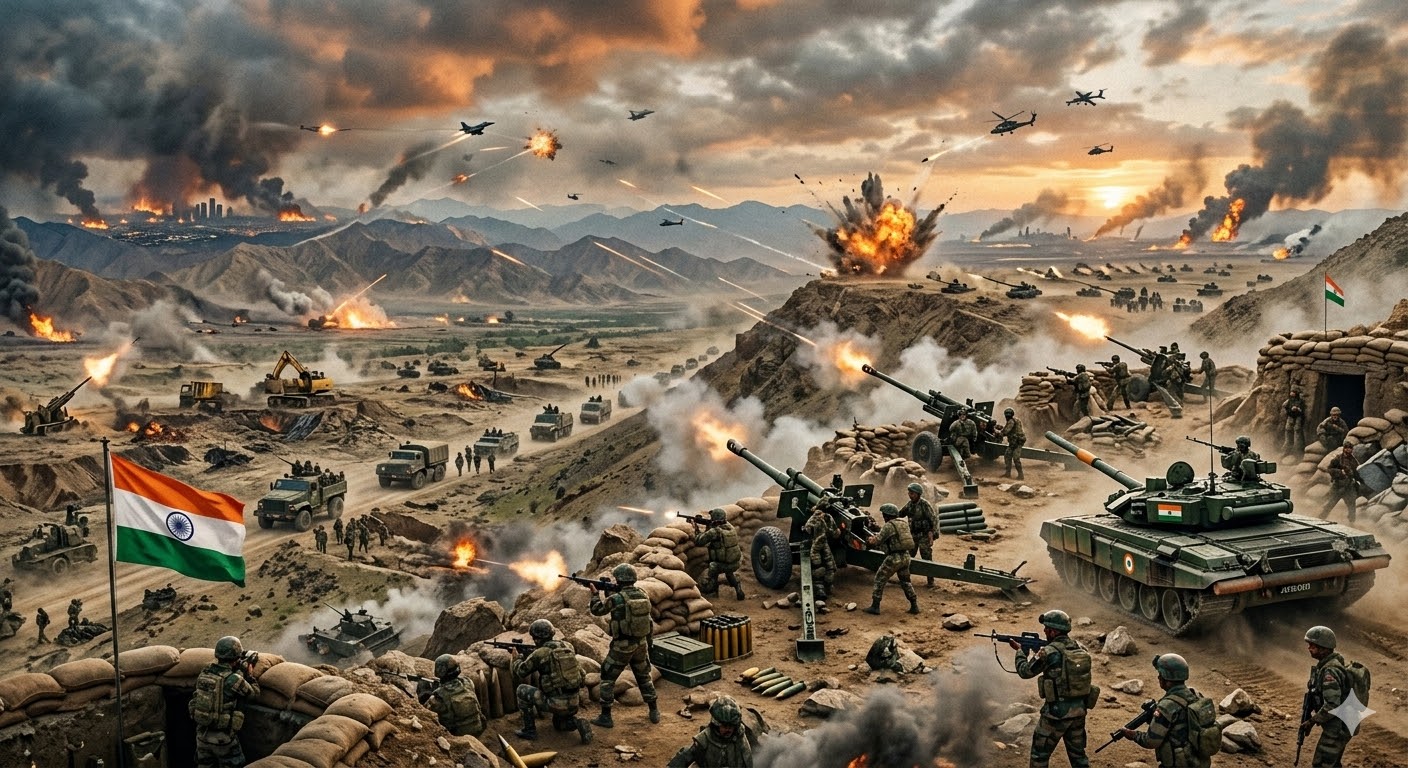
Global conflicts have demonstrated the importance of multi-domain warfare, including cyber warfare, drone warfare, and long-range precision strikes. Lessons from the Russia–Ukraine war in particular have highlighted the effectiveness of drones, electronic warfare, and missile defence systems. India is incorporating these lessons into its military modernization programs.
The Indian armed forces are therefore investing heavily in advanced platforms, including indigenous fighter jets, air defence systems, drones, and naval capabilities. India’s emphasis on self-reliance in defence production under the Atmanirbhar Bharat initiative has gained urgency in this uncertain global security environment.
2. Impact on India’s Maritime Security
The global theatre of war has also heightened competition in the Indian Ocean Region, a critical area for India’s strategic interests.
The Indian Ocean is one of the world’s busiest trade routes, carrying nearly 80 percent of global oil shipments. Rising tensions in West Asia and increasing naval activity by major powers have made maritime security a priority for India.
China’s growing naval presence in the region, including its base in Djibouti and increasing deployments near Sri Lanka and the Maldives, has raised strategic concerns in New Delhi.
In response, India has strengthened the operational reach of the Indian Navy through initiatives such as enhanced maritime surveillance, new naval bases, and deeper cooperation with partners in the Quadrilateral Security Dialogue—which includes United States, Japan, and Australia.
3. Economic and Energy Security Challenges
Global conflicts also have major economic consequences for India, especially in energy markets.
India imports nearly 85 percent of its crude oil requirements, making it vulnerable to fluctuations caused by geopolitical tensions. The Russia–Ukraine war disrupted global energy supply chains and led to sharp increases in oil and gas prices.
However, India also leveraged the situation strategically by increasing imports of discounted crude from Russia, thereby stabilizing domestic fuel prices while maintaining diplomatic balance with Western nations.
At the same time, instability in West Asia—including tensions involving Iran, Israel, and Gulf countries—poses risks to India’s energy supply routes.
Global conflicts have therefore accelerated India’s efforts to diversify energy sources, expand renewable energy capacity, and strengthen strategic petroleum reserves.
4. Diplomatic Balancing in a Polarized World
The global theatre of war has also complicated India’s diplomatic strategy.
India traditionally follows a policy of strategic autonomy, meaning it avoids formally aligning with any major power bloc. However, increasing geopolitical polarization—especially between the United States and China—has created pressure on countries to take sides.
India has responded by maintaining balanced relations with competing powers. For example, it continues defence cooperation with Russia while simultaneously deepening security partnerships with the United States and Europe.
India’s active role in multilateral forums such as the G20, BRICS, and the Shanghai Cooperation Organisation reflects its effort to position itself as a bridge between the Global South and major powers.
This diplomatic balancing act has allowed India to preserve its strategic flexibility while expanding its global influence.

5. Technology and Defence Innovation
Modern warfare is increasingly driven by technological superiority, and global conflicts are accelerating innovation in military technology.
The widespread use of drones, artificial intelligence, cyber warfare tools, and satellite surveillance in recent conflicts has demonstrated how technology can redefine battlefield dynamics.
India is therefore prioritizing emerging defence technologies through partnerships between the government, private sector, and startups. Initiatives such as the Innovations for Defence Excellence (iDEX) program aim to support indigenous defence innovation.
The government is also investing heavily in space-based capabilities, cybersecurity infrastructure, and advanced missile systems to ensure that India remains competitive in future warfare environments.
6. Internal Security and Hybrid Warfare
Another impact of global conflicts is the increasing prevalence of hybrid warfare, which combines conventional military operations with cyber attacks, information warfare, economic pressure, and proxy conflicts.
India faces several hybrid threats, including cross-border terrorism, disinformation campaigns, and cyber intrusions targeting critical infrastructure.
The growing role of social media and digital platforms in influencing public opinion has also made information warfare a significant concern. Governments worldwide, including India’s, are investing in cyber defence capabilities and counter-disinformation mechanisms.
This shift reflects the reality that modern conflicts are no longer limited to physical battlefields but also extend into cyberspace and information domains.
7. Implications for Regional Stability
The global theatre of war also affects India through regional instability in its neighborhood.
Political crises in countries such as Myanmar, economic challenges in Sri Lanka, and evolving dynamics in Afghanistan all have implications for India’s security environment.
Instability in neighboring states can lead to refugee flows, cross-border crime, and increased influence of rival powers. India therefore plays an active role in regional diplomacy, humanitarian assistance, and economic cooperation to maintain stability in South Asia.
8. Opportunities for India’s Global Role
Despite the risks posed by global conflicts, the current geopolitical environment also presents opportunities for India.
As tensions reshape global supply chains, many multinational companies are seeking alternatives to manufacturing bases in China. India is positioning itself as a major destination for investment and production through initiatives such as “Make in India.”
Moreover, India’s relatively balanced foreign policy has enhanced its credibility as a mediator in international disputes. Its leadership during the G20 Presidency in 2023 strengthened its image as a voice for the developing world.
This growing diplomatic and economic influence could allow India to play a larger role in shaping global governance structures.
The global theatre of war is reshaping the international system in profound ways. For India, these developments bring both challenges and opportunities.
On one hand, rising geopolitical tensions require greater military preparedness, economic resilience, and diplomatic agility. On the other hand, the shifting global order provides India with an opportunity to strengthen its strategic influence and accelerate its rise as a major power.
As the world moves toward a more multipolar structure, India’s ability to balance security, economic growth, and diplomatic partnerships will determine how effectively it navigates this era of global uncertainty.