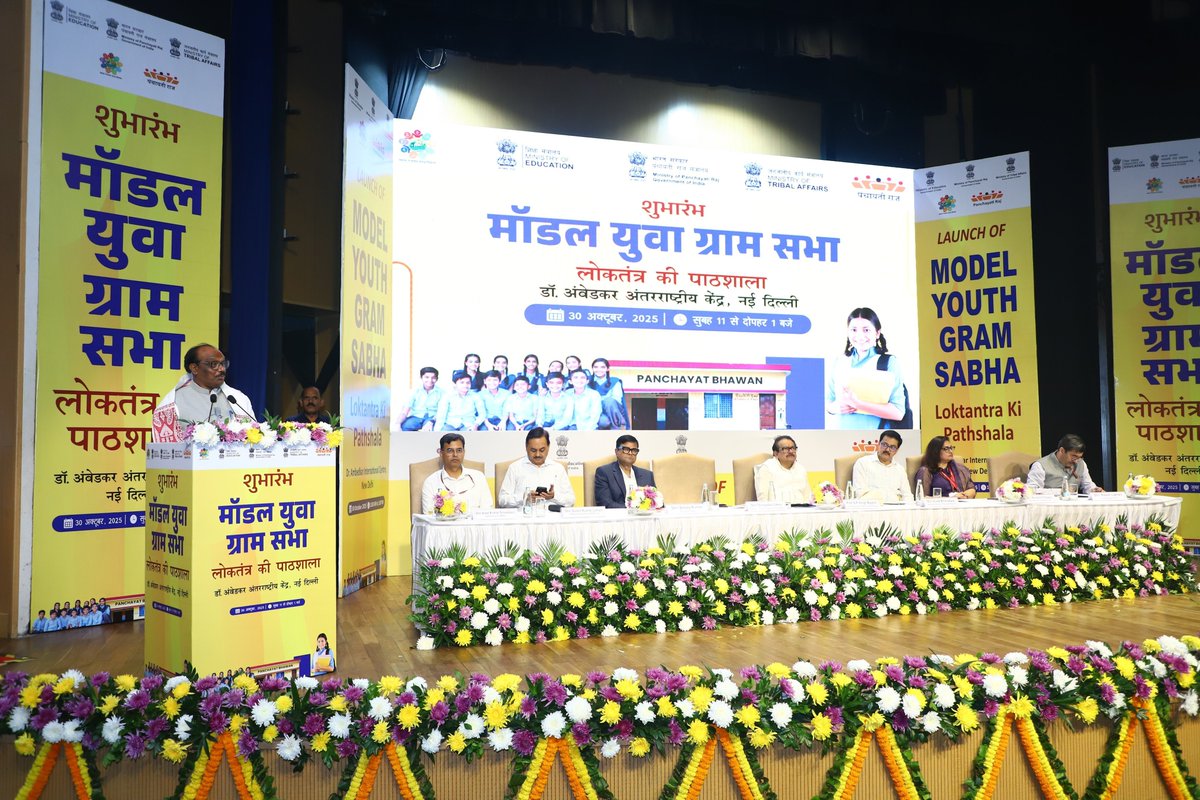
New Delhi | India’s democracy continues to evolve at the grassroots, and the “Adarsh Yuva Gram Sabha” (Model Youth Village Assembly) has emerged as a promising step toward deepening participatory governance. The initiative aims to connect young people with local self-governance, Panchayati Raj institutions, and the core values of democratic participation. By introducing students to the functioning of rural administration, it nurtures leadership, responsibility, and a spirit of public service among them.
The concept seeks to transform passive citizens into active participants in decision-making and community development. Through this platform, students not only observe but engage with the operational aspects of Gram Panchayats — from setting local priorities to understanding budget allocations and monitoring welfare schemes. The program is, in essence, a “laboratory of democracy” where theory meets practice.
Empowering Youth through Democratic Engagement
In India, the Panchayati Raj system—enshrined in Article 40 of the Constitution—forms the foundation of rural governance. However, young citizens, despite being the most dynamic and creative segment of society, have often remained distant from the process. The Adarsh Yuva Gram Sabha bridges this gap by creating opportunities for youth to participate in village-level deliberations, policy discussions, and community initiatives.
This engagement fosters not only political awareness but also a deeper respect for democratic institutions. Students learn the principles of transparency, accountability, and collective decision-making—essential ingredients for any robust democracy.
A Model for Civic Education and Social Inclusion
The initiative also represents a new form of civic education. By attending Gram Sabha meetings, presenting proposals, and engaging in debates, students experience the functioning of democracy firsthand. They learn leadership skills, communication, and problem-solving — lessons that no textbook alone can impart.
Importantly, the Adarsh Yuva Gram Sabha promotes inclusion by bringing together students from diverse backgrounds—across caste, gender, and social groups—on a single participatory platform. For young girls, especially in rural India, this initiative serves as a powerful means of empowerment, enabling them to voice opinions and contribute to local decision-making.
Encouraging Innovation and Ownership
The youth’s exposure to governance inspires them to bring innovative ideas to their villages—whether through digital record systems, sustainable waste management, or water conservation models. Such practical contributions enhance both the quality and sustainability of development projects.

When students take part in reviewing sanitation drives, educational programs, or health schemes, they develop a sense of ownership toward their village’s progress. This shift—from mere residency to responsibility—marks the true essence of participatory democracy.
Strengthening the Foundation of Participatory Governance
The Adarsh Yuva Gram Sabha underscores that democracy is not confined to elections; it is a continuous process of dialogue, deliberation, and duty. By connecting young citizens with governance at the village level, it reinforces the democratic chain from the bottom up.
Preliminary experiments across several states have shown promising results — improved transparency in Panchayats, greater awareness among villagers, and the rise of youth leadership. The initiative has ignited a sense of civic ownership and collective accountability in rural India.
A Pathway to a Vibrant Democratic Future
If institutionalized within schools and Panchayati Raj systems nationwide, the Adarsh Yuva Gram Sabha could redefine India’s rural democracy. It not only strengthens grassroots governance but also cultivates informed, responsible, and empathetic citizens — the true custodians of India’s democratic future.
Ultimately, this initiative reminds us that democracy is not merely about winning elections, but about engaging people, listening to ideas, and building the future together. With active youth participation, India’s villages can become the stronghold of a “participatory democracy” where decisions are taken with the people, not merely for them.