
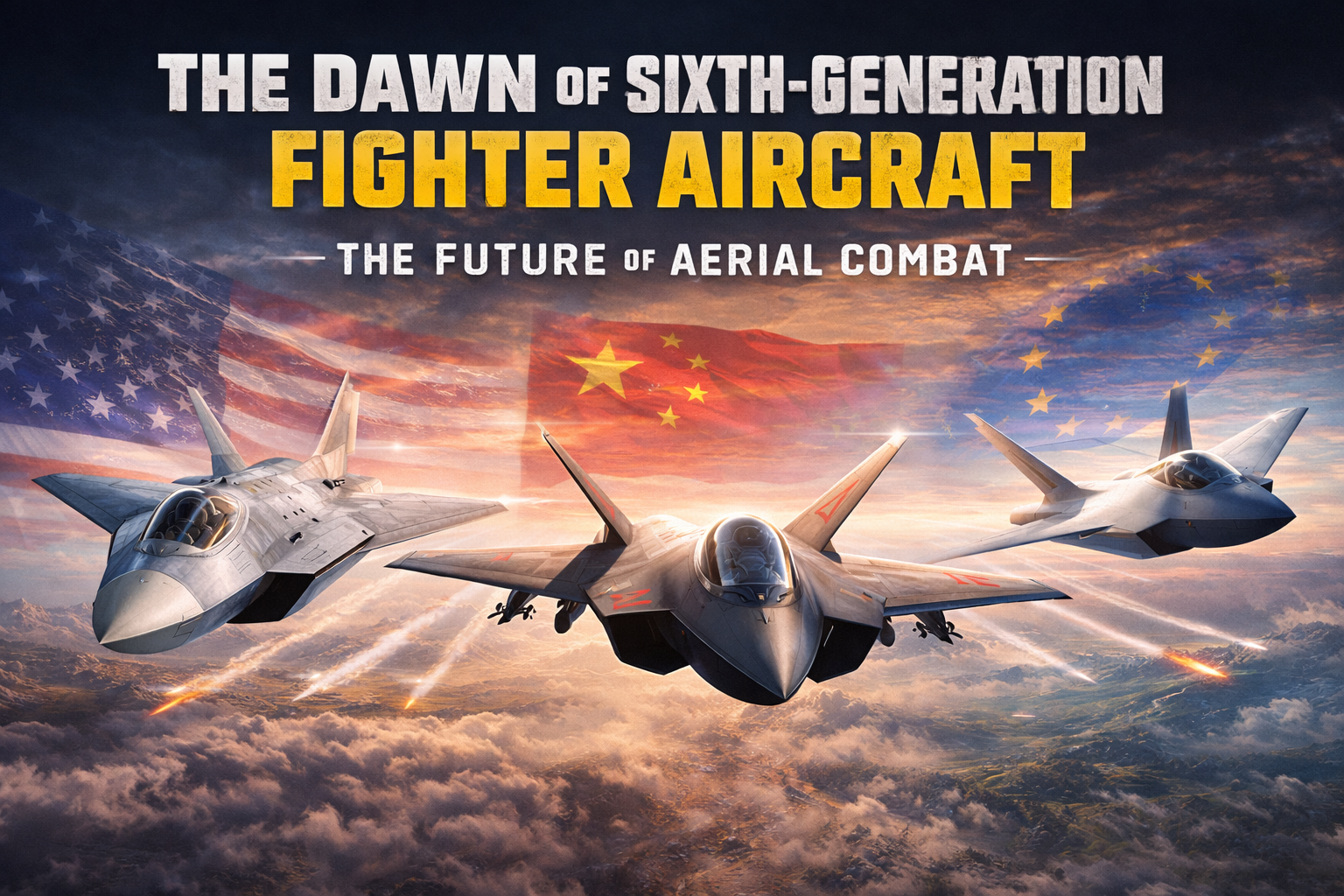
New Delhi: For more than a century, control of the skies has shaped the outcome of wars. From canvas-winged biplanes duelling above World War I trenches to stealth jets silently penetrating contested airspace today, fighter aircraft have remained the sharp edge of military power. Now, a new chapter is unfolding. The world stands on the threshold of sixth-generation fighter aircraft—machines designed not just to fly faster or evade radar, but to think, adapt, and fight as part of an intelligent, networked ecosystem.
As geopolitical rivalries intensify and warfare expands beyond land, sea, and air into cyber and space domains, sixth-generation fighters are emerging as the ultimate instruments of future air dominance.
A Century of Evolution in the Skies
The evolution of fighter aircraft reflects the relentless cycle of innovation and counter-innovation:
-
First Generation (1940s–1950s): Early jet fighters such as the F-86 Sabre and MiG-15 introduced jet propulsion but remained subsonic and visually oriented.
-
Second Generation (1950s–1960s): Supersonic flight and guided missiles reshaped air combat, exemplified by aircraft like the MiG-21.
-
Third Generation (1960s–1970s): Multirole capability and improved avionics emerged, with platforms such as the F-4 Phantom.
-
Fourth Generation (1970s–1990s): High manoeuvrability, fly-by-wire controls, and advanced sensors defined fighters like the F-16 and MiG-29.
-
Fifth Generation (1990s–present): Stealth, sensor fusion, and network-centric warfare became standard with the F-22 and F-35.
Sixth-generation fighters aim to go beyond all of this—dominating not only the air, but the entire battlespace.
What Makes a Fighter Sixth Generation?
Rather than a single defining feature, sixth-generation fighters represent a convergence of revolutionary technologies.
Artificial Intelligence and Autonomous Operations
AI will assist pilots by filtering vast streams of battlefield data, identifying threats, and recommending actions in real time. Some aircraft may fly in optionally manned or fully autonomous modes, undertaking the most dangerous missions without risking human life.
Loyal Wingman Drones
Future fighters will command formations of unmanned combat drones acting as scouts, missile carriers, or electronic warfare platforms. These autonomous wingmen will operate using AI-enabled swarm tactics, dramatically extending combat reach and survivability.
Next-Generation Propulsion
Adaptive and variable-cycle engines promise unprecedented performance, balancing fuel efficiency with extreme speed. Hypersonic flight capabilities could allow rapid penetration of heavily defended airspace.
Multi-Domain Network Warfare
Sixth-generation fighters will function as airborne command centres, linking satellites, naval forces, ground units, and cyber assets into a single combat network. Information dominance will be as decisive as firepower.
Advanced Stealth and Adaptive Signatures
Stealth will evolve beyond passive radar evasion. Future aircraft may feature adaptive materials, active electronic countermeasures, and real-time signature management to remain undetectable across multiple sensor types.
Directed Energy Weapons
Lasers and high-power microwave systems could enable aircraft to disable incoming missiles, neutralise drones, and suppress enemy air defences at the speed of light.
The Global Race for Air Superiority
United States: Next Generation Air Dominance (NGAD)
The US Air Force’s NGAD programme is designed to replace the F-22 Raptor with a family of systems combining crewed fighters, autonomous drones, and advanced networking. Major aerospace firms are competing to deliver an aircraft with unmatched stealth, electronic warfare, and AI integration. A naval variant is also under development for carrier operations.

Europe: Tempest and FCAS
Europe is pursuing two parallel sixth-generation programmes.
-
Tempest, led by the UK alongside Italy and Japan, focuses on AI-driven operations, drone swarms, and directed energy weapons.
-
FCAS, developed by France, Germany, and Spain, emphasises deep integration between crewed aircraft, unmanned systems, and space-based sensors.
Both aim for operational readiness in the mid-2030s.
China’s Next Leap
China has revealed concepts believed to represent early sixth-generation designs, reportedly featuring tailless stealth configurations, AI-assisted flight control, and advanced propulsion. Though details remain classified, the ambition to challenge established air powers is unmistakable.
Russia’s Hypersonic Vision
Russia has announced plans for a future interceptor, often referred to as the MiG-41, designed for extreme speeds and near-space operations. While development timelines remain uncertain, the concept reflects Moscow’s focus on countering high-altitude and hypersonic threats.
India’s Path Forward
India’s Advanced Medium Combat Aircraft (AMCA) programme is currently focused on fifth-generation capabilities, but research into AI-enabled avionics, unmanned teaming, and directed energy systems is laying the groundwork for future sixth-generation developments.
Challenges on the Road Ahead
Despite the promise, formidable obstacles remain:
-
Cost: Sixth-generation programmes demand enormous investment, potentially exceeding the already staggering costs of fifth-generation fleets.
-
Ethics and AI Control: Delegating lethal decisions to machines raises profound moral and legal questions.
-
Cyber Vulnerability: Highly networked aircraft must be protected against hacking, jamming, and data manipulation.
-
Technology Readiness: Many proposed systems—especially energy weapons and adaptive stealth—require years of testing before combat deployment.
Redrawing the Map of Air Power
Sixth-generation fighters will redefine aerial dominance. Pilots may evolve into mission commanders overseeing autonomous systems rather than engaging directly in dogfights. Alliances will deepen as nations pool resources to keep pace with accelerating technological change.
More than just aircraft, these platforms will be flying nodes in a vast, intelligent combat network—where air, space, cyber, and electronic warfare converge.
The Future Takes Flight
Though operational deployment may still be a decade away, the race for sixth-generation air power is already reshaping global defence strategies. Nations that master these technologies will not only control the skies but influence the balance of power for generations to come.
The future of aerial combat will belong to those who can think faster, adapt quicker, and integrate smarter—long before the first shot is ever fired.