New Delhi: Dev Meena, India’s national record holder in men’s pole vault and one of the country’s brightest young athletics prospects, recently faced a deeply distressing and humiliating experience—not on the field of play, but during a routine journey home by train. The incident has sparked widespread concern over the lack of systemic support and sensitivity extended to elite athletes in India, even those representing the nation at the highest levels.
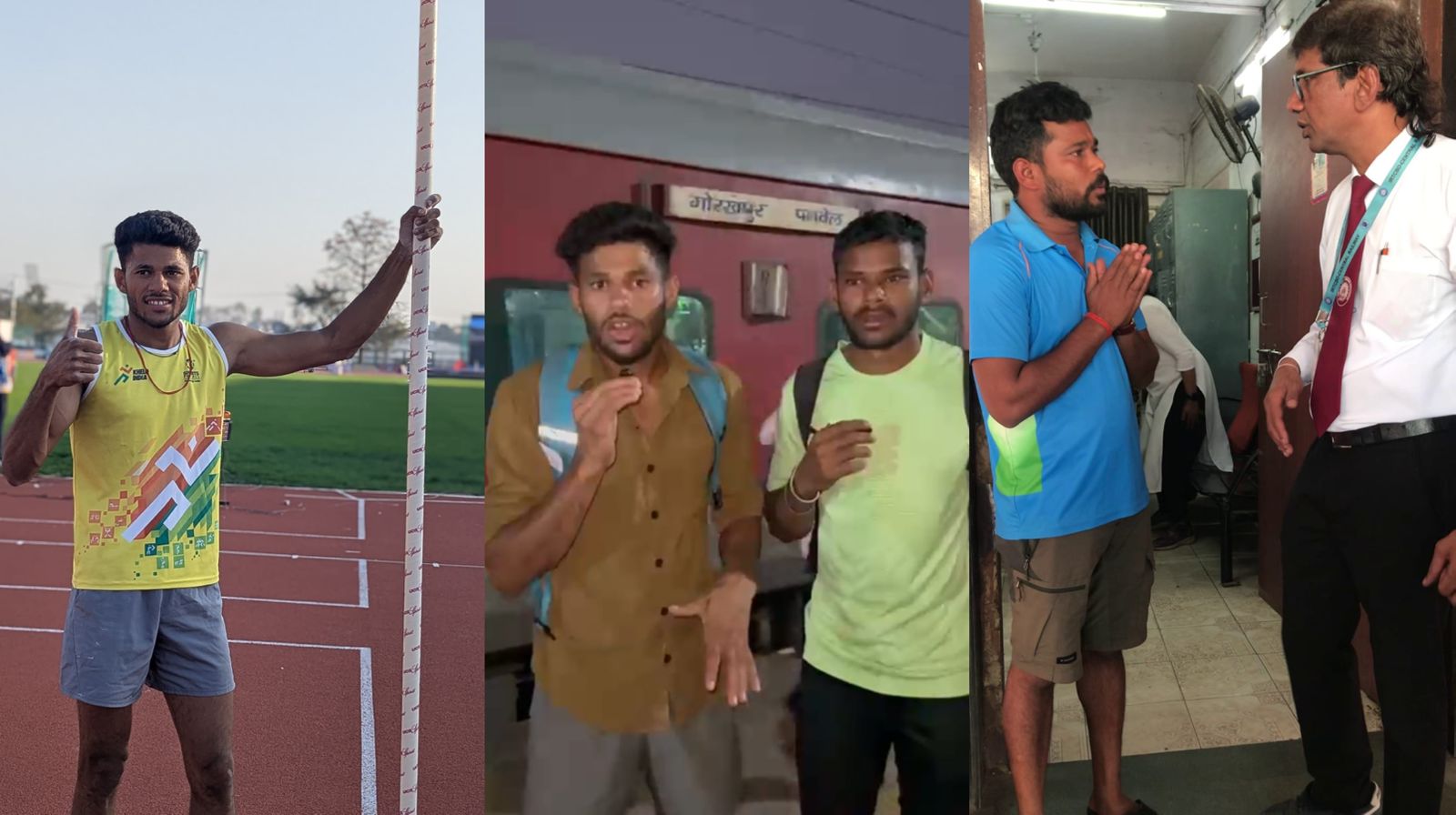
Just 20 years old, Meena has already etched his name into Indian athletics history. He holds the national record with a personal best of 5.40 metres, achieved at the World University Games in Germany in 2025, and has broken his own record multiple times. Known for his discipline, strength, and technical precision, Meena is widely regarded as a strong medal prospect for upcoming international competitions, including the Asian Games.
However, on January 17, 2026, Meena’s journey back from the All India Inter-University Athletics Championships in Mangaluru turned into a prolonged ordeal. Travelling with six fellow athletes and coach Ghanshyam Yadav, including inter-university champion Kuldeep Yadav, the team was returning to Bhopal after the competition. They were carrying 10 pole vault poles, specialised equipment essential to their sport.
Each pole vault pole, measuring nearly five metres in length and made of delicate fiberglass composites, costs around ₹2 lakh. These poles are precision-engineered tools designed to bend under immense force during jumps, and even minor mishandling can cause irreparable damage, severely impacting an athlete’s training and competitive prospects.
After an overnight train journey, the group reached Panvel station in Maharashtra around noon, with a connecting train to Bhopal scheduled for 3:50 pm. During the waiting period, while some athletes stayed with the equipment outside the station premises, a Travelling Ticket Examiner (TTE) objected to the poles being carried on board. The official allegedly dismissed the equipment as “steel pipes” or unauthorised oversized luggage, refusing to acknowledge repeated explanations that they were professional sports gear.
Despite presenting valid tickets, competition credentials, and medals, the team’s pleas were reportedly ignored. The TTE insisted that the poles violated luggage norms and demanded that they either be removed or sent through the luggage van—an option the athletes feared due to the high risk of damage during standard handling.
The situation escalated further when the athletes were reportedly forced to deboard the train, and their equipment was temporarily taken into custody by the Railway Protection Force (RPF). What followed was an exhausting wait of four to six hours, during which Meena, his teammates, and their coach repeatedly requested officials to reconsider.

Videos of the incident went viral after nnis sports, India’s only sports news agency reported the story. The video was later shared widely on social media, showed coach Ghanshyam Yadav with folded hands, pleading for understanding—images that struck a chord across the country and highlighted the indignity faced by even accomplished sportspersons.
According to the athletes, the TTE initially demanded an excessive amount, with claims ranging up to ₹8,000, before finally imposing a fine of ₹1,865 for alleged oversized or overweight luggage. The calculation reportedly assumed the poles weighed nearly 80 kilograms, while the team maintained the total weight was closer to 20 kilograms.
By the time the issue was resolved, the athletes had missed their scheduled train. Left with no alternative, they paid the fine from their own pockets, retrieved their equipment, and booked tickets on a later train departing at 7 pm. The delay resulted in additional expenses, physical exhaustion, and disruption to recovery and training schedules—an especially serious concern with major international events approaching.
Speaking later through interviews and video messages, Meena expressed disappointment and frustration, alleging that the official appeared more interested in extracting money than facilitating a reasonable solution. He also pointed out that this was not an isolated incident, noting that athletes often face similar challenges during air travel as well, forcing them to rely on trains despite the risks involved.
The episode has triggered widespread outrage among athletes, sports administrators, and fans, with many questioning how a national record holder and international representative could be subjected to such treatment. Calls have grown louder for clearer railway policies on sports equipment, dedicated provisions for athletes, and better training for staff to sensitively handle such situations.
Dev Meena’s journey—from clearing record-breaking heights on the track to struggling for basic dignity on a railway platform—highlights a troubling contradiction. While India celebrates sporting success and international achievements, the everyday infrastructure required to support athletes often remains inadequate. For Meena, the challenge was not the height of the bar—but the barriers created by bureaucracy during a simple journey home.