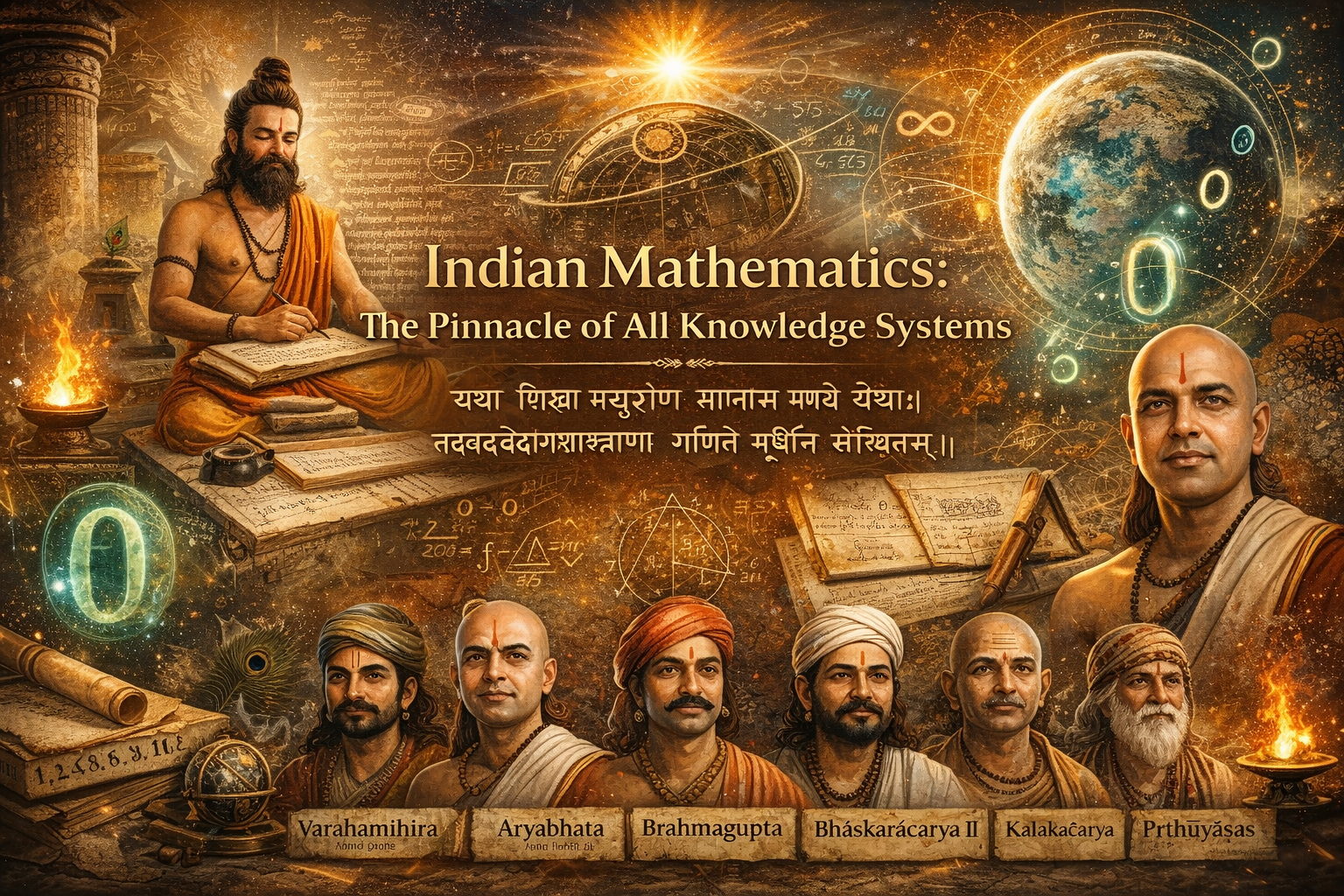
Lucknow: The texts of the Vedās and Vedāṅgas involve mathematics extensively. The Kalpa, which focuses on the preparation of altars (yajñavedikās), employs several geometric principles outlined in the ŚulbaSūtras. Some of the prominent names associated with these texts include Baudhāyana, Āpastamba, and Kātyāyana. Due to its vast scope and significance, Jyotiṣa (the science of astronomy) has been revered for centuries. Lagadha, a great Indian mathematician from around 1500 BCE, expressed in his work on VedāṅgaJyotiṣa that “like the crest of a peacock and the gems on the hoods of serpents, mathematics lies at the pinnacle of all knowledge systems.”
यथाशिखामयूराणांनागानांमणयोयथा।

तद्वद् वेदांगशास्त्राणां गणितं मूर्ध्नि संस्थितम्॥
Similarly,Chandas, which is the science of poetic metre or prosody, contains valuable insights related to permutations and combinations and describes astronomically large numbers. Mathematics is foundational to life and civilization. For instance, the measurement of time guides our lives, often without our being aware of it. Mathematics cultivates logical and analytical thinking, skills that are beneficial not only in one’s profession but also in tackling various practical challenges.
The sages who discovered these mathematical principles include Sūrya, Pitāmaha, Vasiṣṭha, Medhātithi, Garga, Lomāśa, and Cyavana. Famous astronomer-mathematicians includes Varāhamihira, Āryabhaṭa, Bhāskarācārya I, Bhāskarācārya II, Brahmagupta, Mahāvīrācārya, Kālakācārya, Pṛthūyaśas, and PavuluriMallanna.
Vedic thinkers invented and conceptualized numerous ideas, including the number system, counting, and basic operations such as addition, subtraction, multiplication, and division. They also contributed to understanding the solar system and planetary motion. Among their remarkable gifts to humanity is the concept of zero.
Over time, the mathematical literature from India was shared with other countries. A mathematician named Kaṅka from Ujjayinīwas taken to the Arab regions, where he translated Sanskrit mathematics texts into Arabic. It is said that al-Khwārizmī, under whose name algebra became well-known, adopted Sanskrit numerals for his works. Consequently, the influence of Indian mathematics spread to Spain, Germany, France, England, and beyond.
During foreign rule in India, mathematics was introduced into the curriculum through the English language, often with the names of original Indian contributors suppressed. For example, the BaudhāyanaSiddhānta, which pertains to the areas of the sides of a right-angled triangle, is now commonly attributed to Pythagoras, who lived about three centuries after Baudhāyana. Similarly, the theorem of interpolation introduced by Govinda Svāmī around 300 BCE is now known by the names of Newton and Gauss, who were born approximately 1800 years later. Āryabhaṭa’s theory of the Earth revolving around the sun, recorded in the 5th century CE, is often associated with Copernicus, who was born 1000 years later.

It is important to note that the development of Vedic mathematics was not limited to ancient times. In the 1960s, SvāmīBhāratīKṛṣṇaTīrtha of GovardhanaPīṭha in PurīJagannātha authored a book titled Vedic Mathematics, which describes 16 mathematical Sūtras (formulas) and their upasūtras. These sūtras are particularly useful for performing arithmetic at high speed.
Throughout history, numerous Indian mathematicians have made significant contributions to refining and expanding upon ancient mathematical knowledge. Their work has not only preserved this rich heritage but also advanced it in remarkable ways.
- Āryabhaṭa (476–550 CE): A pioneering figure, Āryabhaṭa introduced concepts such as the approximation of π (pi) and developed methods for calculating the area of circles and the volume of spheres.
- Brahmagupta (598–668 CE): In his seminal work, Brahmasphuṭasiddhānta, Brahmagupta provided rules for arithmetic operations involving zero and negative numbers.
- Bhāskara I (7th century): Known for his work on sine functions and trigonometric calculations.
- Bhāskara II (1114–1185 CE):orBhāskarācārya, author of SiddhāntaŚiromaṇi and Bija Ganita which have remarkably advanced concepts of modern algebra.
- Mahāvīra (9th century): Known for his extensive work in algebra.
- Mādhava of Saṅgamagrāma (14th century):Founder of the Kerala School of Astronomy and Mathematics.
- NīlakaṇṭhaSomayājī (15th century): Advanced trigonometry and calculus.
- Rāghavendra Rao and others (17th century):Continued refining mathematical techniques.
In present times, India continues to produce remarkable mathematicians making significant contributions to the field. One notable figure is PurīŚaṅkaraPīṭhādhipatiSvāmīNiścalānanda, who developed formulas for space science, particularly related to the Candrayāna-2 mission. Additionally, Dr.RemallaAvadhanulu, Dr. K. Suresh, and many others are actively decoding Vedic texts into mathematical formulas, bridging ancient wisdom with modern scientific understanding. Their efforts exemplify the enduring legacy of Indian mathematics and its relevance in contemporary research and applications.
Team Siddhanta Knowledge Foundation







 ---------------------------------------------------------------------------------------------------