Lucknow: As the 2026–27 academic session gathers pace across Uttar Pradesh, a growing wave of resentment is building among parents of students enrolled in private schools in Lucknow. Allegations of exploitative practices have gone viral across social media platforms and parent WhatsApp groups, with many accusing certain institutions of operating a virtual “loot shop” by forcing families to purchase essential academic materials from designated vendors at inflated prices.
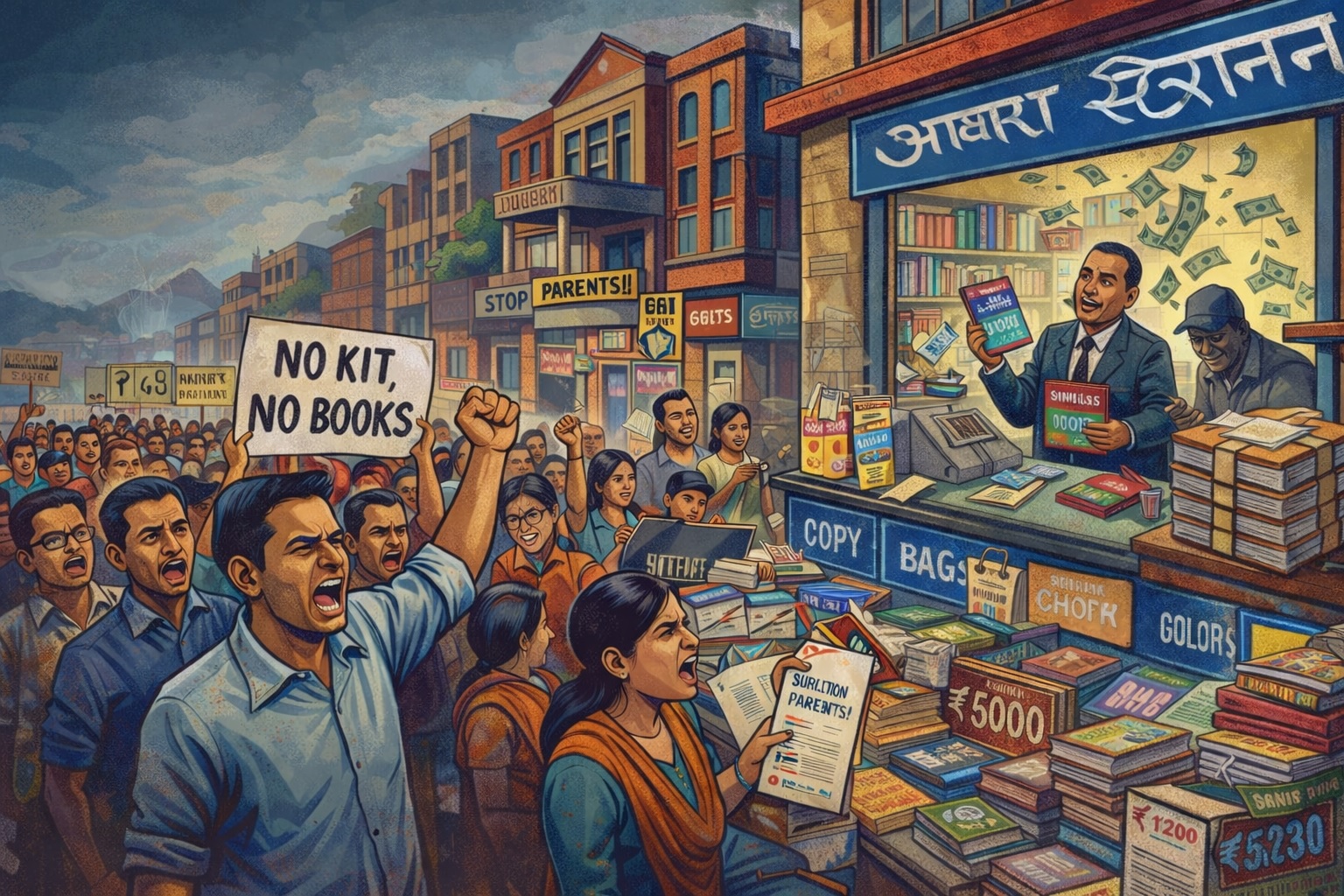
Parents claim that schools are mandating the purchase of books, uniforms, notebooks, stationery, school bags, and even minor items such as chalk and colours from specific shops. These purchases, they allege, are not optional but enforced through indirect pressure, leaving families with little choice. According to a detailed report circulating online, such arrangements often result in “manmani vasooli” (arbitrary collections), with prices reportedly 30 to 100 percent higher than those available in the open market.
A widely shared comparative chart highlights the extent of the financial burden. It shows that a standard set of Class 5 books and notebooks costs around ₹4,000–₹5,000 at school-recommended vendors, while the same materials can be purchased for ₹2,500–₹3,000 elsewhere. Many parents argue that such price differences point to a systematic issue rather than isolated incidents.
One of the biggest concerns raised is the frequent and seemingly arbitrary changes in textbooks, uniform designs, and even stationery specifications. These changes, often introduced annually or every two years, prevent families from reusing materials for younger siblings or continuing with existing items. As a result, parents are forced into repeated and often avoidable expenditure.
Rahul Sharma, a parent from Gomti Nagar, shared his frustration, stating that his family had to spend nearly ₹8,000 again this year after the school changed both the uniform pattern and prescribed books. “It feels like a planned system to extract money,” he said, reflecting a sentiment echoed by many others.
The report describes this system as a “Vasooli ka Jaal” (web of collection), alleging that schools maintain tie-ups with specific vendors and may earn commissions through these arrangements. Parents claim that non-compliance often leads to subtle consequences for students. In several instances, families reported delays in receiving textbooks or indirect pressure on children whose parents chose not to purchase the complete “school kit” from designated shops. A recurring allegation reads: “No books if copies and stationery are not purchased from the designated shop.”
Adding to the outrage, a viral video from Lucknow shows a parent questioning the pricing of a single Class 5 English textbook from the Burlington series, reportedly sold for ₹1,035 at a school-linked vendor. The video has intensified public debate, with many calling such pricing unjustifiable.

Despite existing regulations, parents argue that enforcement remains weak. The Uttar Pradesh Fee Regulation Act and previous government advisories prohibit schools from compelling purchases from specific vendors. In March 2026, the state government reiterated that schools cannot force parents to buy books, uniforms, or stationery from any particular shop. However, complaints continue to emerge from Lucknow and other cities, highlighting a gap between policy and implementation.
Developments in other regions have further fuelled the discussion. Authorities in Delhi recently issued strict directives barring private schools from enforcing vendor-specific purchases, mandating transparency in pricing and limiting frequent changes in uniforms. Many parents in Lucknow are now urging similar action from local authorities.
Working mother Priya Mehra from Aliganj described the situation as “harassment in disguise,” claiming that schools continue to pressure parents despite earlier guidelines issued during the COVID-19 period. Vikram Singh from Indira Nagar added that recurring changes in school requirements make it difficult for families with multiple children to manage expenses.
The controversy has reignited a broader debate on the commercialisation of education. While private schools play a significant role in providing quality education, parents and experts argue that unchecked profit-driven practices undermine accessibility and fairness.
There are growing calls for stricter oversight by the Basic Education Department, including mandatory display of price lists, multiple vendor options, limits on arbitrary changes, and a robust grievance redressal mechanism. Parent groups are also advocating collective action to hold institutions accountable.
As the issue gains traction, many families in Lucknow are hoping for timely intervention and meaningful reform. For now, the “loot shop” allegations highlight a deeper systemic concern—one that challenges the balance between quality education and ethical practices in India’s private schooling system.