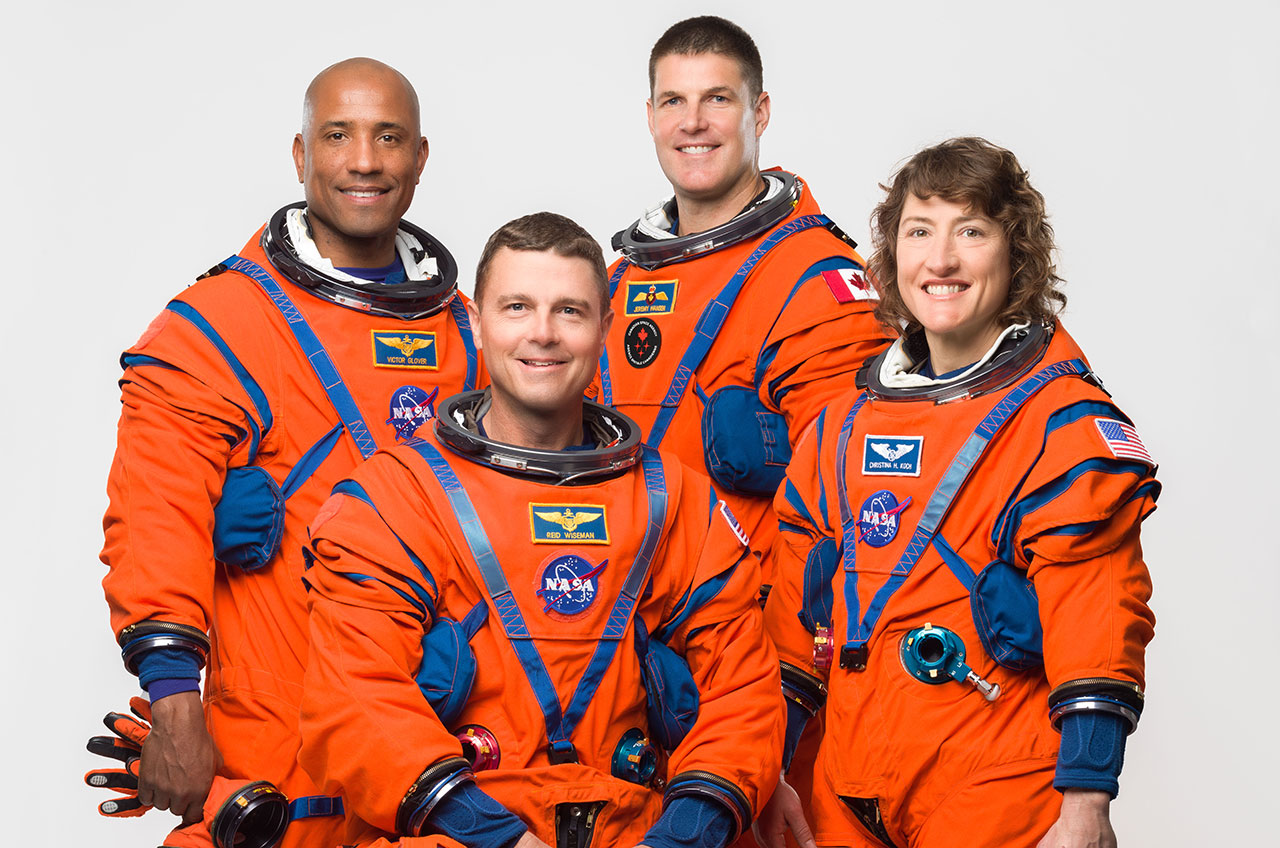
Washington – In a landmark achievement for human space exploration, the crew of Artemis II has successfully completed a close flyby of the Moon, setting a new record for the farthest distance traveled by humans in space.
The mission, led by NASA, marks a significant milestone in efforts to return humans to the Moon after more than five decades. The astronauts navigated around the far side of the Moon before beginning their journey back to Earth, offering rare and detailed views of regions not visible from the planet.

Record-Breaking Distance
During the flyby, the Artemis II crew traveled over 252,000 miles away from Earth, surpassing the previous record set by Apollo 13 in 1970. The achievement represents a major step forward in deep-space human exploration and demonstrates the capabilities of modern spacecraft systems.
Astronaut Jeremy Hansen described the experience as extraordinary, highlighting the clarity and vastness of the lunar surface. The crew noted that future missions could aim to extend these boundaries even further.
Emotional and Symbolic Moments
The mission also featured emotional moments as astronauts proposed naming newly observed lunar craters. One crater was suggested to bear the name of their spacecraft, while another was dedicated to a personal loss experienced by mission commander Reid Wiseman.
These gestures underscored the human element of space exploration, blending scientific achievement with personal reflection.
Free-Return Trajectory and Communication Blackout
Following a free-return trajectory—similar to that used during Apollo 13—the spacecraft utilized the gravitational forces of the Earth and Moon to guide its path efficiently. This approach ensures a safe return with minimal fuel consumption.

As the spacecraft passed behind the Moon, communication with Earth was temporarily lost for approximately 40 minutes. During this period, the crew reached their closest approach to the lunar surface before re-establishing contact and continuing their return journey. The mission is expected to conclude with a splashdown in the Pacific Ocean.
Scientific Observations
Throughout the mission, astronauts conducted extensive scientific observations, capturing high-resolution images of the Moon and Earth. Key areas of interest included large impact basins, previous Apollo landing sites, and regions near the lunar south pole—considered critical for future missions.
In addition, the crew observed planetary alignments and even witnessed a solar eclipse from space, adding further scientific value to the mission.
Paving the Way for Future Missions
Artemis II is the first crewed lunar mission since the Apollo era and serves as a precursor to upcoming missions aimed at landing astronauts on the Moon. Future phases of the Artemis program will focus on testing advanced technologies, docking procedures, and eventually establishing a sustained human presence on the lunar surface.
With international collaboration playing a key role—including participation from Canadian astronauts—the mission highlights a renewed global commitment to space exploration.
As the Artemis II crew makes its way back to Earth, the mission stands as a powerful symbol of human ambition, innovation, and the enduring quest to explore beyond our planet.