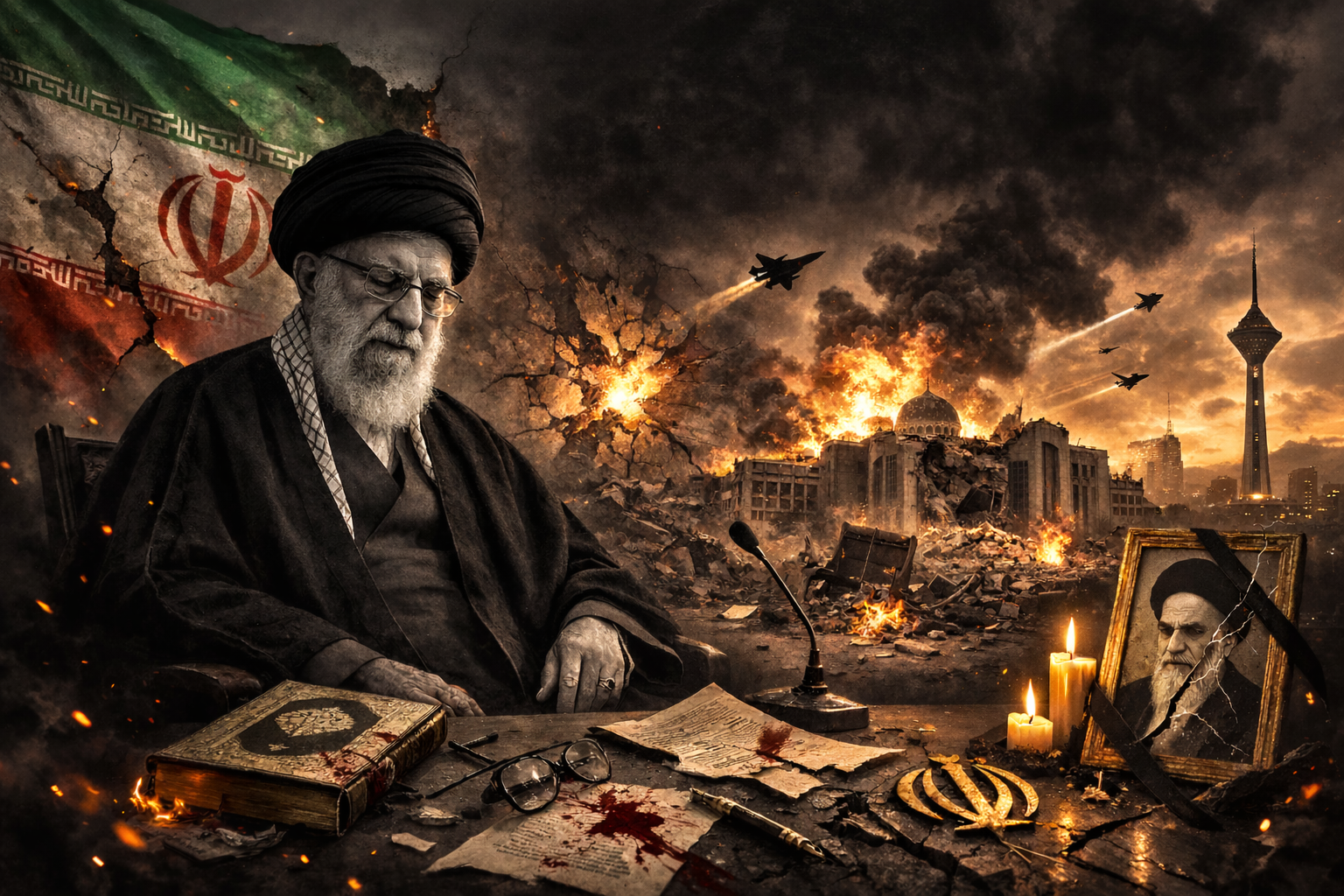
Tehran: The assassination of Ali Khamenei on February 28, 2026, in a joint U.S.–Israeli airstrike marks one of the most consequential ruptures in modern Middle Eastern history. For more than three decades, Khamenei stood at the apex of the Islamic Republic’s power structure, guiding its theocratic governance, shaping its anti-Western foreign policy, advancing its nuclear ambitions, and orchestrating a formidable network of regional proxies. His death at 86—confirmed by Iranian state media on March 1 amid escalating “Operation Epic Fury” strikes—has triggered immediate chaos, retaliatory warfare, a fraught succession battle, and profound shifts in regional and global alignments.
As of March 1, 2026 (evening IST), the conflict remains active, with missile exchanges and airstrikes underscoring the absence of any near-term diplomatic off-ramp.

A Strike Years in the Making
According to U.S. officials, intelligence provided by the CIA pinpointed Khamenei’s presence at his Tehran residence and adjoining office complex. Israeli Air Force missiles struck the compound late on February 28, killing the Supreme Leader along with several family members and senior officials. The precision of the strike—and its audacity—sent shockwaves through Tehran and beyond.
President Donald Trump announced the operation on Truth Social, calling Khamenei “one of the most evil people in history” and framing the strike as overdue justice for decades of Iranian-backed attacks on American personnel and allies. The announcement marked a dramatic escalation in U.S. policy, signaling a return not merely to “maximum pressure,” but to direct decapitation of adversarial leadership.
Iranian state television declared Khamenei a “martyr of the revolution,” announcing 40 days of national mourning and seven public holidays. Anchors, visibly shaken, described the event as an “open declaration of war against Islam.” Yet even as mourning rallies filled Tehran’s squares, reports of small, subdued celebrations in private homes and diaspora communities hinted at the deep fissures within Iranian society.
The Succession Crisis
Unlike Ruhollah Khomeini, who explicitly designated Khamenei as his successor in 1989, Khamenei left no publicly anointed heir. His sudden removal leaves the Islamic Republic confronting an unprecedented vacuum at its core.
An interim three-member council—comprising President Masoud Pezeshkian, the judiciary chief, and a Guardian Council jurist—has assumed temporary leadership, with Ali Larijani overseeing national security. The decisive authority, however, rests with the Assembly of Experts, an 88-member clerical body tasked with selecting the next Supreme Leader.
Possible contenders reflect competing visions within the regime:
-
Mojtaba Khamenei, the late leader’s son, a hardliner with significant influence over regime finances and security networks.
-
Hassan Khomeini, grandson of the republic’s founder, who may appeal to traditionalists seeking symbolic continuity.
-
Establishment figures such as Ali Larijani or cleric Alireza Arafi, representing pragmatic institutional continuity.
The selection process unfolds amid active military conflict and deep factional distrust. Hardliners tied to the Islamic Revolutionary Guard Corps (IRGC) may press for a leader who guarantees uncompromising defiance, while pragmatists could argue for a figure capable of de-escalation to preserve regime survival.
The specter of paralysis looms large. Should the Assembly deadlock, or should public unrest intensify—building on the deadly protests of 2025–2026—the risk of internal fragmentation or even civil conflict cannot be dismissed. Yet the IRGC’s entrenched power and control over security services may prevent systemic collapse, instead consolidating a more militarized order.
Retaliation and Regional Firestorm
Iran responded within hours, launching missile and drone barrages at Israeli cities, U.S. bases in Iraq and Syria, and strategic Gulf sites. Casualty reports remain contested, but both civilian and military losses have been confirmed. Israeli forces resumed strikes on Tehran and key military installations on March 1, signaling a sustained campaign.
The death of Khamenei threatens to unravel—or radicalize—the so-called Axis of Resistance. Under his stewardship, Iran cultivated a web of aligned militias and movements: Hezbollah in Lebanon, the Houthis in Yemen, Iraqi Shia militias, and remnants of Hamas in Gaza. Without his personal authority and funding approvals, cohesion may weaken. Yet decentralized actors could also escalate independently, widening the battlefield.
For Israel, the removal of its principal ideological adversary is a strategic windfall, at least in the short term. Prime Minister Benjamin Netanyahu hailed the operation as eliminating an existential threat. But Israel also faces the prospect of multi-front retaliation, including rocket fire from Lebanon or maritime disruptions in the Red Sea.
Sunni Gulf states such as Saudi Arabia and the UAE tread cautiously. While privately relieved at Tehran’s destabilization, they fear retaliatory strikes on oil infrastructure—memories of the 2019 Abqaiq attack remain vivid. Any disruption could spike global oil prices and roil fragile economies.
Nuclear Uncertainty
Khamenei oversaw Iran’s steady nuclear advances, publicly denying intent to weaponize while expanding enrichment capacity. Recent strikes reportedly damaged several facilities, temporarily setting back progress. However, his death may accelerate hardline arguments for a rapid “breakout” capability as deterrence against future decapitation attempts.

A perceived sprint toward weaponization could trigger preemptive moves by Israel or spark a regional arms race. Saudi Arabia has long hinted it would not remain non-nuclear if Iran crossed the threshold. In an already volatile region, proliferation risks multiply.
Washington’s Gamble
For the United States, the operation represents the boldest act of targeted force against Iran’s leadership since the 2020 killing of Quds Force commander Qassem Soleimani. President Trump’s rhetoric suggests a belief that decisive action can deter adversaries and embolden internal opposition within Iran.
Yet the gamble is immense. Sustained conflict, American casualties, or an oil shock could provoke domestic backlash ahead of congressional midterms. Moreover, overt support for regime change risks reinforcing hardliner narratives within Iran, potentially unifying factions that might otherwise splinter.
Trump’s warning to Tehran against escalation, coupled with calls for Iranians to “take back their country,” underscores the administration’s dual-track approach: coercion abroad, encouragement of internal transformation.
Global Repercussions
International reactions reveal stark geopolitical divides.
Russian President Vladimir Putin condemned the strike as a violation of sovereignty and a “cynical murder,” highlighting Moscow’s loss of a key partner and drone supplier amid the Ukraine conflict. China, heavily dependent on Gulf energy flows, urged restraint and emphasized regional stability.
European governments struck a cautious tone. While some officials privately acknowledge that Khamenei’s death could open space for reform, public statements stress de-escalation to prevent refugee flows, terrorism spikes, and economic fallout from surging oil prices.
Across the Muslim world, responses vary. Pakistan witnessed violent protests near U.S. diplomatic facilities. Indonesia’s Ulema Council issued condolences. Meanwhile, segments of the Iranian diaspora in Los Angeles and elsewhere openly celebrated, viewing the event as the possible dawn of a post-theocratic era.
A System Transformed—or Hardened
Khamenei’s three-decade rule fused clerical authority with security-state pragmatism. He systematically sidelined moderates, empowered the IRGC, and cultivated a narrative of resistance against Western domination. His removal severs the symbolic and operational center of that architecture.
The question is whether the Islamic Republic evolves, fractures, or ossifies.
A swift succession producing a pragmatic cleric might prioritize stability and limited détente, seeking sanctions relief and conflict de-escalation. Alternatively, an IRGC-aligned hardliner could double down on confrontation, accelerating nuclear efforts and intensifying proxy warfare to project strength.
Public sentiment remains unpredictable. Years of economic hardship, sanctions, and repression have eroded regime legitimacy among many Iranians. Yet nationalist outrage at foreign intervention may rally segments of society around the flag.
An Inflection Point for the Middle East
In the short term, Israel appears strategically strengthened, having eliminated its principal ideological foe. The United States has demonstrated willingness to strike at the heart of adversarial regimes. Sunni Arab states may recalibrate their security calculus, deepening quiet cooperation with Israel.
But history cautions against assuming linear outcomes. The removal of a dominant leader can unleash unintended consequences—fragmentation, radicalization, or protracted instability.
The Middle East now stands at a volatile crossroads. Khamenei’s death closes a chapter defined by revolutionary continuity and entrenched hostility. Whether the next chapter brings reform, intensified conflict, or systemic upheaval will depend on decisions made in Tehran’s clerical halls, Washington’s Situation Room, and regional capitals bracing for the aftershocks.
For now, as missiles arc across skies and diplomats scramble behind closed doors, the world watches a region reshaped in real time—its future uncertain, its stakes immeasurably high.