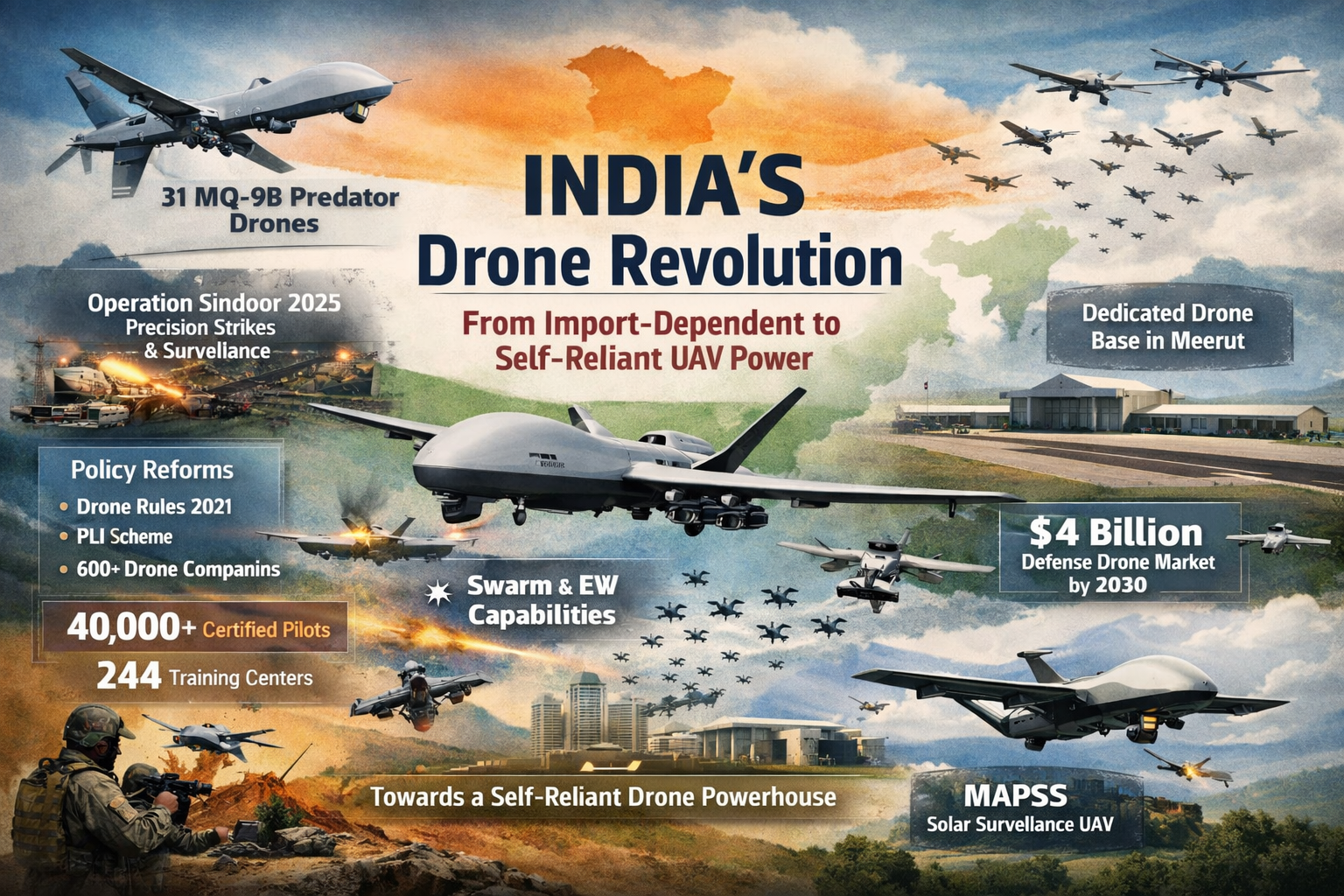
New Delhi: India is rapidly transforming its defense posture through an ambitious expansion of drone warfare capabilities, moving from reliance on imported unmanned aerial systems (UAS) to a self-reliant force capable of deploying advanced drones across diverse combat scenarios. Lessons from recent geopolitical tensions, including border skirmishes and the high-profile Operation Sindoor in 2025, have accelerated this shift. Drones were central to precision strikes, surveillance, and intelligence gathering during these operations, demonstrating the strategic value of unmanned systems in modern conflict.
As of February 2026, India’s push encompasses indigenous development, massive acquisitions, dedicated infrastructure, policy reforms, private sector innovation, and doctrinal shifts toward drone swarm tactics and attritable systems. Experts say this is not merely a technological upgrade; it is a recalibration of India’s military doctrine and operational mindset for the 21st century.
Policy and Regulatory Foundations
India’s drone ecosystem has matured significantly thanks to progressive reforms that encourage innovation while streamlining operations. The Drone Rules 2021 were a landmark policy initiative, liberalizing operations by removing cumbersome approvals and introducing digital self-certification for operators. This regulatory environment incentivized startups and established players alike to scale rapidly.
The government’s Production-Linked Incentive (PLI) scheme for drones and components, offering up to 20% incentives on value addition, aims for 40% localization of drone production by FY28. GST on drones was reduced to a uniform 5% in September 2025, making domestic manufacturing more cost-effective. A February 2022 import ban on complete drones (excluding defense, R&D, and security applications) further accelerated the growth of local production.
Today, India boasts over 38,500 registered drones, nearly 40,000 DGCA-certified remote pilots, and 244 approved training organizations. While much of this supports civilian applications such as agriculture, surveying, and SVAMITVA land mapping, the infrastructure directly benefits defense by creating a scalable industrial base capable of producing combat-ready systems.
Programs like Drone Shakti and Namo Drone Didi have trained operators nationwide, particularly women, fostering inclusivity in tech-enabled defense sectors. Meanwhile, the Innovations for Defence Excellence (iDEX) program, launched in 2018, has been instrumental in bridging domestic innovation with military requirements. Startups receive grants up to ₹25 crore under schemes like ADITI, supporting UAVs, counter-UAS, and autonomous systems. By 2025-2026, iDEX facilitated procurements worth over ₹1,000 crore, demonstrating the government’s commitment to public-private synergy.
Indigenous Development and Technological Advancements
The Defence Research and Development Organisation (DRDO) leads India’s core R&D in drones. Key programs include the Archer series for combat UAVs, loitering munitions like Nagastra, and emerging swarm technologies. DRDO is also experimenting with drones as floating antenna arrays for electronic warfare (EW), enabling adaptive formations capable of jamming, intelligence gathering, and communication in contested environments.
Private sector innovation has surged alongside government initiatives. Startups like NewSpace Research & Technologies are developing autonomous surveillance and armed drone swarms (A-SADS), and solar-powered Medium Altitude Persistent Surveillance Systems (MAPSS). In January 2026, the Army signed a ₹168 crore contract for MAPSS—a long-endurance, solar-electric UAV designed for border ISR missions.
Other technological advances include FPV (first-person view) drones, kamikaze-style loitering systems, and indigenous counter-drone technologies like Indrajaal. The Indian Army’s target of 100,000 UAVs emphasizes low-cost, attritable systems for infantry and mechanized units. By mass-deploying these drones, India seeks to mitigate threats from adversarial UAV swarms and hybrid warfare tactics.
Acquisitions and Operational Integration
India’s drone acquisitions have accelerated in recent years. In 2024, the country signed a contract for 31 MQ-9B Predator drones from the U.S., aimed at enhancing long-endurance ISR and strike capabilities. Indigenous loitering munitions, such as the Harop (produced in collaboration with Israel) and Nagastra, complement these systems.
Following Operation Sindoor in 2025, Indian armed forces inducted drones worth over ₹5,000 crore, including kamikaze, surveillance, and loitering systems sourced from domestic firms. Nineteen dedicated drone training centers were planned by January 2026 to build operator expertise and ensure rapid integration into operational units.
Doctrinally, the armed forces are shifting toward drone-centric warfare. The Army designated 2024-2025 as the “years of tech absorption,” emphasizing drones for reconnaissance, precision strikes, and electronic warfare. Lessons from global conflicts, such as the Ukraine war, have reinforced the importance of attritable, low-cost systems over expensive single-platform investments.
Dedicated Infrastructure Buildout
A landmark milestone in India’s drone journey is the first dedicated military drone base in Meerut, Uttar Pradesh. Built by the Border Roads Organisation (BRO) at a cost of ₹406 crore, the base spans roughly 900 acres, featuring a runway exclusively for drones and remotely piloted aircraft (RPA).
The facility is designed for high-tempo, sustained operations, supporting launch, recovery, maintenance, and command centers. Inspired by the successes of Operation Sindoor, where drones bypassed defenses for precision strikes, the base ensures rapid deployment along sensitive borders.
Complementary infrastructure includes drone testing ranges, simulation centers, and integration facilities. Indigenous counter-drone systems are being deployed at strategic locations, incorporating domed radars and directed-energy solutions for layered defense.

Challenges and the Road Ahead (2026–2030)
Despite impressive progress, gaps remain. These include the limited production of mass attritable systems, procurement delays, and the need for faster operational absorption. India’s roadmap for the next five years emphasizes:
-
2026–2027: Scaling FPV and loitering drone deployment, prioritizing indigenous production.
-
Beyond 2027: Integrating full swarm capabilities, AI-driven autonomy, and EW-capable floating arrays.
The defense drone market is projected to grow to $4 billion by 2030, with the overall UAV sector potentially reaching $23 billion. Geopolitical tensions with neighboring countries are a key driver, positioning India as a strategic drone hub alternative to global leaders.
Experts say India’s drone warfare infrastructure has evolved from nascent experimentation into a strategic asset, reshaping deterrence, reconnaissance, and battlefield engagement. By leveraging the Atmanirbhar Bharat initiative, fostering public-private partnerships, and driving rapid innovation, India is creating a future where unmanned systems dominate operational theaters.
Public-Private Synergy and Innovation Ecosystem
The success of India’s drone initiatives is rooted in the synergy between defense organizations, academia, and the private sector. iDEX and the PLI scheme have incentivized startups to innovate in areas such as AI-enabled autonomous navigation, swarm coordination, and advanced sensors.
Several firms are developing FPV swarms for infantry operations, solar-powered surveillance drones for persistent border monitoring, and multi-role kamikaze drones capable of both ISR and strike missions. These systems not only reduce costs but also provide flexibility for attritable, high-risk missions.
By combining government procurement with startup agility, India is building an ecosystem capable of rapid iteration and adaptation—essential traits for modern drone warfare.
Strategic Implications and Operational Benefits
The rapid expansion of drone capabilities strengthens India’s deterrence posture along contested borders. Drones enhance situational awareness, provide early warning, and allow precision strikes without risking personnel. Loitering munitions and swarm technologies, integrated into infantry and mechanized units, provide operational depth, enabling asymmetric advantages in hybrid warfare scenarios.
Moreover, the ability to produce drones domestically reduces dependency on foreign suppliers, mitigating vulnerabilities in supply chains for critical UAV components. It also allows India to export technology to friendly nations, creating both strategic and economic leverage.
India’s journey from an import-dependent drone user to a self-reliant UAV power reflects a strategic convergence of policy, innovation, and operational vision. Through regulatory reforms, indigenous development, acquisitions, infrastructure buildout, and doctrinal shifts, India is laying the groundwork for drone-dominated warfare in the 21st century.
With the integration of swarm tactics, AI-enabled autonomy, and EW capabilities, India is poised to set new benchmarks in unmanned aerial operations. Beyond the battlefield, this investment reinforces technological self-reliance, boosts industrial capacity, and positions India as a global hub for defense drones.
As the next generation of drones takes flight along India’s borders and in its strategic theaters, the country’s Atmanirbhar Bharat vision is manifest not just in policy and infrastructure, but in the skies—where unmanned systems are shaping the future of warfare and national security.