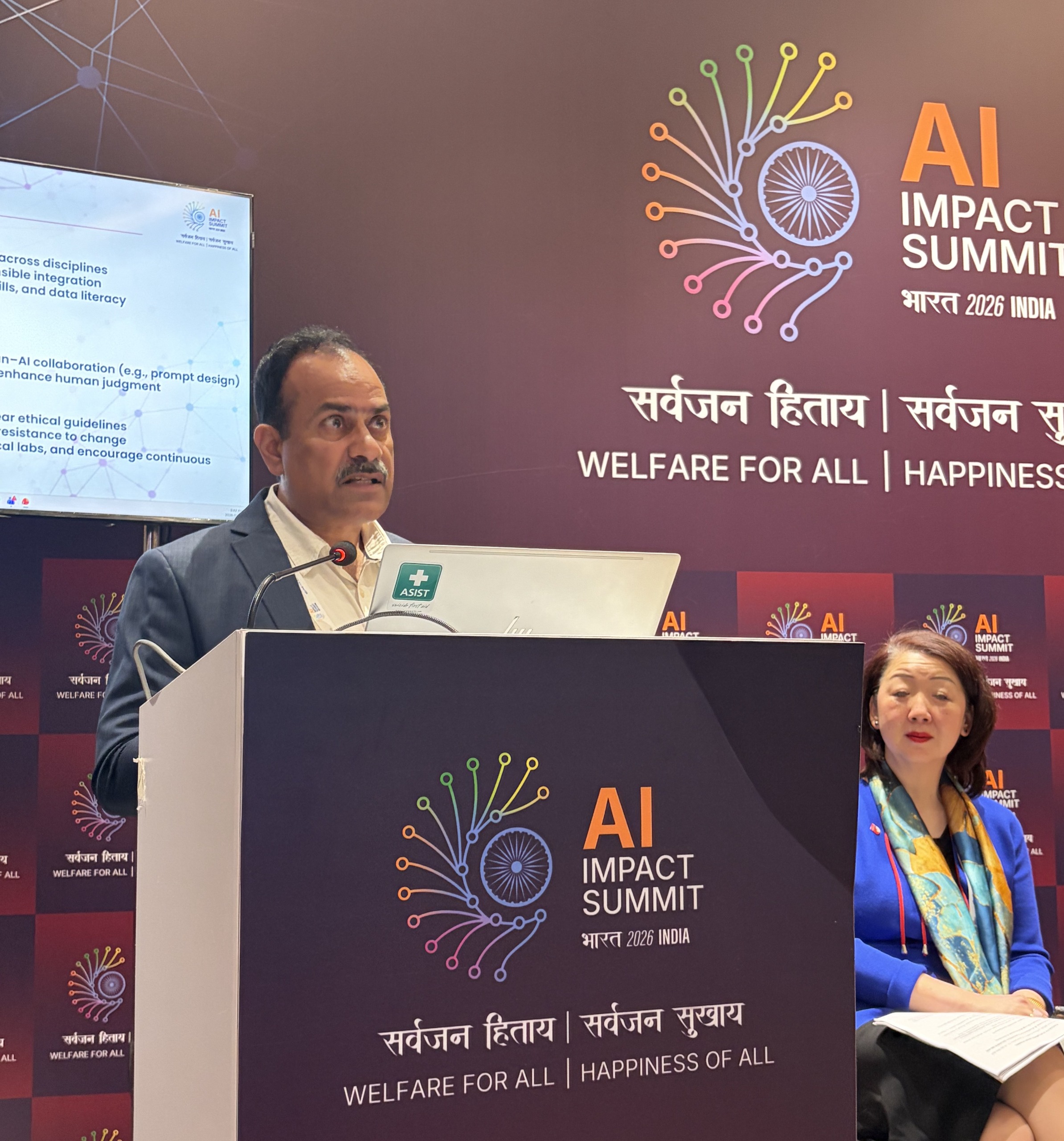
Unnao: “The right use of Artificial Intelligence is that which strengthens human thinking and decision-making. Ethical AI integration, domain expertise, data literacy, and continuous professional development will ensure that AI strengthens, rather than replaces, human judgment. In the education system of 2035, teachers will work alongside AI to shape the future.” This was stated by Prof. (Dr.) Thipendra P. Singh, Pro-Vice Chancellor, Chandigarh University, Uttar Pradesh, while addressing the India AI Impact Summit 2026 held at Bharat Mandapam in New Delhi.
In an era of rapid technological transformation, Artificial Intelligence has not only become an integral part of daily life but has also emerged as a focal point of global strategic competition. While technologically advanced nations are reassessing their strategic positioning in AI, India continues to establish new benchmarks and assert its presence on the global stage. Hosted by India in the national capital, the India AI Impact Summit 2026 marks the first global AI summit to be organized in the Global South, drawing significant international attention.

Demonstrating its academic and research strength at this prestigious platform, Chandigarh University, Uttar Pradesh, India’s first AI-augmented multidisciplinary university, participated actively and took the canter stage in the summit. Under the theme “Faculty Futures 2035”, Prof. (Dr.) Thipendra P. Singh presented a Global Roadmap for Human-Centred AI Education, highlighting the evolving and critical role of universities in AI-supported higher education. The expert session underscored the need to redefine faculty roles amid the growing influence of AI and digital technologies and called for a global direction to embed human-centred AI principles in higher education systems. Emphasis was laid on structured faculty upskilling and training, along with promoting ethical and inclusive use of AI in curricula to ensure responsible deployment of technology. Meaningful discussions were also held to strengthen academic collaboration among India, Canada, and Australia.
It is noteworthy that Chandigarh University, Uttar Pradesh, had earlier hosted three official pre-events of the summit in the month of January 2026, contributing significantly to the intellectual groundwork of the global gathering. The summit witnessed extensive deliberations by policymakers, academicians, and technology experts from India and abroad on the future, challenges, and opportunities of AI. The international forum brought together leaders from over 20 countries, delegations from more than 45 nations, senior officials from the United Nations and other global organizations, as well as over 100 academic leaders, policymakers, technologists, and institutional representatives. The special session on the Global Roadmap for Human-Centred AI Education featured international academic leaders and AI experts who engaged in in-depth discussions on the changing role of faculty in AI-driven academic ecosystems.
Chandigarh University, Uttar Pradesh, was represented by Prof. (Dr.) Thipendra P. Singh, Pro-Vice Chancellor; Dr. Ajay Kumar Singh, Head, School of Computer Science and Engineering; Dr. Amit Kumar Mishra, Program Coordinator, School of Computer Engineering; and Dr. Vikash Kumar Mishra, Program Co-Coordinator, School of Computer Engineering. The distinguished international panel included Dr. Sandra Song, Dean, School of Arts, Science and Technology, and Dr. Sana Jamil, Educational Technologist from University Canada West (Canada), along with Dr. Pranil Prasad, Dean, and Dr. Amandeep Sehmi from Canterbury Institute of Management (Australia).

The deliberations focused on redefining faculty roles in the context of rapid AI and digital transformation and on developing a comprehensive global roadmap to embed human-centred AI principles within higher education systems. The session highlighted the importance of structured faculty capacity building, continuous professional development in AI competencies, and the integration of ethical, inclusive, and responsible AI practices into academic curricula.
During the main event at Bharat Mandapam, Prof. (Dr.) T.P. Singh elaborated on Chandigarh University’s academic and research ecosystem, noting that expert faculty members are actively engaged in areas such as AI, Data Science, Biotechnology, and Computational Science. He highlighted the Chandigarh University’s strong research culture, international collaborations, and Centres of Excellence such as CAIRA and CRADLE, which are working in emerging domains including computer vision, natural language processing, robotics, healthcare, finance, and AI governance. Referring to the roundtable discussion held on January 24, 2026, he observed that the role of teachers in AI-based education systems is undergoing continuous transformation.
Concluding his address, Prof. (Dr.) Singh recommended that institutions invest in robust AI infrastructure, implement structured faculty training programmes, and establish clear ethical guidelines. He underscored the importance of integrating AI literacy into curricula and creating enabling ecosystems that promote innovation while safeguarding academic values and integrity.




 ---------------------------------------------------------------------------------------------------