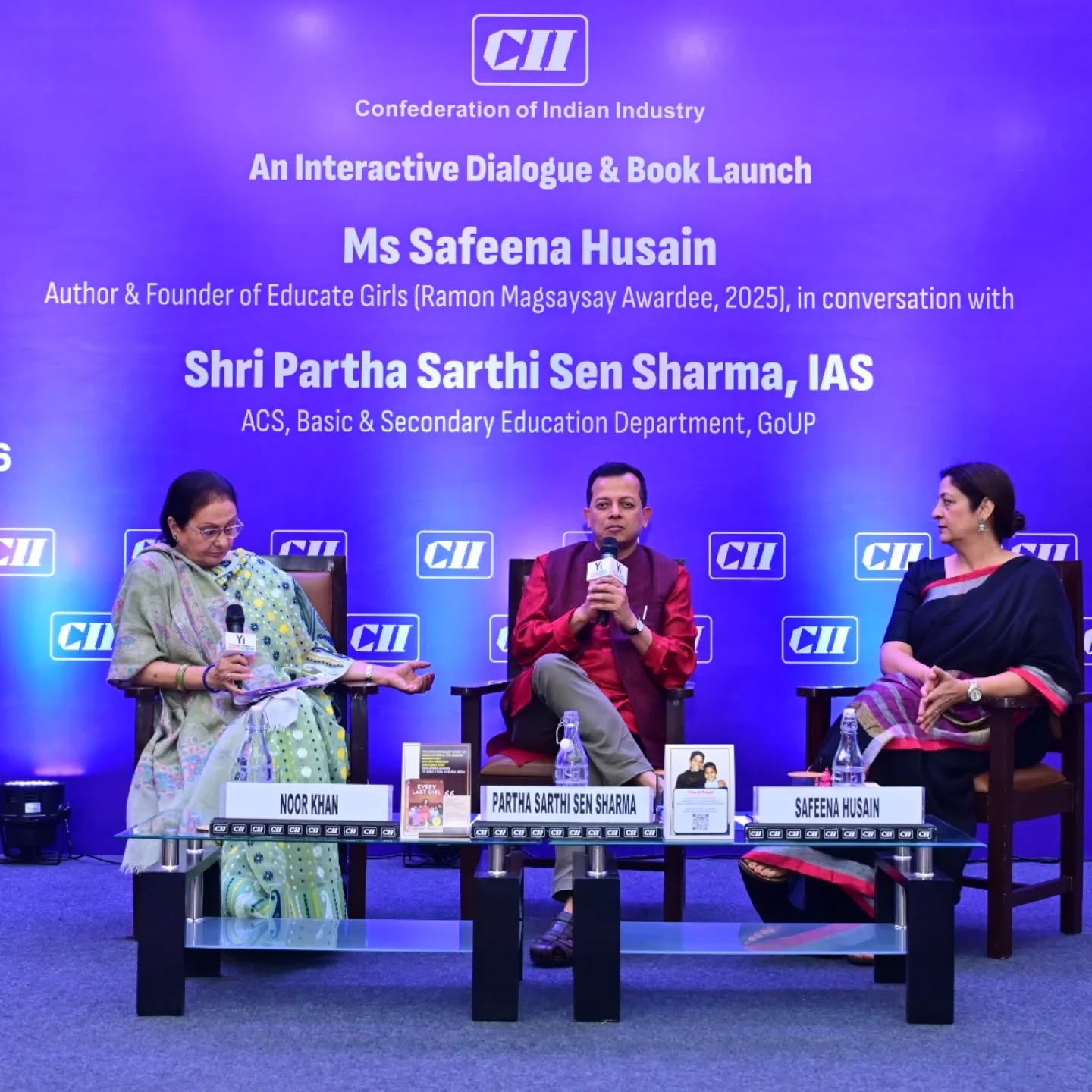
Lucknow: In an age where progress is often measured by cold spreadsheets and shifting decimal points, a recent gathering at the Confederation of Indian Industry (CII) offered something far more profound: a soul. Hosted in collaboration with Lucknow Bioscope, the evening marked the launch of Every Last Girl: A Journey to Educate India’s Forgotten Daughters, a book that serves as both a roadmap of past victories and a manifesto for the work yet to be done.
The air in the room was thick with the weight of “forgotten stories” as Safeena Husain, the visionary founder of Educate Girls, sat down with Partha Sarthi Sen Sharma (IAS), Additional Chief Secretary, Government of Uttar Pradesh. Moderated by the seasoned educationist Dr. Noor Khan, the dialogue bridged the gap between state-level policy and the dusty trails of rural India.

From a Spark in Rajasthan to a 30,000-Village Flame
The narrative of Educate Girls is a classic “feature” story of scale and grit. What began as a modest intervention in 2007 in Rajasthan has morphed into a staggering grassroots movement. Today, a small army of 55,000 volunteers, known as Team Balika, operates across 30,000 villages. Their singular mission? Ensuring that the two million girls who slipped through the cracks of the education system find their way back to a classroom.
This relentless pursuit of “the last girl” culminated in a historic milestone in 2025. Educate Girls became the first Indian organization to receive the Ramon Magsaysay Award, often referred to as Asia’s Nobel Prize. For Husain, the award wasn’t just a trophy; it was a megaphone.
“It is our responsibility to put out our voice and celebrate the progress that has been made,” Husain shared during the event. “Our vision is to reach 10 million learners by 2035. If girls do not complete their 10th grade, they are excluded from the economic circle. We must bridge that gap.”

The Parity Paradox
The evening took a fascinating turn when Mr. Sharma provided the macro perspective. He noted that over the last 50 years, India’s Gender Parity Index has climbed from a staggering 60 to a perfect 100. Yet, he warned against the “anesthesia” of statistics.
“The macroscale data does not show the stories,” Sharma observed. “It is important to listen to stories, build on them, and use those stories to make new stories.” His point was clear: while the numbers say we have reached parity, the lived reality for adolescent girls in marginalized pockets of Uttar Pradesh or Bihar tells a different, more nuanced tale.
The Catch-22 of the Second Chance
Dr. Noor Khan underscored the urgency, noting that while enrollment is at an all-time high, retention—the act of keeping a girl in school through her teen years—remains the true frontier. This is where the book, and the organization, find their purpose. Through “second-chance” programs, they are helping young women complete Grades 10 and 12, effectively preventing them from falling into a lifelong “economic black hole.”
As the evening concluded, the consensus among the industry leaders and educators was unanimous: educating the “last girl” isn’t just a charitable act—it is an economic necessity for a nation aiming for global leadership.







 ---------------------------------------------------------------------------------------------------