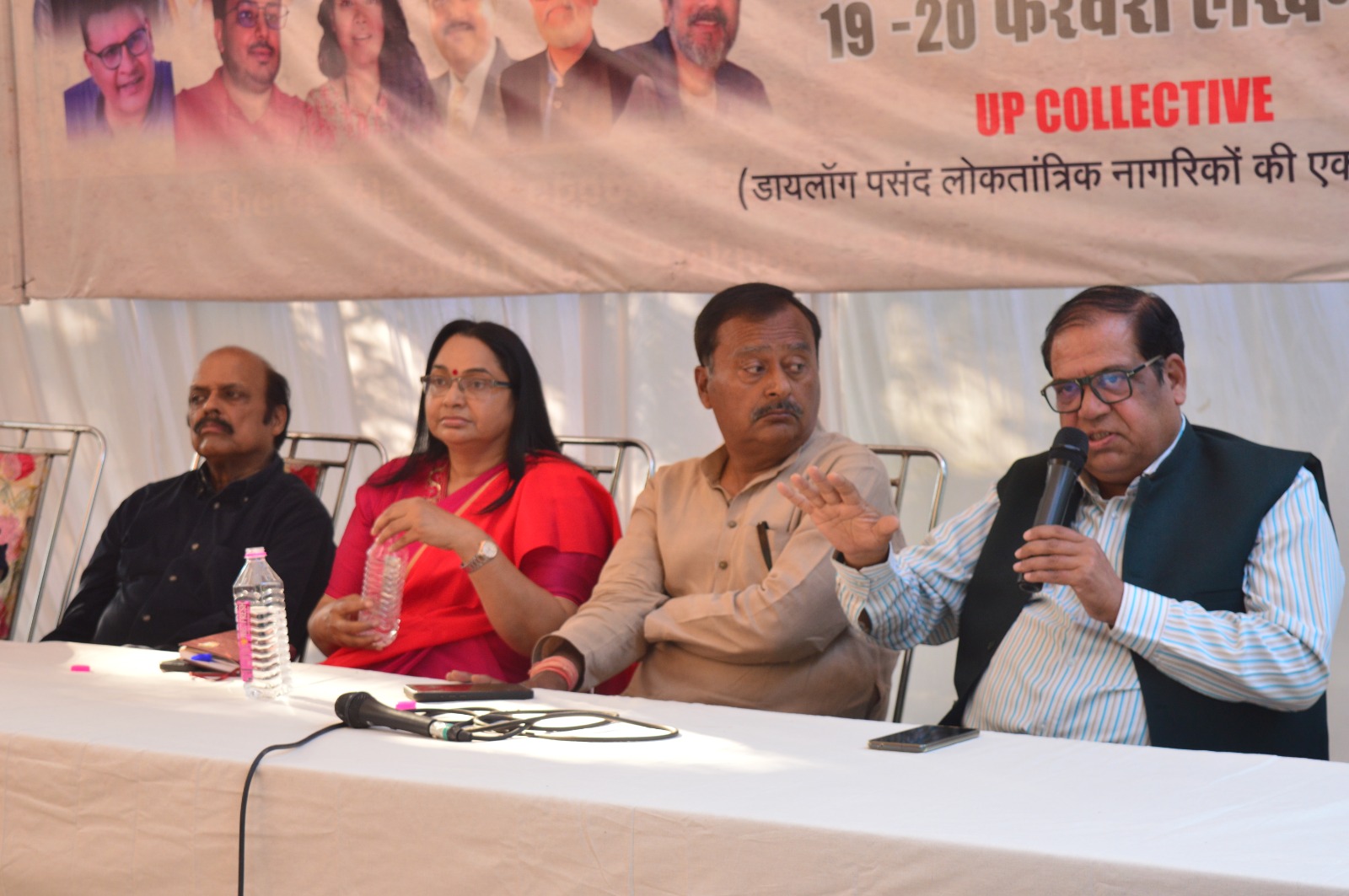
Lucknow: The second day of the Social Justice Conclave was held at the IPTA Campus, 22 Kaiserbagh (behind Amiruddaula Library), witnessing vibrant participation and wide-ranging discussions on pressing national issues concerning youth, history, journalism and democracy.
Youth: Challenges and Hopes
The opening session, titled “Youth: Challenges and Hopes,” focused on the role of young people in contemporary politics and social movements. Mahendra Kumar, associated with the Chhatra Mahasabha, expressed concern that many youths are being drawn toward harmful habits and regressive ideologies. He remarked that universities remain one of the last active spaces of opposition in the country.

Shantam Shantam from All India Students Association (AISA) highlighted the prevalence of caste-based discrimination and harassment on university campuses, alleging administrative inaction and lack of police response in addressing such issues.
History, Literature and the Politics of Narratives
The second session, “History–Literature in an Era of Myths and Misinformation: The Way Forward,” brought together writers, journalists and activists including Rajiv Dhyani, Raghvendra Dubey, Vandana Mishra, Rajiv Nigam and Professor Roop Rekha Verma. Speakers voiced concern over the reinterpretation of history and the growing influence of distorted narratives that risk deepening social divisions.
Journalist Raghvendra Dubey emphasized that individuals seek identity through history and warned of grave consequences if historical narratives are manipulated. Rajiv Dhyani noted that groups promoting divisive agendas are technologically more advanced in spreading their message. Rajiv Nigam observed that both ruling and opposition parties appear apprehensive—each wary of confronting issues of social justice.
Vandana Mishra cautioned against relying solely on social media as a tool for social justice struggles, describing it as primarily a personal platform. Professor Roop Rekha Verma urged participants to take the fight for social justice to the streets, even if it entails risks.
Journalism in the Storm of Capital
The third session, “Truth of Journalism Amid the Storm of Capital,” examined media independence, freedom of expression and corporate influence. The panel featured journalists Shararat Pradhan and Juhi Singh, Congress spokesperson Surendra Rajput, and Siddharth Kalhans. Speakers stressed that fearless and people-centric journalism is essential for a healthy democracy.
Sharat Pradhan stated that journalism and journalists operate under constant pressure. Juhie Singh said the opposition must engage civil society more actively to amplify public voices. Siddharth Kalhans argued that the survival of mainstream media, despite declining credibility, is largely sustained by continued funding that enables narratives to be shaped and disseminated.

Special Lecture: The Himalayan Concern
At 3:30 pm, noted academic Shekhar Pathak delivered a special lecture titled “Concern for the Himalayas is Concern for the Entire Nation.” He warned that environmental neglect, climate change and socio-cultural disruptions in Himalayan regions would have far-reaching consequences for the entire country.
Democracy, Diversity and the Idea of India
The fourth session, “Whose Country Is This? Or Does It Belong to All?” sparked deep reflection on democratic values, equality and pluralism. Eminent writer Subhash Kushwaha remarked that while Adivasis are the original inhabitants of the land, a nation ultimately belongs to those who sacrifice to build it. “The struggle will continue until equality is achieved,” he said.
Renowned anthropologist Professor Nadeem Hasnain underlined that the core of the “Idea of India” lies in diversity and plurality. He stressed that India’s strength rests in its languages, cultures and traditions, not uniformity. Former Education Minister Professor Masood echoed the sentiment, stating that inclusive progress is the only path to genuine national development.
Senior journalist Arvind Kumar Singh reflected on how electoral strategies and communication platforms globally shape politics and media, emphasizing the complex and influential relationship between media institutions and political power.
The conclave concluded with former MLC Shashank Yadav leading the gathering in reading the Preamble to the Constitution, with attendees collectively reaffirming its principles.
Organisers from the Social Justice Conclave Committee appealed to citizens, students, intellectuals and social activists to actively participate and strengthen this ongoing dialogue on justice, democracy and inclusive nation-building.