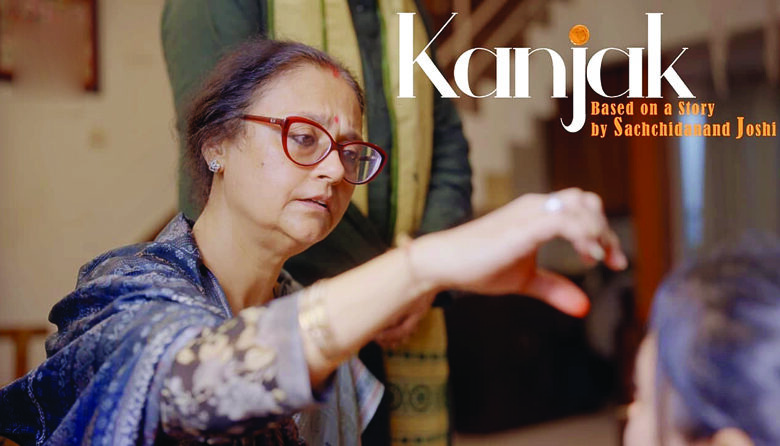
Mumbai: For Hindus, Navratri is not merely a festival but a deeply rooted emotional and spiritual experience woven into the fabric of Indian culture. Celebrated twice a year, the festival culminates on Ashtami or Navami with Kanjak or Kanya Pujan—a ritual where nine young girls and a boy are invited into homes, worshipped as living embodiments of Goddess Durga, offered puri, halwa and chana, and given gifts as a mark of devotion and gratitude toward feminine power.
While the ritual is sacred and heartwarming, it also carries subtle social complexities. These layered realities are sensitively portrayed in the short film Kanjak: The Girl Without a Name, based on a story by Sachchidanand Joshi and directed by Rahul Yadav. Set in a middle-class household in Delhi during Durga Puja, the film presents a moving narrative that lingers long after it ends.

The story revolves around a respected and devout woman affectionately called “Aunty,” portrayed with depth and sincerity by Malavika Joshi. She meticulously prepares for Kanya Pujan, determined to uphold every detail of tradition. However, chaos unfolds on the morning of the ritual—her domestic help fails to arrive, essential items go missing, and tension builds within the household.
Through these everyday disruptions, the film subtly highlights a deeper truth: women often bear the invisible burden of preserving cultural and religious traditions. What begins as light domestic confusion gradually transforms into a reflection on responsibility, faith and social expectations.
At the height of the turmoil, a mysterious young woman known simply as “Didi,” played by Savleen Kaur, arrives unexpectedly—accompanied by exactly nine girls. Calm and self-assured, she restores order, finds the missing items, comforts Aunty and ensures the ritual proceeds smoothly. The tense atmosphere shifts into warmth and celebration as the girls laugh, sing and participate joyfully.
Yet amid the festivities, Didi voices a piercing truth: “We have polluted our rivers.” Her comment subtly references how post-ritual offerings are often immersed in the Yamuna River, contributing to environmental degradation. The statement prompts an uncomfortable but necessary question—can rituals performed without responsibility truly honor the divine?

The film takes a spiritual turn as the ceremony concludes and the bhajan of Kabir plays softly in the background: “Moko kahan dhoonde re bande, main to tere paas mein.” The message becomes clear—divinity is not confined to elaborate rituals or distant idols but resides in compassion, empathy and human connection.
Without resorting to dramatic excess, the film introduces a powerful twist regarding Didi’s identity, elevating the narrative from social realism to spiritual symbolism. “The girl without a name” becomes a metaphor for the overlooked purity and humanity we often fail to recognize.
Rahul Yadav’s direction balances humor, tenderness and philosophical depth. The pacing is crisp, performances natural, and storytelling understated yet impactful. Malavika Joshi beautifully captures Aunty’s journey from anxiety to revelation, while the child actors bring authenticity and innocence to the screen.
More than a festival-themed short, Kanjak: The Girl Without a Name is a gentle reminder that true devotion lies not in rigid ritual but in kindness and awareness. In an age where festivals can become performative spectacles, the film calls viewers back to the essence of faith—finding the divine not in grandeur, but in humanity itself.