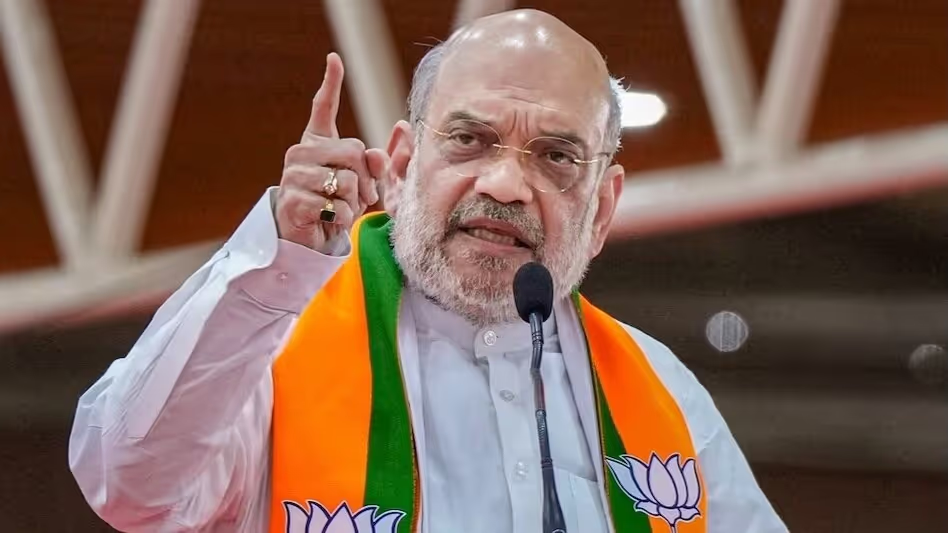
New Delhi – Union Home Minister Amit Shah on Monday announced an ambitious roadmap to strengthen India’s internal security, stating that terrorism in Jammu and Kashmir and insurgency in the North-East will be fully eradicated by 2029, while Maoist violence is targeted to end by March 31, 2026.
He made the remarks while addressing the 79th foundation day celebration of the Delhi Police in the national capital.

Expansion of Safe City Surveillance
Highlighting steps to modernize policing in Delhi, Shah announced a major expansion of the Safe City project. Around 2,100 artificial intelligence-enabled cameras will soon become operational, forming part of a broader 10,000-camera network. Additionally, nearly 15,000 existing cameras across the city are being integrated into a unified monitoring system.
He said the newly upgraded Special Cell headquarters of Delhi Police will strengthen counter-terror coordination and intelligence-sharing capabilities.
Progress Against Maoist Violence
Reviewing the security landscape prior to 2014, Shah said large areas of the country — including Jammu and Kashmir, parts of the North-East, and Maoist-affected districts — faced serious internal security challenges.
According to him, nearly 80 percent of those issues have now been brought under control. He expressed confidence that ongoing security operations and development programs will eliminate Maoist violence nationwide by March 2026.
Peace Initiatives in the North-East
The Home Minister noted that nearly 20 peace accords have been signed with insurgent groups in the North-East over recent years. More than 10,000 former militants have surrendered and joined mainstream society, contributing to a significant decline in violence.
He described these agreements as transformative for the region’s stability and economic prospects, reiterating that long-standing insurgency in both Jammu and Kashmir and the North-East is expected to end by 2029.

Referring to the abrogation of Article 370, Shah said the security situation in Jammu and Kashmir has steadily improved since the constitutional change.
Delhi Police Commended
Shah praised the Delhi Police for its role in handling high-risk investigations and maintaining security in the capital. He cited major terror-related cases, including the 2001 Indian Parliament attack, as examples of the force’s preparedness and professionalism.
He emphasized that continued modernization efforts will further enhance law enforcement’s ability to address emerging threats.
Criminal Law Reforms and Conviction Rates
The Home Minister also highlighted the introduction of three new criminal laws aimed at modernizing India’s justice system and improving investigative efficiency. The government, he said, is targeting a conviction rate of 75–80 percent through streamlined procedures and stronger evidence collection.
States such as Assam, Haryana, and Gujarat have already reported notable improvements after adopting reform measures aligned with the new framework.
Focus on Drugs, Cybersecurity and Organized Crime
Looking ahead, Shah reaffirmed the government’s commitment to building a drug-free India, tackling cyberterrorism, and dismantling organized crime networks. He stated that several major criminal operatives have been neutralized in recent operations, while authorities continue tracking individuals operating from abroad.
With defined timelines for addressing terrorism, insurgency, and Maoist violence, the government’s internal security strategy now moves into a consolidation phase focused on modernization, coordination, and long-term stability.