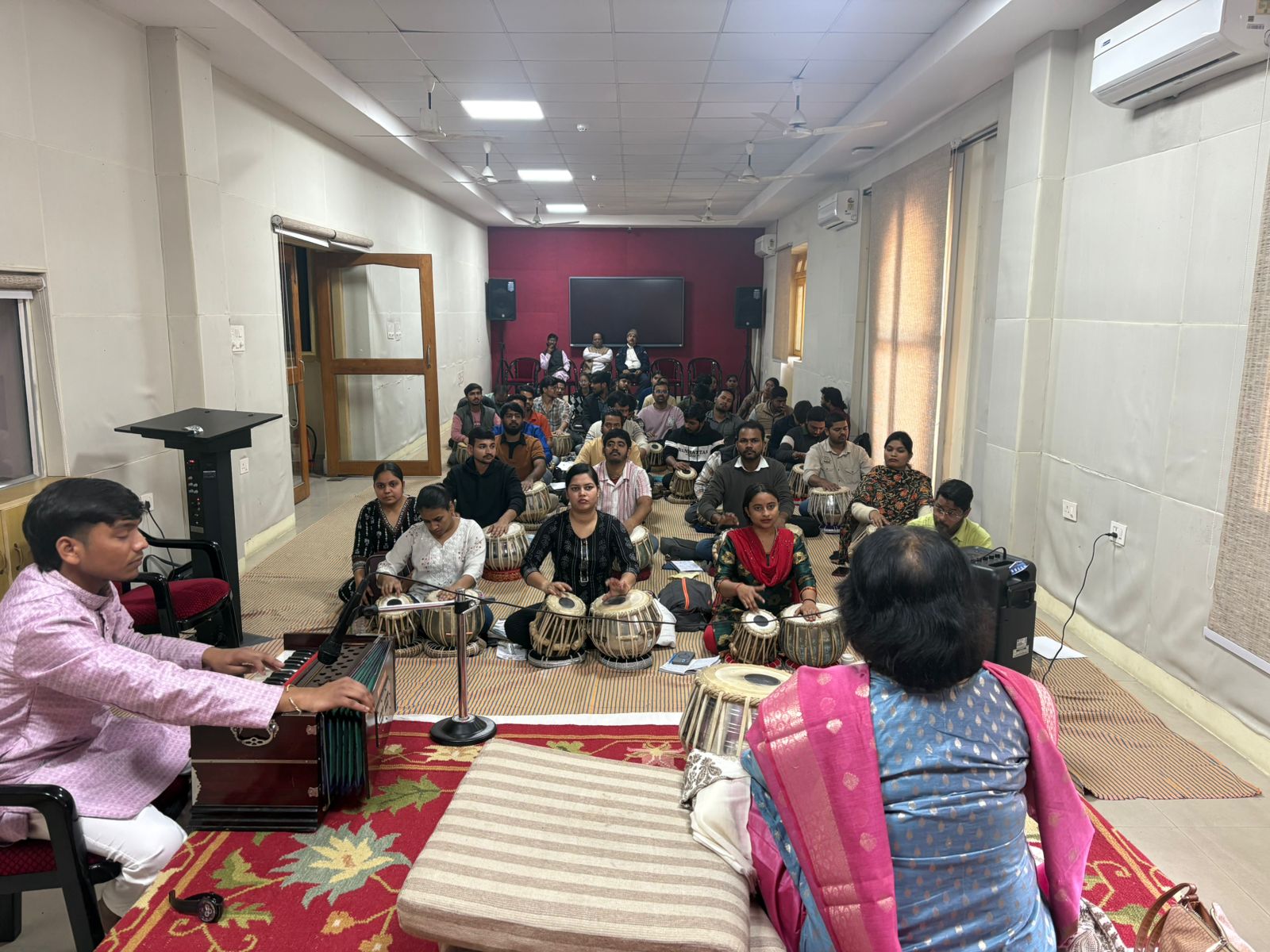
Lucknow: A two-day tabla workshop organized by the Department of Percussion under the Chair established in the sacred memory of Pandit Vishnu Narayan Bhatkhande concluded successfully at Bhatkhande Sanskriti Vishwavidyalaya, Lucknow. The workshop was held at the university’s Sujan Auditorium in a dignified and scholarly atmosphere.
The primary objective of the workshop was to familiarize students and research scholars with India’s rich rhythmic tradition, focusing particularly on the role of tabla, its technical aspects, stylistic nuances, and research-oriented dimensions within Indian classical music.
Inauguration of the Valedictory Session
The second and concluding day began with the Head of the Department of Percussion, Dr. Manoj Kumar Mishra, offering floral tributes to the statue of Pandit Vishnu Narayan Bhatkhande. Eminent expert Prof. Neelu Sharma, who served as the resource person for the workshop, was welcomed with a bouquet in the presence of faculty members, accompanists, research scholars, and students.
Insightful Academic and Practical Sessions
During the concluding session, Prof. Neelu Sharma delivered an in-depth lecture-demonstration covering various types of gats, stylistic comparisons between the Lucknow and Farrukhabad gharanas, structural analysis of different talas, and the aesthetic dimensions of solo and accompaniment performances.
She elaborated on the stylistic characteristics of traditional compositions and provided practical training on the execution of repertoire specific to different gharanas. Emphasizing the need for analytical thinking in tabla studies, she encouraged participants to rely on authentic sources and presentation-based research methodologies.
The practical sessions focused on clarity of bols (mnemonic syllables), balanced hand movement, rhythmic precision, and the sensitivity required in accompaniment. Students were guided through hands-on exercises aimed at enhancing their performance skills and technical command.

University Leadership Applauds Initiative
Vice-Chancellor Prof. Mandavi Singh remarked that tabla holds a significant place in Indian classical music and that such workshops help students develop practical expertise, creativity, and a research-oriented perspective. She added that these initiatives also enable learners to understand the balance between tradition and modernity in contemporary music education.
Registrar Dr. Srishti Dhawan informed that under the Chair established in memory of Pandit Bhatkhande, the university will continue to organize lecture series, seminars, workshops, music and dance performances, and research-driven programs throughout the year. These efforts aim to strengthen music education, promote research, and foster cultural dialogue with society.
Participants Express Gratitude
Participants described the workshop as highly enriching and inspiring, expressing gratitude to the university for providing such a valuable learning platform. The two-day program significantly contributed to deepening students’ understanding of tabla traditions, technical proficiency, and scholarly approaches to rhythm studies.
With its blend of theory, performance, and research discourse, the workshop reaffirmed Bhatkhande Sanskriti Vishwavidyalaya’s commitment to preserving and advancing India’s classical music heritage.