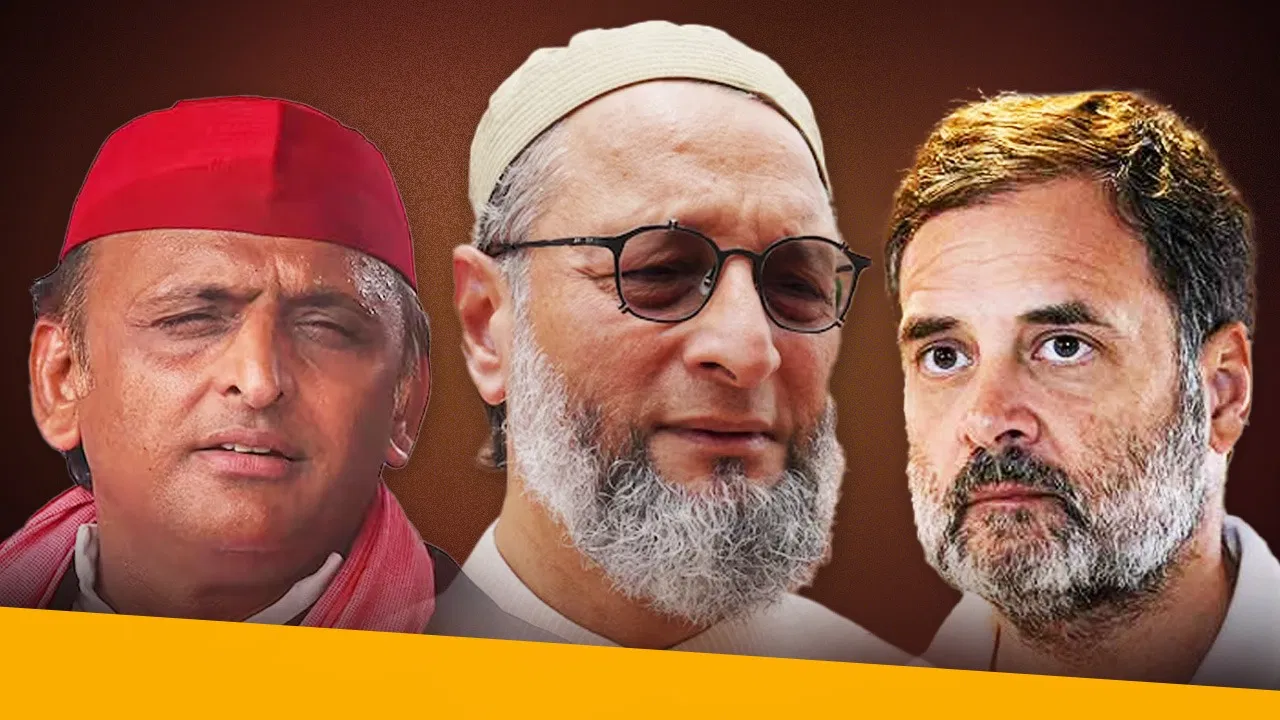
New Delhi: With the 2027 Uttar Pradesh Assembly elections on the horizon, concerns are mounting within the Samajwadi Party (SP) and the Indian National Congress over a potential division of Muslim votes due to the expanding presence of Asaduddin Owaisi and his party in the state.
Muslim voters, who constitute nearly 20 percent of Uttar Pradesh’s population, have historically played a decisive role in shaping electoral outcomes. Of the state’s 403 Assembly constituencies, over 125 are considered significantly influenced by Muslim voters, with around 70 seats having more than 30 percent Muslim electorate. Traditionally aligned with the Congress, the community gradually shifted its support to the Samajwadi Party and, to some extent, the Bahujan Samaj Party (BSP), particularly after the Congress weakened in the state.
In the 2022 Assembly elections, the bulk of Muslim votes consolidated behind the SP, although the BSP also secured a share. However, recent municipal elections signaled a shift in voting behavior, with Muslim voters backing candidates based on local factors rather than rallying uniformly behind a single party. In parts of western Uttar Pradesh, candidates from smaller parties reportedly outperformed SP and BSP nominees in Muslim-dominated pockets.
The rise of Owaisi’s All India Majlis-e-Ittehadul Muslimeen (AIMIM) has added a new dimension to the political calculus. After winning five seats in Bihar Assembly elections in previous years, AIMIM has intensified its focus on Uttar Pradesh. The party had earlier announced plans to contest around 100 seats and is now reportedly preparing to field candidates in nearly 200 constituencies for the 2027 polls, dividing the state into strategic zones.
Western UP districts such as Saharanpur, Moradabad, Rampur, Sambhal and Bareilly — all with sizeable Muslim populations — are seen as areas where AIMIM is attempting to expand its base. Its improved performance in recent local body elections has further heightened concerns among opposition parties.
The issue reportedly figured in recent internal discussions within the SP, where some leaders cited examples from Bihar and Maharashtra, suggesting that ignoring Owaisi’s presence could prove costly. While senior SP leader Shivpal Yadav has dismissed alliance speculation, strategic deliberations for “Mission 2027” are said to be underway.

Congress president Mallikarjun Kharge has also indirectly signaled unease. A viral video showing him in conversation with party MP Imran Masood, where he appeared to caution against a “Hyderabad problem” entering Uttar Pradesh, has sparked political debate, with observers interpreting it as a veiled reference to Owaisi.
Political analysts suggest that if AIMIM manages to secure even five to ten seats, as it did in Bihar, it could significantly dent the SP’s prospects in Muslim-dominated constituencies. The Congress, already weakened in the state, may face further marginalization. Meanwhile, the BSP’s recent focus on Brahmin outreach is seen as having reduced its traditional Muslim appeal.
Without a pre-poll alliance, a three-way split in Muslim votes among SP, Congress and AIMIM could indirectly benefit the BJP in tightly contested seats. However, recent trends indicate that Muslim voters are increasingly pragmatic, often prioritizing local issues, development and candidate credibility over blanket political alignments.
As Uttar Pradesh moves closer to 2027, the evolving dynamics of Muslim electoral behavior may well determine the state’s political trajectory, potentially reshaping alliances and strategies across party lines.