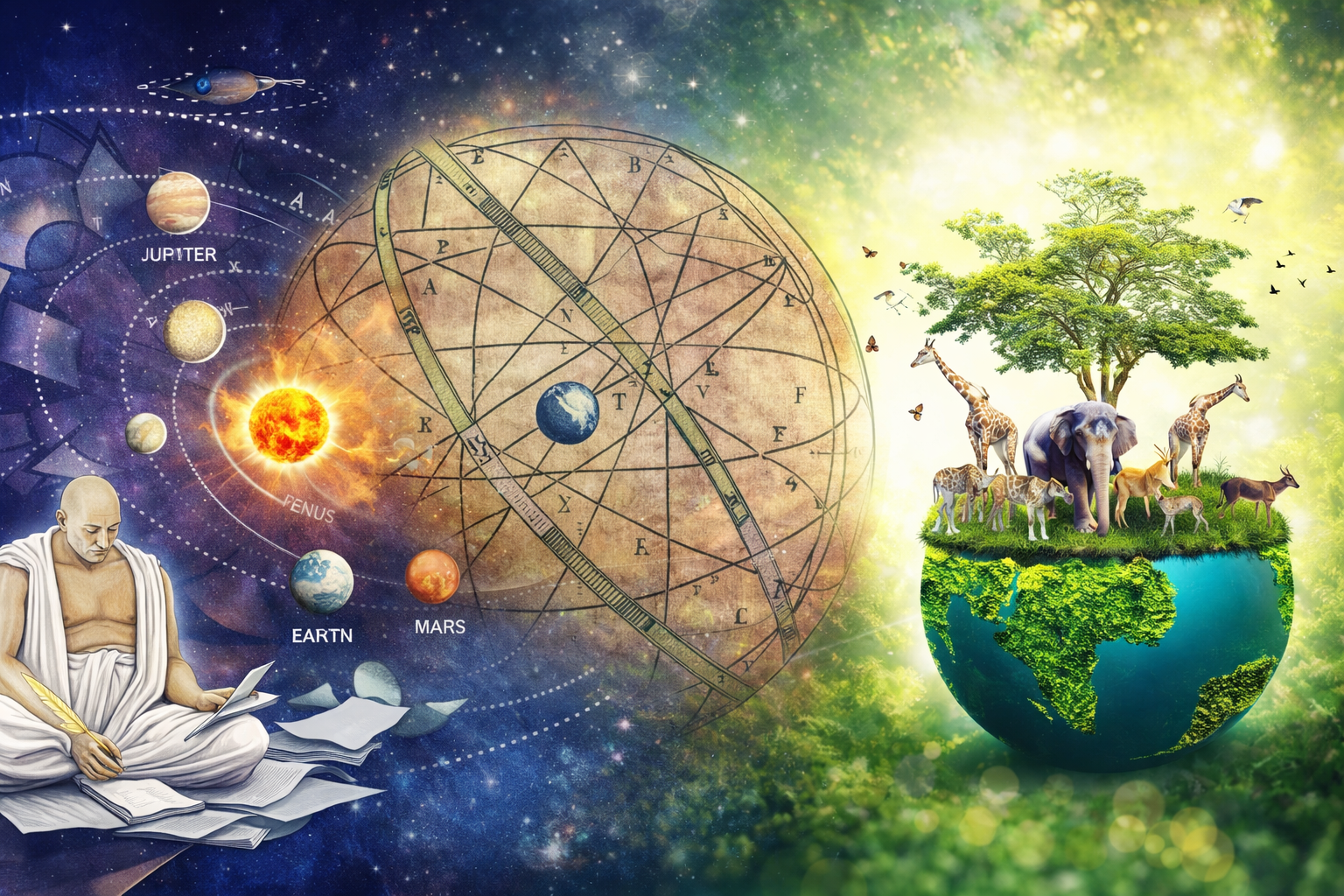
We will now explore the comparative analysis of scientific traditions and the exchange of scientific knowledge between civilizations, particularly between the Western world and India. We will examine how both Indian and Greco-European traditions approached science, and how this influenced their astronomical, mathematical, and physical inquiries.
Throughout history, civilizations have exchanged knowledge in astronomy, mathematics, and medicine. Indian scholars, renowned for their pragmatic approach to science, shared insights with their counterparts in Greece, the Islamic world, and later Europe, significantly influencing the scientific traditions in both India and the West.
Indian scientists, especially astronomers, focused on practical and accurate computational methods rather than constructing philosophical or cosmological models to represent the heavens. Their goal was clear: highly empirical and open-ended, to calculate planetary positions with precision for calendrical computations and religious observances. They continuously updated their calculations based on new observations, evident in the works of Aryabhata and Brahmagupta.
In contrast, the Greco-European scientific tradition, particularly in ancient Greece, was driven by a quest for eternal, unchanging and undeniable truths. Plato and Aristotle, emphasized the need for abstract, immutable laws that governed the cosmos. This outlook shaped the development of Greco-European astronomy, where theoretical constructs were treated as representations of physical reality.
For instance, Plato’s Republic emphasizes that true knowledge comes from studying eternal truths, not the perishable, transient world. Astronomy, in this context, was seen as a means to understand the divine and unchanging nature of the cosmos, far removed from the practical concerns of observable reality. Similarly, Aristotle’s division of philosophy into Physics, Mathematics, and Theology, as discussed by Claudius Ptolemy reflects this hierarchy of knowledge, where mathematical astronomy, dealing with the “eternal things” beyond the lunar sphere, was considered the most exact and noble pursuit.
The quest for eternal laws that governed the cosmos continued into the early modern period, influencing the work of scientists such as Copernicus, Kepler, and Newton. Their search for immutable “laws of nature” was grounded in the belief that these laws reflected divine commands, a concept deeply rooted in Western theological ideas. Joseph Needham in his Science and Civilisation in China, notes that this idea of divine laws governing both natural and human realms was absent in Chinese civilization, and, by extension, in Indian thought as well.

The Western ethos generally views science and technology as tools of dominion over nature; in 1967, Lynn White, a scholar of medieval history, argued that modern science and technology arose from Judeo-Christian attitudes towards the relationship between humanity and nature:
“[We] should try to clarify our thinking by looking in some historical depth at the presuppositions that underlie modern technology and science. … Our daily habits of action are dominated by an implicit faith in perpetual progress, a concept rooted in Judeo-Christian theology and largely foreign to the Greco-Roman and Oriental traditions. This belief system posits that all creation exists for the benefit of man, as reflected in Biblical narratives where man, created in the image of God, holds dominion over nature.”
White’s article highlighted how Christianity, particularly in its Western form, positioned humanity as superior to nature, justifying its exploitation for human purposes and noted that this anthropocentric worldview also permeated Marxism, Islam, and secular ideologies, all sharing a common lineage. White critiqued the widespread belief that humanity is distinct from and superior to nature, fostering attitudes that degrade the environment: “Man is made in God’s image, and thus not merely part of nature. Christianity insists that man’s role is to exploit nature for his own ends, a view profoundly different from ancient paganism and most Eastern religions.”
Indian Knowledge Systems on the other hand take a holistic view of the inter-dependence of all creatures in the cosmos. and teaches sustainability in human activity. The Taittiriya Upanishad, one of the core texts of Indian knowledge systems, offers a profound view of the relationship between scientific knowledge (vijnana) and the broader purpose of life. It teaches that the primary function of vijnana (science, or specialized knowledge) is to manifest yajna, which refers to both ritual sacrifice and a deeper principle of creating, sustaining, and sharing abundance. The sentence “विज्ञानंयज्ञंतनुते, कर्माणितनुतेऽपि च” explains that scientific knowledge (vijana) manifests yajna and the actions (karma) that sustain it.
Science and technology, according to IKS, are not just tools for exploitation but are disciplines that should enhance the well-being of all living beings and the environment. The goal is to maintain the cycles of creation and regeneration, ensuring that resources are used wisely and shared equitably, thus fostering sustainability.