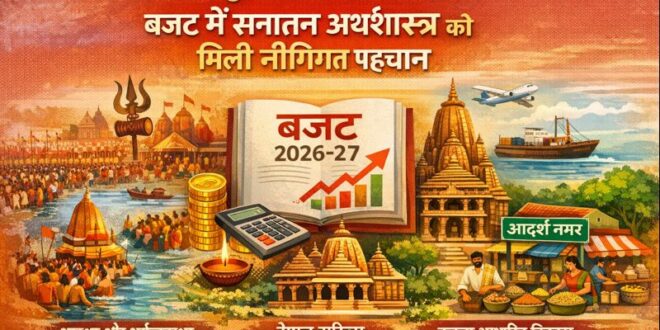
Lucknow: The significant economic outcomes emerging from the Maha Kumbh and its contribution to the Gross Domestic Product (GDP) have prompted the Union Government to take a fresh look at India’s traditional economic framework. For the first time, the Union Budget 2026–27 reflects clear policy recognition of India’s Sanatan economic model—rooted in festival-driven activity, temple tourism and town-based economies. This signals that India’s development journey is no longer confined to industries and metropolitan cities, but is increasingly drawing strength from its cultural and civilisational foundations.
Maha Kumbh: A Large Economic Model Rooted in Faith
According to Pankaj Jaiswal, President of UPDF, the successful organisation of the Maha Kumbh under the leadership of Chief Minister Yogi Adityanath demonstrated that faith-based events are not merely religious gatherings but powerful economic catalysts. During the Maha Kumbh, the Prayagraj–Kashi–Ayodhya circuit witnessed a surge in hotels, transport services, local trade, temporary and permanent employment, healthcare services and logistics—together forming a robust economic ecosystem. This experience helped policymakers understand that faith-based events can energise the economy down to the grassroots level.
City Economic Regions to Empower Towns
The Budget’s announcement to develop Tier-2 and Tier-3 cities as City Economic Regions (CERs) is being seen as an extension of Chief Minister Yogi Adityanath’s vision of “developed towns.” Historically, towns formed the backbone of India’s supply chains for centuries. Strengthening towns will directly benefit surrounding villages, farmers, artisans and traders by providing local markets and economic opportunities. These towns are also expected to emerge as fulfilment centres for larger cities, reinforcing the middle layer of the economy and ensuring that the benefits of development reach the last mile.
Uttar Pradesh, with the highest number of towns and urban clusters in the country, is likely to be the biggest beneficiary of the City Economic Region model.
‘Temple City’ Mention in Budget Seen as Historic
Another major takeaway from the Maha Kumbh experience is the historic inclusion of the term “Temple City” in the Union Budget speech for the first time. Traditionally, temple towns have been central to India’s economic life. Religious tourism has long been the foundation of Indian travel, naturally integrating trade, cultural exchange and social interaction. The success of the Prayagraj–Kashi–Ayodhya circuit has shown that planning around temple cities can drive holistic development of thousands of towns and small cities across the country.

Uttar Pradesh to Gain the Most from Sanatan Economics
The policy shift towards Sanatan economics is expected to benefit Uttar Pradesh the most. Major spiritual and cultural centres such as Mathura, Kashi, Ayodhya, Prayagraj, Naimisharanya, Gorakhnath, Hastinapur, Sarnath and Kushinagar are all located in the state. Focused development of tourism, services, local products and infrastructure in these regions is expected to provide long-term strength to the state’s economy.
Inland Waterways to Revive River-Based Economy
The Budget’s announcement to further develop the inland waterway between Varanasi and Patna is set to make logistics in Uttar Pradesh more affordable and efficient. This move is expected to revive the river-based economy. With the country’s largest network of rivers—including the Ganga, Yamuna, Ghaghara and Rapti—Uttar Pradesh is well positioned to play a leading role in inland water connectivity alongside road, rail and air transport.
Overall, the Union Budget 2026–27 indicates that in the coming years, Uttar Pradesh could emerge as the nucleus of India’s new development model, driven by Sanatan economics, town-centric growth and temple tourism—blending tradition with modern economic planning.