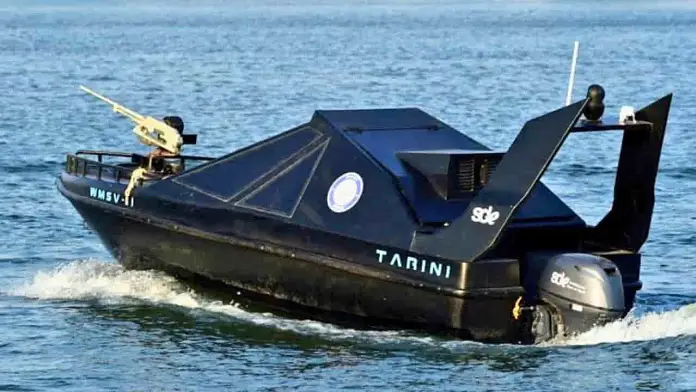
New Delhi | The Indian Navy has begun inducting the country’s first indigenously developed armed unmanned fast interceptor craft, marking a significant leap in autonomous naval warfare and coastal security capabilities. The first batch of these advanced unmanned platforms has been delivered by Pune-based defence startup Sagar Defence Engineering, with two units already earmarked for deployment along India’s western seaboard.
Designed, developed and manufactured entirely in India, the unmanned interceptor craft represent a transformative shift in the Navy’s operational doctrine. With their induction, India joins a select group of nations possessing armed boat swarm technology capable of executing coordinated maritime operations without onboard crew.
The Indian Navy had placed an order for 12 such unmanned interceptor craft in January 2022. Deliveries will continue in a phased manner under the same contract. These platforms are expected to play a critical role in coastal surveillance, rapid interdiction of suspicious vessels, and high-risk maritime missions.
Advanced Capabilities and Indigenous Technology
The unmanned interceptor craft are high-speed autonomous boats capable of operating independently or via remote control. Built to counter modern maritime threats, they are fully armed and optimized for combat, interception, intelligence gathering, and surveillance roles.
One of the standout features of the system is its ability to function effectively in GPS-denied environments. Even if enemy forces attempt to jam satellite navigation signals through electronic warfare, the craft can continue operations using an indigenous navigation system and collision-avoidance software. This ensures reliable performance in contested and hostile maritime zones.
With an operational range exceeding 400 nautical miles and speeds of over 90 kmph, the craft offer long-endurance patrol capability of more than 48 hours. They are also equipped with self-righting technology, allowing them to recover automatically if capsized in rough sea conditions. Designed for day and night operations, the platforms can withstand high sea states and adverse weather.

Weapon Systems and Swarm Operations
The interceptor craft feature a layered weapon architecture to counter a range of threats. A stabilized remote-controlled 12.7 mm gun provides close-range firepower against fast-moving targets. The platform can also deploy short-range missiles and loitering munitions, enhancing its effectiveness against asymmetric and high-intensity combat scenarios.
A major force multiplier is the craft’s swarm capability. Multiple unmanned boats can be networked and operated together, enabling area domination, coordinated interception, and reduced risk to human personnel. The platform is reconfigurable, allowing it to be tailored for pure ISR missions or full combat roles as required.
Strategic Impact
Until now, the Indian Navy relied partially on imported unmanned surface vessels, largely limited to mine countermeasure roles. The induction of these indigenous armed interceptor craft significantly enhances India’s maritime deterrence, rapid response capability, and coastal defence posture.
The project aligns with the government’s Aatmanirbhar Bharat initiative and has been developed under the Innovations for Defence Excellence (iDEX) framework, strengthening domestic defence manufacturing and reducing foreign dependence.
As maritime security challenges grow in the Indian Ocean Region, these unmanned interceptor craft are set to become a crucial component of India’s future naval operations.