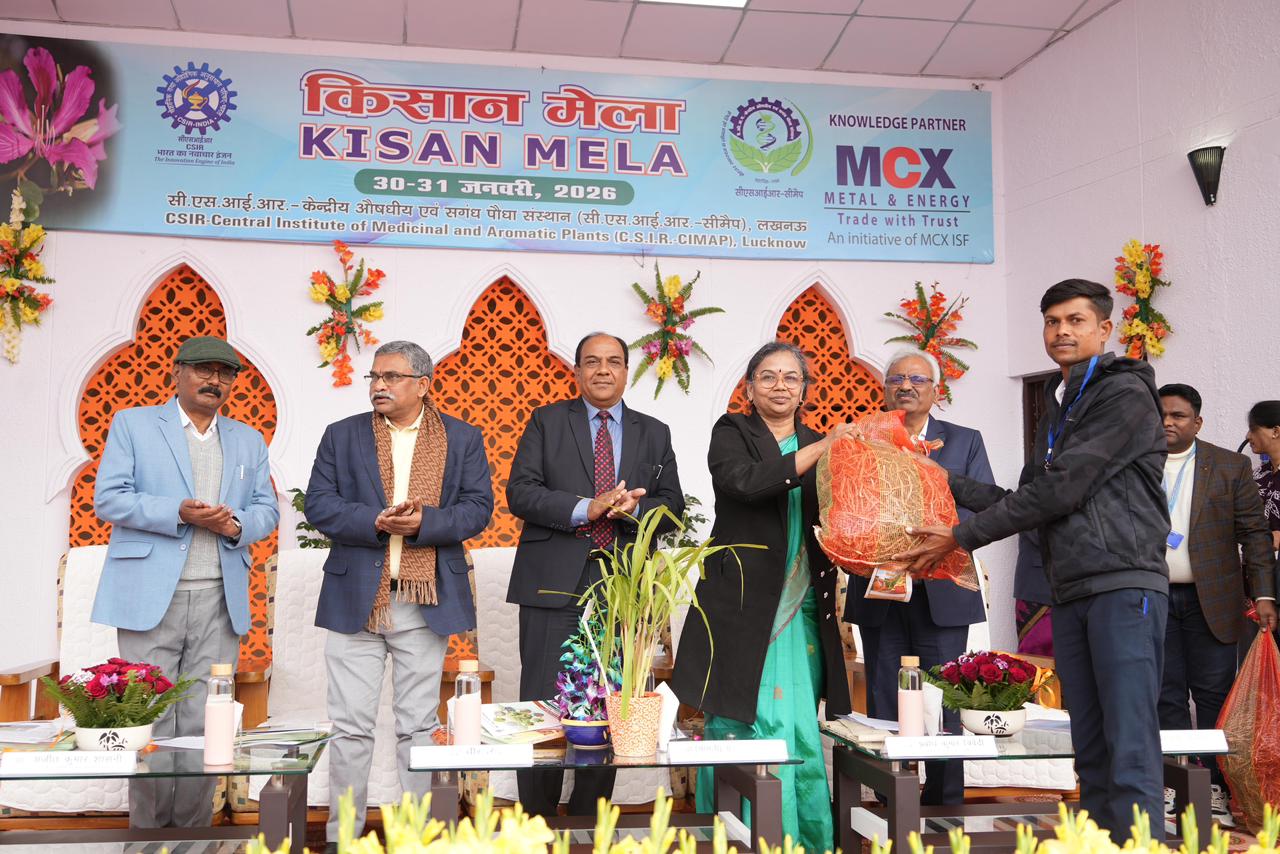
Lucknow: A two-day Kisan Mela was organised at the campus of CSIR–Central Institute of Medicinal and Aromatic Plants (CSIR–CIMAP), Lucknow, on January 30 and 31, 2026, drawing enthusiastic participation from farmers, scientists, industry representatives, and policymakers. On the second day alone, nearly 4,000 farmers from various states of the country attended the event, making it one of the largest farmer-centric gatherings hosted by the institute in recent years.
On the occasion, the dignitaries performed tree plantation within the campus, symbolising the institute’s commitment to sustainability and environmental conservation.

The Chief Guest, Dr. N. Kalaiselvi, Director General, CSIR and Secretary, DSIR, Government of India, while addressing the main ceremony, welcomed the directors of CSIR laboratories based in Lucknow, eminent guests, and farmers. She lauded the extensive work carried out by CSIR–CIMAP and described the Kisan Mela as a “Triveni Sangam”, as farmers from across the country, scientists, and industry representatives came together on a common platform. She remarked that the success of the Aroma Mission was a result of close collaboration between scientists and farmers, for which CSIR–CIMAP and associated laboratories were honoured with the National Science Award 2025 (Science Team Award). Highlighting the socio-economic impact of the mission, she noted that it has brought prosperity to thousands of farming families. She also proposed the formation of a Vetiver Board under CSIR–CIMAP leadership to further benefit farmers.
The Guest of Honour, Dr. Ajit Kumar Shasany, Director, CSIR–National Botanical Research Institute (NBRI), Lucknow, praised CSIR–CIMAP’s contribution to medicinal and aromatic plant production. He said that CIMAP’s efforts have helped India reach the top position globally in mentha production and exports. The mentha varieties developed by CIMAP have gained wide acceptance among farmers due to their high yield potential. He emphasised the importance of developing cropping systems for rain-fed areas and expressed confidence that aromatic crops like lemongrass, rosa grass, palmarosa, and geranium can be successfully cultivated in low-water and drought-prone regions. He also encouraged farmers to adopt proper crop rotation involving food grains, cash crops, and medicinal and aromatic plants to enhance income.
Another Guest of Honour, Dr. Dheer Singh, Director, ICAR–National Dairy Research Institute (NDRI), Karnal, welcomed the guests and farmers and appreciated CSIR–CIMAP’s role in strengthening farmer-oriented research and innovation.
Earlier, Dr. Prabodh Kumar Trivedi, Director, CSIR–CIMAP, welcomed all participants and explained that the Kisan Mela was conceptualised to disseminate improved varieties, advanced cultivation practices, and processing technologies developed by the institute to farmers and entrepreneurs. He noted that CSIR–CIMAP has completed over 60 years of research and development, developing more than 150 improved varieties, along with advanced cultivation, processing, storage, and distillation technologies. These technologies have been successfully transferred to farmers across the country.
Dr. Trivedi highlighted that CIMAP-developed mentha varieties have enabled India to produce nearly 80 percent of the world’s mentha, with Uttar Pradesh alone contributing about 80 percent of India’s production. He informed that around 500 quintals of high-yielding mentha planting material are being distributed to farmers this year from the Lucknow headquarters. He reaffirmed CIMAP’s commitment to making India self-reliant by working closely with farmers. Under the Aroma Mission, over 5,000 farmer clusters, including 20 tribal clusters, have been formed, more than 400 advanced distillation units installed at farmers’ fields, and 121 farmers have emerged as entrepreneurs.
The Kisan Mela Convener, Dr. Sanjay Kumar, briefed participants about the activities planned during the event and conducted the programme. A panel discussion session for farmers was also organised, moderated by Dr. Sanjay Kumar, Dr. Ramesh Kumar Srivastava, Dr. Ram Suresh Sharma, Dr. Rishikesh Bhise, and Dr. Anil Kumar Singh, where scientists and industry experts addressed farmers’ queries.

On the occasion, dignitaries released the farmers’ handbook “Aus-Gyanya”, a practical guide aimed at helping farmers adopt profitable medicinal and aromatic crop cultivation practices in simple language. A coffee table book showcasing the journey of 121 farmer-entrepreneurs under the Aroma Mission was also released.
Several major scientific and technological outputs were unveiled, including:
- Technical bulletin on the use of de-oiled aromatic plant residues as animal feed (joint publication of CSIR–CIMAP and ICAR–NDRI);
- Agro-technology bulletin on management of lethal yellowing disease in citronella;
- Release of new improved varieties CIM–Haritima (citronella) and CIM–Nitya (Akarakara);
- Launch of lemongrass genome, poppy genome, and ceRNET 1.0 computational platform.
Under industrial collaboration and technology transfer, multiple agreements and launches took place, including incense stick manufacturing technology from temple flowers, room freshener technology transfer, bioactive fungicide formulation transfer, soil health restoration technology transfer to Meghalaya Basin Development Authority, exchange of NDA for Certified Reference Materials, and the launch of CIM-Belpatra Body Lotion and CIM Flora Sol products.
The Chief Guest also inaugurated the renovated Sugandh Sandesh Auditorium, pilot plant, and glasshouse facilities, enhancing research, training, and technology demonstration capabilities.
A special exhibition showcased farmer-friendly technologies and schemes developed by CSIR laboratories, along with stalls by industries, NGOs, and women empowerment initiatives. Women participants showed keen interest in training and demonstrations on incense and cone making from floral waste.
The programme was conducted by Dr. Rishikesh N. Bhise, while the vote of thanks was delivered by Dr. Ramesh Kumar Srivastava. Scientists, staff, research scholars, industry representatives, and farmers from across the country were present, making the Kisan Mela a vibrant platform for knowledge exchange and collaboration.



 ---------------------------------------------------------------------------------------------------