New Delhi — The Union Budget 2026–27 has delivered the highest-ever financial support for India’s fisheries sector, allocating ₹2,761.80 crore to drive sustainable growth, strengthen coastal livelihoods, and enhance the country’s global competitiveness in seafood exports. The announcement marks a decisive step in positioning fisheries as a key pillar of India’s expanding blue economy.
Of the total allocation, ₹2,530 crore has been set aside for scheme-based interventions aimed at providing direct benefits to fishers and fish farmers. The Pradhan Mantri Matsya Sampada Yojana (PMMSY) continues as the backbone of sectoral development, receiving ₹2,500 crore in the 2026–27 financial year.
Integrated Development of 500 Reservoirs and Amrit Sarovars
Presenting the Budget in the Lok Sabha, Finance Minister Nirmala Sitharaman announced a major initiative for the integrated development of 500 reservoirs and Amrit Sarovars to strengthen the fisheries value chain, particularly in coastal regions. The initiative seeks to improve production, post-harvest handling, market access, and income realisation for fishers.
The programme will emphasise linkages with start-ups, women-led self-help groups, and Fish Farmer Producer Organisations (Fish FPOs), enabling community-driven enterprise development and inclusive growth. According to the Finance Minister, the initiative is expected to reduce post-harvest losses, improve price discovery, and connect primary producers with processing and export markets.
India has one of the world’s largest inland reservoir networks, covering nearly 31.5 lakh hectares, offering vast untapped potential for inland fisheries. Under Mission Amrit Sarovar, the government has already developed 68,827 Amrit Sarovars across the country, of which 1,222 are linked to fisheries, supporting aquaculture, water conservation, and aquatic biodiversity.
Boost to Coastal Fisheries Value Chains
Strengthening coastal fisheries value chains forms a central component of the new budgetary thrust. The initiative aims to integrate fishing communities with processing, cold chain, logistics, and export ecosystems, ensuring that value addition occurs closer to the source of production.
As part of this effort, nearly 200 fisheries-focused start-ups will receive support, with domain experts engaged to promote innovation, technology adoption, and enterprise scalability. Additionally, 34 production and processing clusters identified by the Department of Fisheries will be strengthened to enable cluster-based growth and operational efficiency.
Government officials estimate that these interventions could benefit around 50 lakh individuals across coastal regions, including traditional fishers, fish farmers, and primary producers engaged in domestic and export-oriented seafood value chains.
Major Reform: Duty-Free Fish Catch in EEZ and High Seas
In a significant reform aimed at expanding export opportunities, the Budget proposes that fish catch by Indian vessels operating in the Exclusive Economic Zone (EEZ) and the high seas will be made duty-free. Importantly, fish landed at foreign ports by Indian vessels will now be treated as exports, unlocking new revenue streams for Indian fishers and vessel operators.
Safeguards will be introduced to prevent misuse during transit or transshipment, ensuring regulatory compliance and traceability. The move is expected to enhance India’s presence in international seafood markets and incentivise responsible deep-sea fishing.
India’s vast maritime geography — with a coastline of over 11,099 km and an EEZ spanning approximately 24 lakh square kilometres — supports the livelihoods of more than 50 lakh people across 13 coastal States and Union Territories. Marine fisheries play a critical role in nutrition security, employment, and export earnings.

To ensure sustainability, the government has notified the Rules for Sustainable Harnessing of Fisheries in the EEZ and the Guidelines for Sustainable Harnessing of Fisheries in the High Seas by Indian-Flagged Fishing Vessels, 2025, providing a regulatory framework for responsible exploitation of marine resources.
Duty-Free Import Limit for Seafood Processing Raised
To support export-oriented growth, Budget 2026–27 has raised the duty-free import limit for specified seafood processing inputs from 1% to 3%. This measure is expected to significantly reduce input costs for processing units and improve compliance with stringent international food safety and quality standards.
The enhanced limit will allow exporters to access high-grade inputs required by key global markets such as the European Union, Japan, South Korea, and the United Kingdom, strengthening India’s competitiveness in value-added seafood products.
Industry stakeholders believe the reform will improve operational efficiency, promote product diversification, and help Indian exporters move up the global value chain.
Sector on a Strong Growth Trajectory
The fisheries sector has emerged as one of India’s fastest-growing segments within agriculture and allied activities. Since 2014–15, the sector has recorded an average annual growth rate of 7.87%, the highest among allied sectors.
The sector’s Gross Value Added (GVA) has risen sharply from ₹98,190 crore in FY 2013–14 to ₹3.41 lakh crore in FY 2023–24, reflecting its increasing contribution to economic growth, employment generation, and nutritional security.
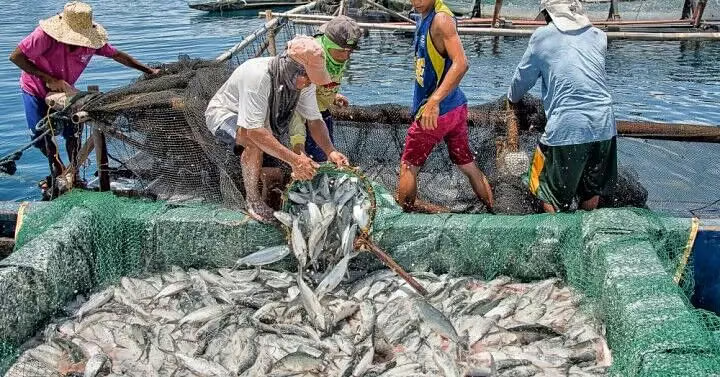
India’s fish production has more than doubled over the last decade, increasing from 95.79 lakh tonnes in FY 2013–14 to a record 197.75 lakh tonnes in FY 2024–25. Inland fisheries and aquaculture have been the primary growth drivers, registering a 147% increase during this period.
Seafood exports have also shown robust growth, doubling from ₹30,213 crore to ₹62,408 crore, while shrimp production surged by 296%, driven by expanding coastal aquaculture and increased participation of entrepreneurs, youth, and women.
A Strategic Push for Sustainable Blue Economy
With cumulative investments of over ₹39,272 crore since 2015 across major schemes such as PMMSY, FIDF, PM-MKSSY, and KCC, the government’s renewed focus in Budget 2026–27 reinforces fisheries as a sunrise sector with immense socio-economic potential.
Collectively, the new measures are expected to enhance export earnings, create employment, promote sustainable resource use, and strengthen the resilience of coastal and inland communities — positioning India as a global leader in sustainable fisheries and seafood trade.