New Delhi: The Union Budget 2026–27 has proposed a series of wide-ranging initiatives to strengthen India’s position as a global destination for medical tourism, hospitality, heritage and eco-tourism, while generating large-scale employment and boosting regional economies.
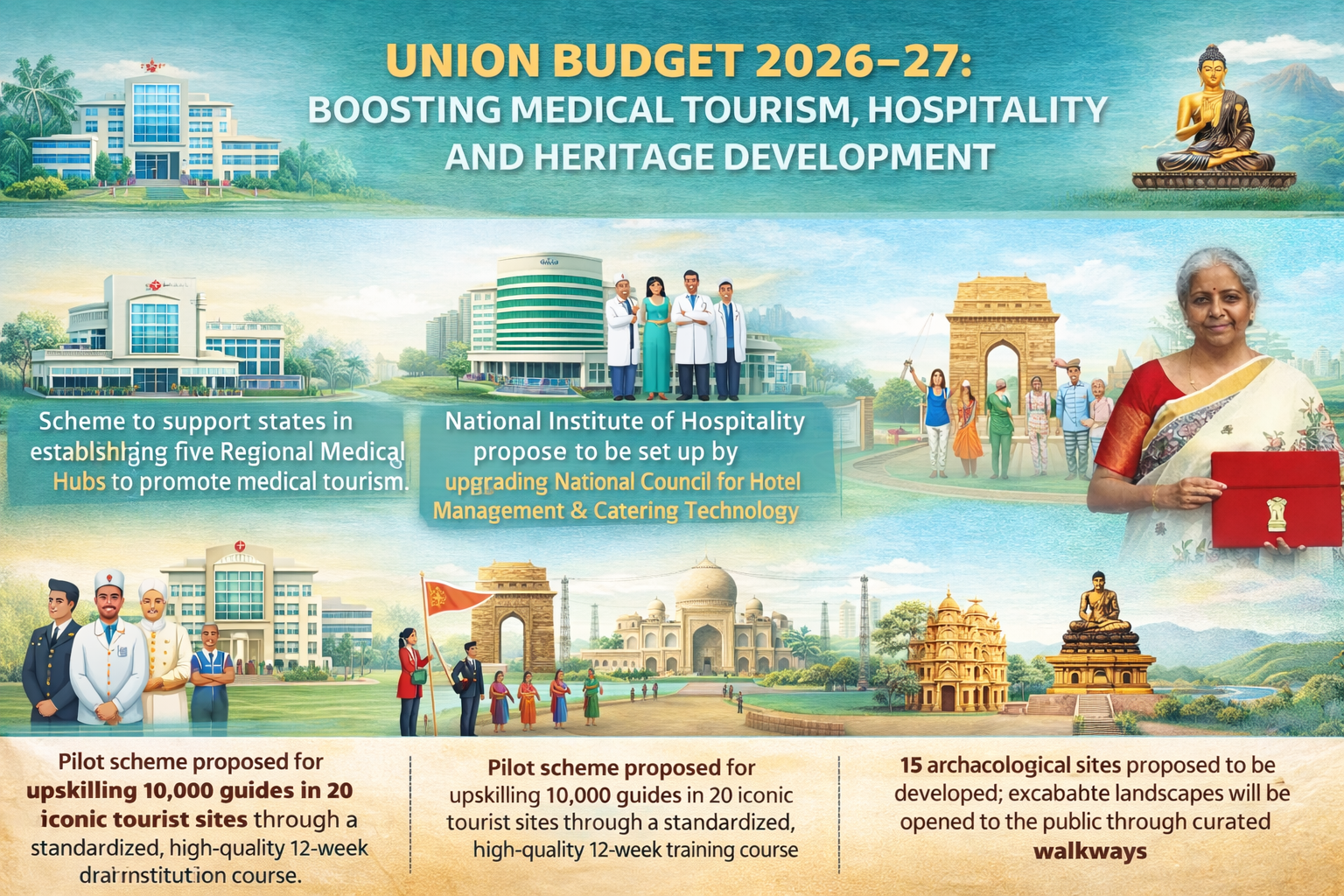
Presenting the Budget in Parliament, Union Minister for Finance and Corporate Affairs Nirmala Sitharaman announced a scheme to support States in establishing five Regional Medical Hubs, in partnership with the private sector, to promote India as a leading hub for medical tourism.
“These hubs will function as integrated healthcare complexes combining medical, educational and research facilities,” the Finance Minister said. The hubs will house AYUSH centres, Medical Value Tourism Facilitation Centres, and advanced infrastructure for diagnostics, post-care and rehabilitation. They are expected to create diverse employment opportunities for doctors, allied health professionals and other healthcare workers.
Tourism as an Engine of Growth
Highlighting tourism as a major driver of employment generation, foreign exchange earnings and local economic expansion, Sitharaman announced the proposal to establish a National Institute of Hospitality by upgrading the existing National Council for Hotel Management and Catering Technology. The institute will act as a bridge between academia, industry and government to create a future-ready hospitality workforce.
A pilot scheme for upskilling 10,000 tourist guides across 20 iconic tourist sites was also announced. The guides will undergo a standardized, high-quality 12-week training programme in hybrid mode, implemented in collaboration with an Indian Institute of Management.
To digitally preserve India’s vast cultural and heritage assets, the Budget proposed the creation of a National Destination Digital Knowledge Grid. The platform will digitally document places of cultural, spiritual and heritage significance, creating new employment opportunities for researchers, historians, content creators and technology professionals.
Eco-Tourism and Nature Trails
The Finance Minister said India has immense potential to offer world-class trekking and nature-based tourism experiences. The Budget proposes the development of ecologically sustainable tourism trails, including:
-
Mountain trails in Himachal Pradesh, Uttarakhand, Jammu and Kashmir, Araku Valley in the Eastern Ghats and Podhigai Malai in the Western Ghats
-
Turtle trails along key nesting sites in Odisha, Karnataka and Kerala

-
Bird-watching trails around Pulikat Lake in Andhra Pradesh and Tamil Nadu
She also noted that India will host the first Global Big Cat Summit, bringing together leaders and ministers from 95 range countries to deliberate on conservation strategies under the International Big Cat Alliance.
Heritage and Culture Tourism
Under the heritage and culture tourism initiative, the Budget proposes the development of 15 archaeological sites—including Lothal, Dholavira, Rakhigarhi, Adichanallur, Sarnath, Hastinapur and Leh Palace—into vibrant, experiential cultural destinations.
“Excavated landscapes will be opened to the public through curated walkways, supported by immersive storytelling technologies,” the Finance Minister said, adding that conservation labs, interpretation centres and trained guides will be strengthened to enhance visitor experience.
Focus on Purvodaya and the North-East
Reiterating the government’s commitment to balanced regional development, Smt. Sitharaman announced proposals for an integrated East Coast Industrial Corridor, five tourism destinations across the Purvodaya states, and the deployment of 4,000 e-buses.
Recognising the North-East as a civilisational confluence of Theravada and Mahayana-Vajrayana traditions, the Budget also proposes a Scheme for Development of Buddhist Circuits in Arunachal Pradesh, Sikkim, Assam, Manipur, Mizoram and Tripura. The scheme will focus on preservation of monasteries and temples, pilgrimage interpretation centres, improved connectivity and enhanced pilgrim amenities.
Together, these initiatives signal a strong push towards positioning tourism, healthcare and heritage as key pillars of inclusive growth in the journey towards a Viksit Bharat.