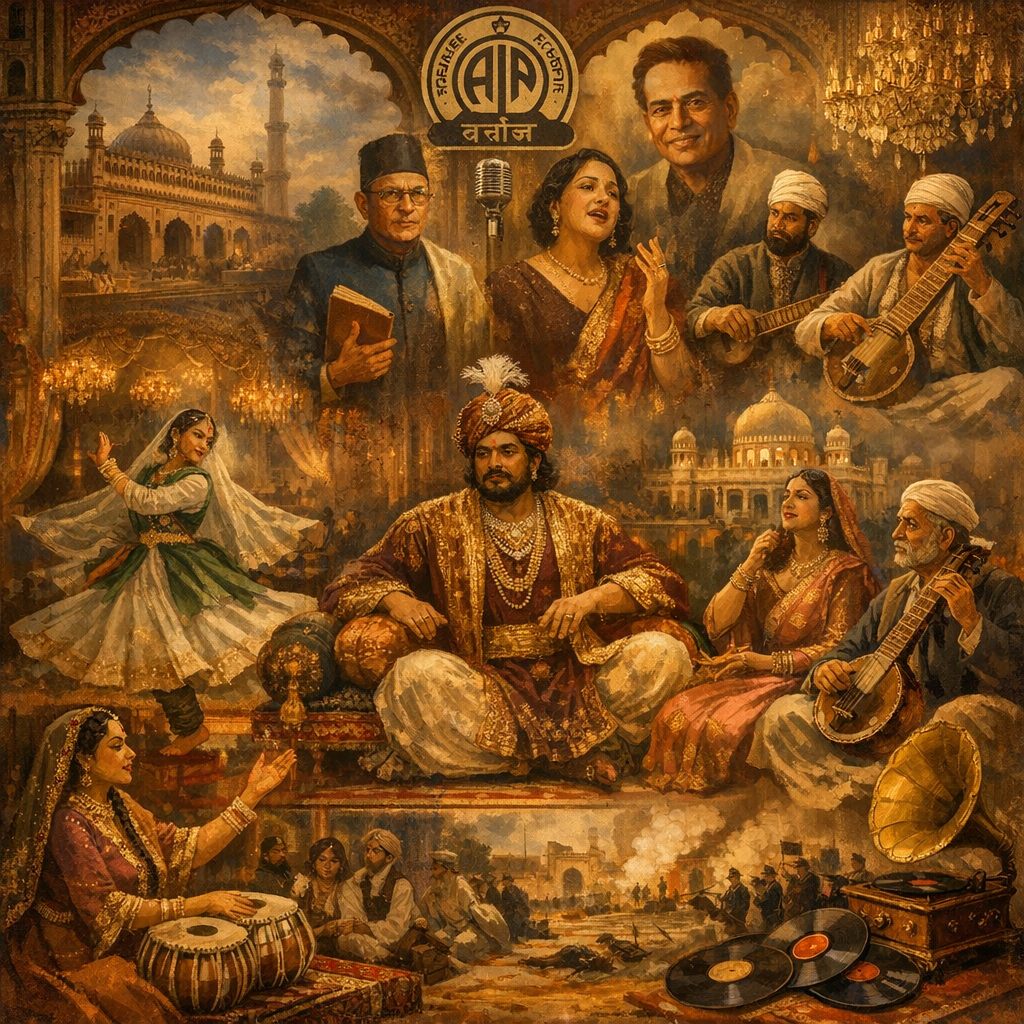
Lucknow: Lucknow, the enchanting city of nawabs, exquisite tehzeeb (etiquette), and profound adab (culture), owes much of its identity to music. For over three centuries, melodies and rhythms have not merely entertained but have profoundly shaped the city’s architecture, social fabric, and emotional ethos. Music in Lucknow reflects patronage, romance, melancholy, and resilience, weaving itself into the very heartbeat of the Awadh capital.
The city’s musical zenith arrived during the 18th and 19th centuries under the Nawabs of Awadh. As Delhi’s Mughal court declined, Lucknow emerged as North India’s premier hub for Hindustani classical music. The last Nawab, Wajid Ali Shah (reigned 1847–1856), epitomised this golden era. A poet, composer, playwright, and dancer, Wajid Ali Shah lavishly patronised the arts. His court attracted luminaries like khayal maestros Pyare Saheb and Jaffar Khan, thumri pioneers of the Lucknow gharana, and Kathak legends Thakur Prasad, Bindadin Maharaj, and Kalka Prasad.
Semi-classical forms such as thumri, dadra, and ghazal flourished, mirroring the city’s romantic and introspective temperament. Wajid Ali Shah’s innovative rahas (dance-dramas) and mujras blended music, poetry, and choreography, earning Lucknow the title “Constantinople of India” for its refined indulgences. Kathak, evolving in the Nawabi courts, emphasised grace, expression (abhinaya), and intricate footwork, establishing the Lucknow gharana as a beacon of elegance and technique.
Music’s influence even extended to architecture. The Bara Imambara’s expansive hall and labyrinth (Bhool Bhulaiya) were designed to enhance acoustics, amplifying the sound of qawwalis and devotional performances. Similarly, the Chota Imambara was crafted for the resonant recitation of soz and marsiya during Muharram, demonstrating the city’s seamless integration of sound and space.

The British annexation of Awadh in 1856 and the 1857 Revolt shattered royal patronage, and Wajid Ali Shah was exiled to Metiabruz, Kolkata. Yet music endured. Displaced ustads and tawa’ifs (courtesans) in neighborhoods like Kaiserbagh, Chowk, and Aminabad became the custodians of culture. These accomplished women hosted intimate mehfil gatherings in salons (kothas), preserving and transmitting classical traditions across generations.
From this milieu emerged iconic artists such as Badi Moti Bai, Gauhar Jaan—the pioneering recording artist—and Begum Akhtar (1914–1974). Raised in Lucknow, Begum Akhtar captured the city’s poignant elegance in her ghazals and dadras, her voice a haunting echo of Awadh’s lost glory.
The 20th century institutionalised Lucknow’s musical legacy. Pandit Vishnu Narayan Bhatkhande established the Bhatkhande Music Institute in 1926, formalising Hindustani classical education. All India Radio’s Lucknow station, founded in 1938, broadcast local talent to a national audience. Composer Naushad Ali, born in Lucknow in 1919, carried the city’s melodic sophistication to Bollywood, creating unforgettable scores in films like Baiju Bawra and Mughal-e-Azam.