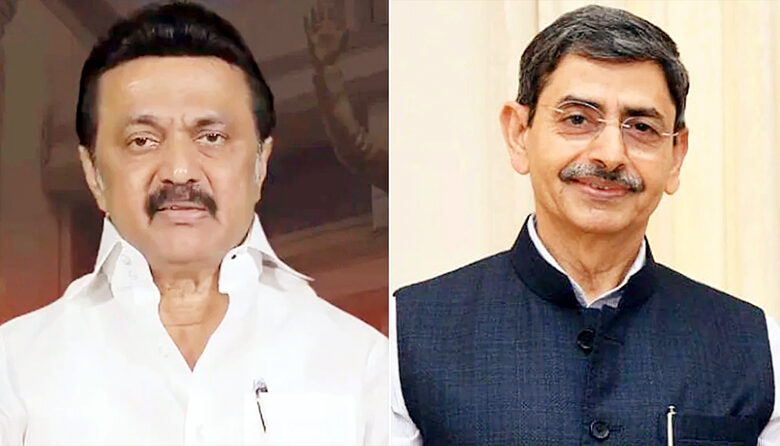
Chennai | A constitutional and political controversy unfolded recently in the Tamil Nadu Legislative Assembly after Governor R.N. Ravi omitted several portions of the customary address prepared by the state government at the commencement of the Assembly session. The omitted sections reportedly referred to B.R. Ambedkar, Dravidian leaders, the Dravidian model of governance, and the law-and-order situation in the state.
Following the Governor’s address, Chief Minister M.K. Stalin moved a resolution in the House demanding that only the original, printed speech—prepared by the elected government and written in Tamil—be entered into the official records of the Assembly. The resolution was adopted by the House.

In an unprecedented development, the Governor exited the Assembly before the national anthem was played, triggering sharp reactions from the ruling DMK and intensifying an already strained relationship between the Raj Bhavan and the state government.
Background and Constitutional Context
Under Article 175 of the Constitution of India, the Governor is required to address the first session of the Legislative Assembly each year, as well as the first session following the formation of a new government or a newly constituted Assembly. Conventionally, this address is drafted and approved by the elected Council of Ministers and is read by the Governor, similar to the President’s address to Parliament.
The address is considered a statement of the government’s policies, achievements, and priorities, and not the personal views of the constitutional head. Any disagreement with its content is traditionally expected to be resolved outside the floor of the House.
Not an Isolated Incident
The Tamil Nadu episode is not without precedent. In the past, Governors in several states—including West Bengal (1965), Rajasthan (1967), Punjab (1969), Tripura (2017), Kerala (2018), and Rajasthan—have declined to read, or have deviated from, addresses prepared by state governments, citing disagreements over content.

In Kerala, for instance, the Governor had earlier modified portions of the address prepared by the Left Democratic Front government. While differences were later explained through formal communication, the address itself proceeded, and the revised text was subsequently placed on record.
Political Reactions
The DMK government has maintained that the Governor’s role is bound by constitutional convention and that selectively omitting portions of the address undermines the authority of the elected government and the dignity of the Assembly. The opposition, meanwhile, has offered support to the Governor’s objections, particularly on issues related to governance and law and order.
The Governor later issued a statement from Raj Bhavan explaining his reasons for not reading certain portions of the address, citing factual disagreements with several claims made by the state government.
Broader Implications
The incident has reignited a wider national debate on the role, powers, and limitations of Governors in India’s federal structure, especially in states ruled by parties opposed to the ruling dispensation at the Centre. Constitutional experts have reiterated the need for clarity, restraint, and mutual respect between elected governments and constitutional authorities to preserve the spirit of parliamentary democracy.
As tensions continue, the Tamil Nadu episode is likely to be cited as a key case in ongoing discussions about reforming conventions surrounding gubernatorial addresses and Centre–state relations in India.