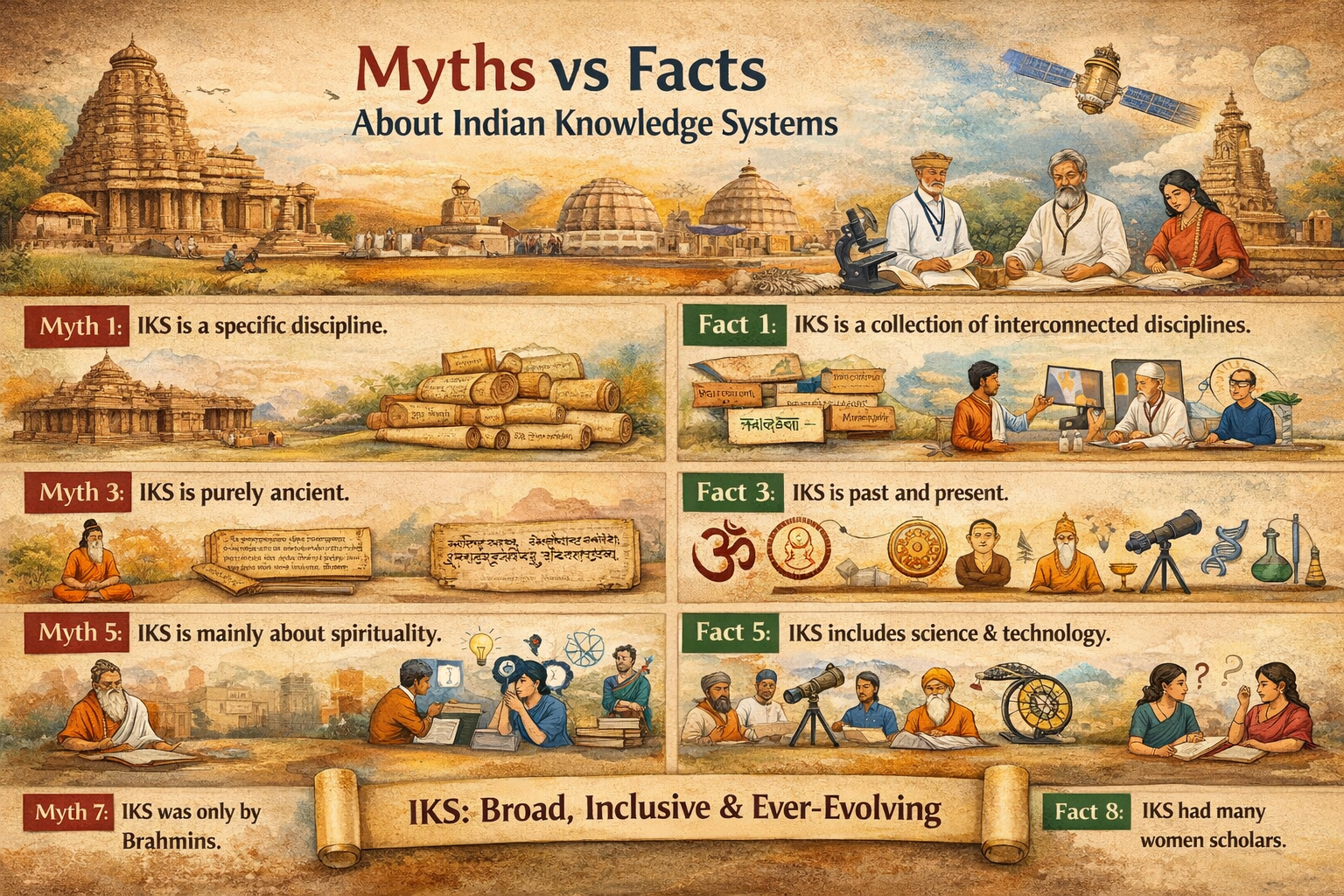
Lucknow: Numerous misconceptions about IKS persist, clouding its true nature and scope, which stem from many factors – limited understanding of its vastness, misrepresentation in popular media and the overlay of modern paradigms on ancient knowledge traditions.
IKS is a dynamic, evolving, and interdisciplinary repository of knowledge that has developed over millennia in the Indian subcontinent, covering disciplines such as art, architecture, linguistics, health sciences, governance, mathematics, astronomy, etc. These are interconnected and deeply rooted in the lived experiences, cultural practices, and philosophical inquiries of the Indian civilization.

Let us look into the popular myths and attempt to present the facts about IKS.
Myth 1: IKS is a specific disciplineor specialization.
Fact 1: IKS is a collection of interconnected disciplines.Often mistakenly perceived as singular disciplines, similar to physics, chemistry, or mathematics, in reality, IKS is a complex, comprehensive framework. For example, the science of temple architecture in India cannot be fully understood without knowledge of Indian art forms, cultural practices, philosophical schools (darshanas), and even the lifestyle of the time.
Myth 2: IKS is confined to Sanskrit and is the domain of ‘Sanskrit people.’
Fact 2: Sanskrit is one of many languages used in IKS, and there is no such thing as ‘Sanskrit people.’ Sanskrit is recognised as a foundational and common linguistic thread across the subcontinent, but is never spoken of as the sole language. India has a rich linguistic tapestry.
For instance, while Ayurveda is predominantly found in Sanskrit, the Siddha system of medicine—an equally ancient tradition—is documented in Tamil. This linguistic diversity is integral to IKS, and valuable works can be found across regional languages.The Siribhuvalaya, a monumental Kannada text by the Jain monk Kumudendu Muni, which consists of 600,000 verses covers mathematics, chemistry, physics, astronomy, and history. SahadevaBhaadali, a 12th-century text on Jyotisha (astronomy) authored by alady scholar highlights the contributions of Marathi literature.
Myth 3: IKS is purely ancient.
Fact 3: IKS encompasses the entire spectrum of knowledge traditions from India, both past and present, and continues to evolve with new contributions.
Myth 4: IKS is exclusively written by Hindus.
Fact 4: This depends on how the term ‘Hindu’ is understood. While much of IKS falls within the Hindu fold, Jaina and Bauddhatraditions have also significantly contributed to IKS.The term “Hindu” was initially used by outsiders to describe the people living beyond the Indus (Sindhu) River. Over time, “Sindhu” became “Hindu,” referring to the inhabitants of Bharat.
Myth 5: IKS is mainly about spirituality.

Fact 5: While spirituality is central to IKS, it also includes a vast body of empirical sciences. Disciplines such as mathematics, astronomy, architecture, economics, and metallurgy were also developed with incredible accuracy and vision.
Myth 6: IKS has answers to all problems of life, “Our ancient teachers have given us all solutions.”
Fact 6: While the wisdom of our ancestors offers valuable insights, it does not address every contemporary issue, which have to be resolved using creative thinking, which is encouraged by IKS.
Myth 7: IKS is written and studied only by Brahmins.
Fact 7: Numerous non-Brahmin scholars have made significant contributions to IKS.
Myth 8: IKS was written only by men.
Fact 8: Women made substantial contributions to Indian Knowledge Systems.A common misconception, often perpetuated by some feminist and Western perspectives, is that women in ancient India were deprived of education and knowledge. However, this is far from the truth. Numerous women made significant contributions to IKS throughout Indian history, as detailed study clearly show.
An IKS-inspired academic system offers not just a multidisciplinary approach to education, but one that is deeply attuned to personal growth, societal harmony, and ecological sustainability. By learning from the ancient methods of integrating disciplines and customizing education, modern academia can foster a more cohesive, adaptable, and sustainable learning environment.
Team Siddhanta Knowledge Foundation
https://siddhantaknowledge.org/