Lucknow: The journey from Raj Bhavan to Jan Bhavan encapsulates India’s long and layered struggle to reconcile its colonial inheritance with its republican identity. Spanning nearly eight decades, this transformation is far more than a bureaucratic renaming exercise. It represents a gradual ideological shift—from symbols of imperial raj (rule, authority, dominion) to democratic jan or lok (the people).
In January 2026, Uttar Pradesh brought this journey to a symbolic culmination by renaming the Governor’s residence in Lucknow as Jan Bhavan. The decision marked not just the end of a name but the closing of a historical arc—one that began under the British Raj and evolved through independence, constitutional continuity, and finally, deliberate decolonization.

Colonial Foundations: The Birth of Government House
The story begins in the era of the British Raj, when official residences of governors were uniformly called Government House or Governor’s House. These structures were designed not as homes but as instruments of power—architectural assertions of imperial supremacy.
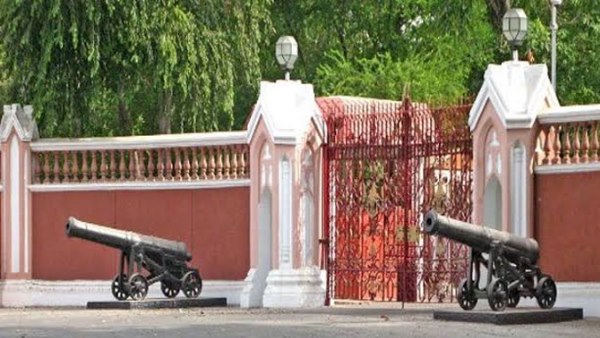
Across India, Government Houses were built to intimidate and awe: neoclassical mansions set amid vast lawns, wrought-iron gates crowned with imperial insignia, marble halls echoing with colonial ceremony. Entry was restricted, and access tightly controlled. These were fortresses of authority, spaces where decisions affecting millions were taken behind closed doors.
In Lucknow, the present Governor’s residence traces its origins to the early nineteenth century. Originally known as Kothi Hayat Baksh—“the building that gives life”—it became firmly embedded in colonial administration after the 1857 uprising, when the British Crown assumed direct control of India. Lucknow, once the heart of Awadhi culture, was transformed into a key administrative centre, and its elite architecture was repurposed to serve imperial power.
Similar trajectories unfolded elsewhere. Kolkata’s Government House, built between 1799 and 1803 under Governor-General Lord Wellesley and modelled on England’s Kedleston Hall, served as the seat of viceregal pomp until the capital moved to Delhi in 1911. These residences symbolised not governance but domination—monuments to distance between ruler and ruled.
Independence Without Rupture: The Rise of Raj Bhavan
When India gained independence in 1947, the political system underwent a seismic change. Yet the physical and symbolic architecture of governance remained largely intact. The new republic inherited colonial institutions out of necessity, prioritising stability over rupture.
It was Chakravarti Rajagopalachari, India’s last Governor-General and first Indian to hold the office, who popularised the term Raj Bhavan. The word raj—derived from Sanskrit—meant rule or sovereignty. In the new context, it subtly shifted from imperial dominance to constitutional authority vested in the Indian state.
By January 26, 1950, when India formally became a republic and the United Provinces were renamed Uttar Pradesh, the Lucknow residence officially became Raj Bhavan. The nomenclature spread nationwide. Government Houses in Kolkata, Chennai, Shimla, and other capitals adopted the same name, becoming standard across India’s federal structure.
For decades, the term went largely unquestioned. Governors such as Kailash Nath Katju and Padmaja Naidu occupied Raj Bhavan as constitutional heads, overseeing ceremonial and administrative duties. Yet the buildings remained elite enclaves. Grand durbars, state banquets, and strict security reinforced the perception of distance between the institution and the people.
During the Nehruvian era and well into the late twentieth century, the contradiction remained unresolved: a republic born from an anti-colonial struggle housed its constitutional authorities in spaces still echoing monarchical language and colonial hierarchy.
Quiet Dissent and Incremental Openings
By the 1990s and 2000s, as India liberalised its economy and gained greater cultural confidence, mild critiques of colonial symbolism began to surface. Civil society voices questioned why democratic institutions continued to operate from spaces that appeared inaccessible and aristocratic.
Some governors attempted incremental change. Raj Bhavans across states began hosting cultural events, school visits, and public functions. In Uttar Pradesh, heritage walks and limited public interactions were introduced. Yet these initiatives remained symbolic gestures; the name and underlying structure persisted.
The real shift in tone emerged in the 2010s and early 2020s, driven not by policy but by individual governors seeking to redefine their roles. In West Bengal, Governor C.V. Ananda Bose publicly spoke of “handing over the keys” of Raj Bhavan to the people, informally referring to it as Jana Raj Bhavan.
In Tamil Nadu, Governor R.N. Ravi spoke of transforming Raj Bhavan into Makkal Maaligai—the People’s Palace—opening its gates for public programs and consciously reducing ceremonial excess.
These efforts, however, were fragmented and personality-driven. There was no national framework or coordinated approach. Raj Bhavan, as a term, remained deeply embedded in India’s administrative lexicon.
The National Push: From Raj to Lok
The decisive turn came in late 2025, aligned with the Union government’s broader push toward symbolic decolonization. Earlier initiatives—such as renaming Rajpath to Kartavya Path—had already signalled a shift from power-centric symbolism to duty and service.
On November 25, 2025, the Union Ministry of Home Affairs issued a formal directive to all governors and lieutenant governors. The instruction was clear: Raj Bhavan would be renamed Lok Bhavan, and Raj Niwas would become Lok Niwas.


The reasoning was explicit. The term raj carried residual connotations of monarchy and colonial authority, while lok aligned with constitutional principles rooted in popular sovereignty—echoing institutions such as the Lok Sabha and Lokayukta.
Compliance was swift. By early December, states including West Bengal, Tamil Nadu, Kerala, Assam, Uttarakhand, Odisha, Gujarat, Tripura, and several Union Territories implemented the change. Plaques were replaced, official stationery updated, and social media handles rebranded.
Prime Minister Narendra Modi framed the initiative as a transition “from power to service,” linking it to the broader vision of Viksit Bharat and citizen-centric governance.
Uttar Pradesh’s Distinct Choice: Jan Bhavan
Uttar Pradesh followed the directive—but with a crucial adaptation. In Lucknow, Lok Bhavan already existed as the Chief Minister’s secretariat complex. Renaming the Governor’s residence the same would have created administrative confusion.
Instead, the state chose Jan Bhavan—a term more direct, more intimate. Jan speaks of the common citizen, the janata, evoking ideas of public ownership and collective identity.
On January 21, 2026, the Governor’s office formally notified that the historic residence would henceforth be known as Jan Bhavan for all official, legal, and statutory purposes. There was no elaborate ceremony. The change was quiet, deliberate, and unmistakably symbolic.
The decision underscored India’s federal flexibility. While most states adopted lok, Uttar Pradesh preserved the spirit of the directive while tailoring it to local context and administrative realities.
More Than a Name
Sceptics argue that such renamings are cosmetic—changing signboards without altering power structures. And the critique is not without merit. Governors continue to function within the same constitutional framework; the buildings remain guarded; access is still regulated.
Yet symbolism matters. Language shapes perception, and perception shapes public consciousness. Replacing raj—rule over—with jan or lok—of the people—reasserts a foundational constitutional truth: sovereignty resides with citizens, not institutions.
In Uttar Pradesh, India’s most populous state and the crucible of movements from 1857 to modern electoral politics, the renaming carries particular resonance. The heartland that once housed imperial authority now consciously frames its highest constitutional office as belonging to the people.
An Arc Eight Decades Long
Seen in historical perspective, the journey from Raj Bhavan to Jan Bhavan mirrors India’s political maturation:
-
1947–1970s: Retention of colonial structures amid urgent nation-building
-
1980s–2010s: Gradual questioning and partial opening of elite spaces
-
2020s: Coordinated symbolic reform rooted in democratic self-confidence
What began as inherited imperial architecture has, over decades, edged closer to reflecting the ethos of a people’s republic. Jan Bhavan does not erase history, but it reframes it—acknowledging the past while asserting a democratic present.
In that quiet renaming in January 2026 lies a powerful message: the architecture of power in India is no longer about ruling over the people, but standing in service of them.












 https://www.youtube.com/watch?si=RtToJsBhYBatUrym&v=mOuYNSdhjHA&feature=youtu.be