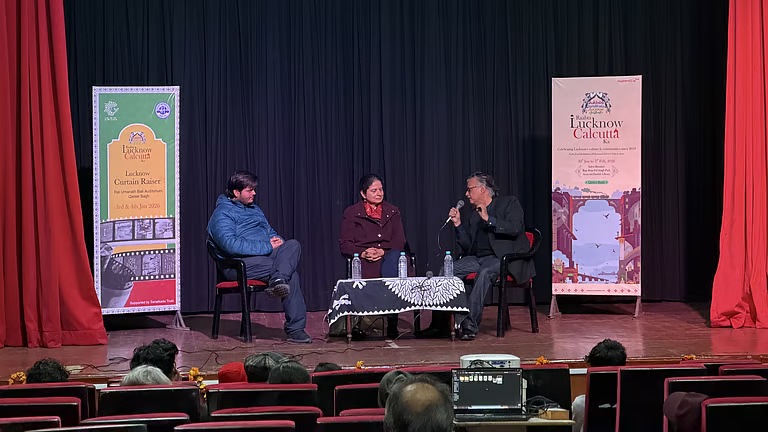
Lucknow | The Mahindra Sanatkada Lucknow Festival (MSLF) 2026 hosted a press conference at Baradari, Saraca Hotel, Lucknow, announcing the 17th edition of the festival and outlining its key highlights and overarching vision. The interaction offered a glimpse into the festival’s continued commitment to celebrating craft, cuisine, culture, and community engagement.
The conference opened with Naghma Parveen, Co-Director at Sanatkada, who spoke about the craft-focused programming planned for this year. She introduced Koocha-e-Bazm-e-Hunar, a dedicated craft street where visitors will experience live demonstrations by master artisans, including kantha embroidery by Shantanu Guha and pattachitra painting by Suhana.

Parveen also spoke about the Meera and Satti Kuckreja Husn-e-Karigari Lifetime Achievement Award, instituted in 2024 to honour master craftspersons who have devoted their lives to traditional arts. The 2026 award will be conferred upon Mahesh Kumar and Sunita Devi, celebrated for their intricate work in miniature mufti making.
Speaking on the culinary segment, Sanatkada team member Mariyam Imran detailed the offerings at Bawarchi Khana, the festival’s food court. Alongside popular street food vendors, outlets such as Pista House and stalls serving Calcutta cuisine will be present. A special attraction will be Mutton Razala, a historic Kolkata delicacy, prepared by Manzilat Fatima, the great-great-granddaughter of Nawab Wajid Ali Shah. Parveen also announced the launch of a new festival dish, Lub-e-Mashooq, to be served with zafrani paratha and rasawal.
Actor and producer Rishad Rizvi reflected on the significance of rasawal and traditional Awadhi cuisine, observing that such food traditions demand time, patience, and slow cooking—elements increasingly absent in modern life. Describing Lucknow as a melting pot of civilizations, he underlined the role of heritage festivals in reconnecting people with cultural practices that are gradually fading.
Jay Shah, Vice President and Head of Cultural Outreach at the Mahindra Group, noted that modern lifestyles are steadily distancing society from its cultural and culinary roots. He said his long association with the festival stems from its authenticity and deep community connect. Emphasising that culture is inseparable from society, Shah highlighted the festival’s commitment to giving back to communities and reiterated MSLF’s vision of being a zero-waste festival.
The press conference also discussed the festival’s theme, “Raabta: Lucknow–Calcutta Ka,” highlighting historical and cultural exchanges between the two cities. References were made to shared traditions such as khas ka sharbat, the Chitpur ittar shops of Bengal with roots in Lucknow, and the practice of patangbaazi in Kolkata.

Joining via video call, Talat Fatima, another great-great-granddaughter of Nawab Wajid Ali Shah, spoke about Lucknow and Kolkata as the two pillars of the Nawab’s legacy—his cultural flowering in Lucknow and his final years in Kolkata—observing that this shared history is seldom discussed.
On the cultural programming front, the festival will feature a dhaak performance by Padma Shri awardee Gokul Das Ji and his all-women troupe. A legendary master of the instrument, Gokul Das Ji has taken dhaak from ritual spaces to global stages and pioneered the inclusion of women in a traditionally male-dominated art form. The festival will also introduce the Husn-e-Karigari Showcase, a first-of-its-kind initiative celebrating exceptional handcrafted works and master artisans.
Musical highlights include Seher, a dawn concert featuring Ustad Irfan Mohammad Khan, a distinguished sarod player of the Lucknow–Shahjahanpur Gharana, accompanied by Ustad Ilmas Husain Khan on tabla. Among the intellectual offerings will be a key lecture by Nobel Laureate Abhijit Banerjee.
The festival’s Heritage Experiences segment will feature 12 curated thematic walks, eight of which will be outdoor experiences, offering immersive engagements with the cultural memory of Awadh, including Lucknow and its adjoining qasbas.
Reflecting on his long association with the festival, Rishad Rizvi noted that many traditions remain invisible simply because they exist around us. He shared that the festival has encouraged his team to rediscover lost Awadhi recipes—dishes preserved in memory but no longer cooked due to time constraints—which are now being recreated to revive the region’s authentic culinary legacy. He also emphasised the richness and nuance of Awadhi vegetarian cuisine.
The Mahindra Sanatkada Lucknow Festival 2026 promises a vibrant confluence of craft, cuisine, music, ideas, and heritage, reaffirming its role as one of India’s most distinctive cultural celebrations.