Mumbai: When the results of the Brihanmumbai Municipal Corporation (BMC) elections were declared on January 16, 2026, the headlines were dominated by the sweeping victory of the BJP-led Mahayuti alliance. Yet, beneath the larger narrative of power consolidation and the end of Thackeray-era dominance, another story quietly but decisively unfolded — the arrival of the All India Majlis-e-Ittehadul Muslimeen (AIMIM) as a consequential force in Mumbai’s civic politics.
For a party that until a decade ago had little footprint beyond Hyderabad and a few pockets of Maharashtra, AIMIM’s performance in the 2026 BMC polls marked a coming-of-age moment. Winning between four and eight seats — depending on final confirmations — and sharply increasing its vote share in minority-dominated wards, the Asaduddin Owaisi-led party announced that it was no longer a peripheral player in India’s financial capital. It had become, unmistakably, a factor.

A Quiet but Calculated Entry into Mumbai
AIMIM’s relationship with Mumbai has always been cautious. The city’s complex demography, layered political loyalties, and entrenched party networks made it a difficult terrain for an outsider. In the 2017 BMC elections, the party made a tentative entry, contesting a limited number of wards and winning just two seats — enough to signal intent, but insufficient to shape outcomes.
The 2026 elections were different. This time, AIMIM entered Mumbai with a clear plan. The party contested around 50 wards, not spread thin across the city but concentrated sharply in Muslim-majority and minority-influenced areas, particularly in the M/East ward cluster — Mankhurd, Govandi, Cheetah Camp, and surrounding localities. These neighbourhoods share a common story: dense populations, chronic neglect, flooding during monsoons, inadequate sanitation, stalled slum redevelopment, and a persistent sense of being left out of Mumbai’s growth narrative.
For AIMIM, these were not just electoral wards; they were natural constituencies.
Owaisi’s Personal Stamp and Ground Mobilisation
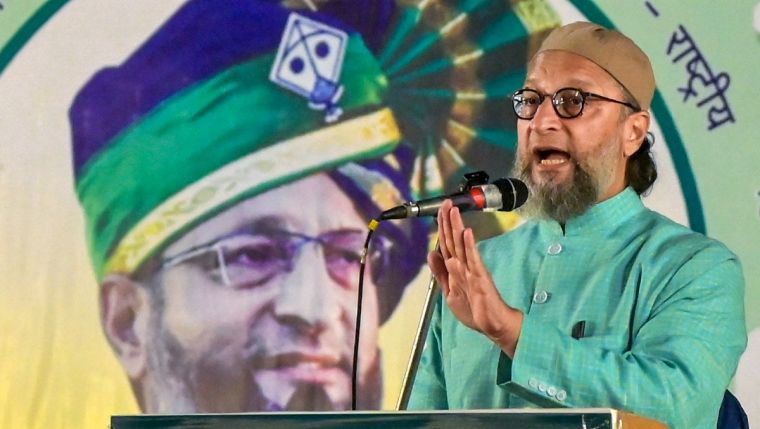
Unlike earlier forays, the 2026 campaign bore the unmistakable imprint of Asaduddin Owaisi himself. Though he did not physically campaign extensively in Mumbai, his recorded messages, social media outreach, and targeted appeals to voters added weight to the party’s push. AIMIM leaders repeatedly framed the election as a chance for Muslims to “send their own representatives” to the BMC — not intermediaries dependent on larger parties.
This message resonated on the ground. Party workers, emboldened by successes in other parts of Maharashtra, intensified door-to-door campaigns, especially in housing colonies, slum clusters, and redevelopment sites where civic promises had repeatedly fallen flat. Waris Pathan, AIMIM’s national spokesperson and one of its most recognisable faces in Maharashtra, publicly predicted “great success” even before polling day — a statement that initially drew skepticism but later appeared prophetic.
What differentiated AIMIM this time was confidence. Narrow defeats in previous elections had taught the party where it stood a chance — and where it did not.
Consolidating the Muslim Vote
The most critical factor behind AIMIM’s emergence was its ability to consolidate Muslim votes in key pockets. Mumbai has a substantial Muslim population, particularly in areas such as Dharavi, Govandi, Mankhurd, Kurla, and parts of the western suburbs. Traditionally, this vote had gravitated toward the Congress, Samajwadi Party (SP), or, in some cases, the undivided Shiv Sena.
By 2026, that loyalty had weakened.
Congress, once the default choice for minority voters, was widely perceived as organisationally fragile and politically indecisive. The Shiv Sena split further muddied the waters, with Uddhav Thackeray’s faction focusing heavily on Marathi identity and legacy politics — themes that did not always align with minority priorities. Into this vacuum stepped AIMIM, offering clarity of purpose and a promise of unambiguous representation.
The party’s pitch was direct: no diluted alliances, no dependence on larger partners, and no compromise on speaking up for minority issues inside the BMC. For many voters in neglected wards, this message carried weight.
Breakthrough Wins and Symbolic Victories
AIMIM’s impact became visible as counting progressed. Its first confirmed victory — and historic maiden win in the BMC — came from Ward 134 in Mankhurd Village, where Mehjabeen Ateeq Ahmed Khan emerged victorious. The win was symbolic: a woman candidate from a minority-dominated, infrastructure-starved area defeating better-resourced rivals.
Other confirmed wins followed in adjacent wards:
-
Ward 145: Khairunnisa Hussein (also reported as Khairnusa Akbar Hussain)
-
Ward 136: Jameer Qureshi
-
Ward 137: Sameer Patel

Early trends showed AIMIM leading in as many as eight wards before final tallies narrowed the figure to between four and eight. Almost all these successes came from the M/East belt, underscoring the effectiveness of the party’s focused strategy.
Even in defeat, AIMIM demonstrated competitiveness. In Dharavi’s Ward 188 — one of the most closely watched contests — AIMIM candidate Ali Munawar Sayyed lost to BJP’s Bhaskar Shetty by just 478 votes after a recount. The margin was narrow enough to unsettle established players and highlight AIMIM’s growing traction.
The Spoiler Effect and Displacement of Old Players
Perhaps AIMIM’s most significant impact was not just in seats won, but in seats altered.
In several wards, AIMIM candidates outperformed Congress and SP contenders, directly displacing them from second or even first positions. This fractured the opposition vote and, in close contests, altered outcomes. For decades, Congress and SP had relied on minority-heavy wards as safe zones. The 2026 elections shattered that assumption.
For the Thackeray camps — both UBT and Shinde factions — AIMIM’s rise was an unwelcome complication. While the Mahayuti retained dominance, AIMIM chipped away at opposition cohesion, especially in areas where anti-BJP votes were already fragmented. The party’s presence forced a recalibration of electoral arithmetic in Mumbai’s minority belts.
Riding a Statewide Wave
AIMIM’s Mumbai breakthrough did not occur in isolation. Across Maharashtra, the party posted its strongest-ever performance in urban local bodies. It won between 95 and 114 seats across 13 municipal corporations, emerging as a serious third force in several cities.
In Chhatrapati Sambhajinagar, the party won between 15 and 24 seats. In Malegaon, it dominated with over 20 seats. In Amravati, it made significant inroads with around 15 wins. Even in Mumbra — under the Thane Municipal Corporation — AIMIM secured six seats, reinforcing its hold in Muslim-majority urban clusters.
This broader momentum boosted morale, resources, and organisational confidence heading into the Mumbai battle. By the time BMC voting arrived, AIMIM was no longer testing the waters — it was swimming with intent.
A New Voice Inside the BMC
With four to eight corporators, AIMIM now qualifies for a recognised group leader post within the BMC and an official office at the civic headquarters. In practical terms, this ensures visibility, access, and a formal platform to raise issues related to minority welfare, housing, urban planning, and alleged discrimination in service delivery.
In a house overwhelmingly dominated by the Mahayuti alliance, AIMIM’s role will not be to decide power equations, but to shape discourse. Its corporators are expected to act as vocal critics, particularly on issues affecting peripheral and marginalised neighbourhoods — from flood mitigation in low-lying slums to delays in rehabilitation projects.
On select civic matters, AIMIM may even align issue-wise with other opposition members, but its core strength will lie in being a persistent, unignorable presence.
What AIMIM’s Rise Means for Mumbai
AIMIM’s emergence reflects a deeper shift in Mumbai’s political ecosystem. The city’s electorate is fragmenting along lines of aspiration, identity, and perceived neglect. Minority voters, in particular, are increasingly willing to move beyond traditional parties if they feel unheard.
For mainstream players, AIMIM’s success is both a warning and a challenge. Ignoring minority concerns or assuming automatic loyalty is no longer a viable strategy. For the Thackerays, it adds another layer of complexity in an already shrinking political space. For Congress, it raises uncomfortable questions about relevance in urban Maharashtra.
A Small Force with a Loud Echo
AIMIM did not challenge the Mahayuti’s mandate in the 2026 BMC elections — nor did it intend to. Its achievement lies elsewhere. By converting focused mobilisation into tangible victories, the party proved that even in a megacity dominated by giants, a smaller force with clarity and conviction can carve out space.
As Mumbai’s new civic house settles into place, AIMIM’s corporators will sit on the opposition benches with limited numbers but amplified voices. In doing so, they have already reshaped the city’s political conversation — and signalled that Mumbai’s civic politics, once again, is evolving.