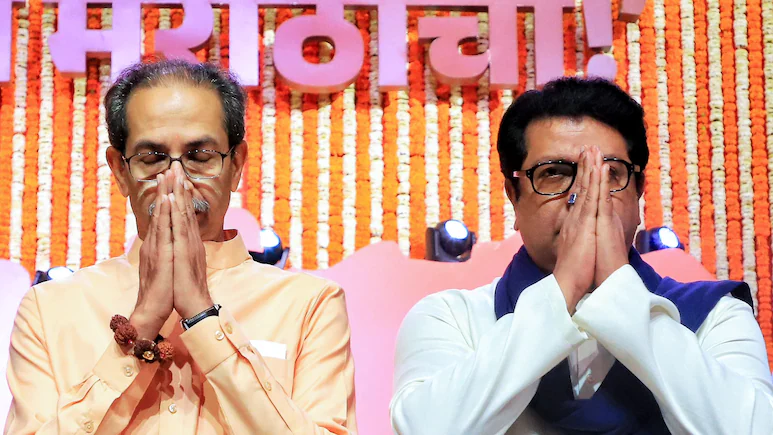
Mumbai: The Brihanmumbai Municipal Corporation (BMC) elections of January 2026 delivered a verdict that was as politically symbolic as it was strategically decisive. Despite the much-publicised reunion of cousins Uddhav Thackeray and Raj Thackeray after nearly two decades of estrangement, Mumbai’s civic electorate chose continuity in governance over nostalgia in politics. The BJP-led Mahayuti alliance — comprising the Bharatiya Janata Party and Eknath Shinde’s Shiv Sena — secured a comfortable majority in India’s richest municipal body, effectively ending nearly three decades of Shiv Sena and Thackeray family dominance over the BMC.
With the Mahayuti leading in roughly 125–130 of the 227 wards, and the BJP emerging as the single-largest party with around 87–93 seats, the verdict underlined a decisive shift in Mumbai’s political mood. Shinde’s Shiv Sena added another 27–31 seats, consolidating the alliance’s control. In comparison, the Thackeray-led front — Shiv Sena (UBT) and the Maharashtra Navnirman Sena (MNS) — trailed significantly, leading in about 70–85 seats combined. Congress remained marginal with 13–24 seats, while smaller parties and independents filled the rest.

Beyond the arithmetic, the result marked a turning point. It demonstrated the limits of emotional politics, family legacy, and identity-based appeals in a city that increasingly sees itself as global, aspirational, and impatient with symbolism unaccompanied by delivery.
The End of a Civic Era
For nearly 30 years, the BMC functioned as the Shiv Sena’s crown jewel — a source of political power, patronage, and ideological influence unmatched by any other municipal body in the country. Control over a civic budget exceeding ₹74,000 crore allowed the party to shape Mumbai’s infrastructure, urban planning, and political ecosystem. Losing the BMC is therefore not merely an electoral defeat for the Thackerays; it is the loss of an institutional stronghold that sustained their relevance long after their state-level fortunes began to fluctuate.
The 2026 election was also the first full civic contest after a prolonged democratic vacuum. Since the previous election in 2017, Mumbai had spent nearly four years under administrator rule following delays caused by the pandemic, ward delimitation disputes, and reservation issues. Voter turnout of 52.94 percent — the second-highest in 32 years — indicated that citizens were eager to reclaim their voice in local governance. Yet that engagement did not translate into support for the Thackeray reunion.
1. A Reunion That Came Too Late
The alliance between Uddhav Thackeray and Raj Thackeray was, on paper, a potent political moment. Two heirs to Bal Thackeray’s legacy coming together promised consolidation of the traditional Marathi vote and a symbolic challenge to the BJP-Shinde combine. In reality, the timing and optics worked against them.
Announced barely days before polling on January 15, the reunion appeared rushed and reactive. Years of bitter rivalry, public accusations, and ideological divergence could not be undone overnight. For many voters, the pact looked less like reconciliation and more like desperation — a last-ditch attempt to stem decline after Uddhav’s setbacks since the 2022 Shiv Sena split and the party’s poor showing in the 2024 Maharashtra Assembly elections.
Crucially, the late alliance left no room for effective groundwork. Seat-sharing remained uneven, cadre coordination was weak, and campaign messaging lacked coherence. In contrast, the Mahayuti ran a disciplined, months-long campaign backed by state and central government machinery. Mumbai’s voters, especially in the suburbs and satellite areas where elections are often won or lost, responded to organisation and clarity rather than symbolism.
2. Identity Politics in a Changing City
At the heart of the Thackeray campaign lay a familiar refrain: the “Marathi Manoos.” Protecting Marathi pride, language, and cultural primacy has been the Shiv Sena’s ideological foundation since Bal Thackeray founded the party. However, Mumbai of 2026 is not the Mumbai of the 1970s or even the 1990s.
The city today is deeply cosmopolitan. Migrants from across India form a substantial and growing share of the electorate. Muslims, North Indians, South Indians, Gujaratis, Marwaris, and an expanding professional middle class coexist in a city driven by finance, entertainment, technology, and services. In this context, identity politics rooted in exclusion proved counterproductive.
Raj Thackeray’s past rhetoric resurfaced during the campaign, reminding voters of earlier episodes when MNS workers assaulted people for not speaking Marathi or targeted migrants from Bihar and Uttar Pradesh. His confrontational positions on language imposition, mosque loudspeakers, and cultural dominance alienated minorities and non-Marathi voters, many of whom saw the alliance as divisive rather than protective.
Instead of mobilising a broad coalition, the “Marathi Manoos” narrative consolidated only core pockets — areas like Worli, where Shiv Sena (UBT) won six of seven seats. Beyond these enclaves, the message failed to resonate. Analysts widely agree that the emphasis on identity pushed neutral, minority, and aspirational voters toward the Mahayuti, which projected itself as inclusive and development-focused.

3. The Hollowing Out of the Shiv Sena Organisation
Perhaps the most structural reason for the Thackeray alliance’s failure lies in organisational erosion. The 2022 split of the Shiv Sena dealt a severe blow to the party’s grassroots machinery. Eknath Shinde walked away with a significant chunk of corporators, shakhas, and ground-level workers — the very network that had sustained Sena dominance in municipal politics for decades.
Shinde’s faction, now aligned with the BJP and backed by state power, proved adept at reclaiming and even expanding into former Shiv Sena bastions. Areas like Dharavi, Dadar, and parts of the eastern suburbs — once considered impregnable Sena territory — saw BJP and Shinde Sena candidates perform strongly.
In comparison, the Thackeray alliance struggled with vote transfer. The MNS, despite contesting over 50 seats, managed to win or lead in only 6–11, underlining its limited organisational depth. Its presence did not significantly boost UBT’s prospects. Meanwhile, Uddhav’s Shiv Sena performed respectably in legacy areas but lacked the reach to offset losses elsewhere.
The campaign’s narrow focus on identity also meant that broader civic grievances — potholes, flooding, waste management, housing affordability — were not foregrounded effectively. After years of administrator rule, voters appeared eager for solutions, not slogans.
4. A Statewide Wind at Mahayuti’s Back
The Mumbai verdict did not emerge in isolation. Across Maharashtra, the Mahayuti alliance dominated urban local bodies, leading or winning in over 25 of the state’s 29 municipal corporations. This reflected a broader political momentum that has favoured the BJP-led alliance since its 2024 assembly victory.
In Mumbai, this translated into a clear preference for stability and alignment. The “double-engine government” pitch — synchronisation between municipal, state, and central authorities — resonated with voters tired of stalled projects and bureaucratic delays. High-visibility infrastructure initiatives such as the coastal road, metro expansion, road concretisation, and large-scale redevelopment projects provided tangible reference points for the Mahayuti’s claims.
The opposition’s fragmentation compounded the Thackerays’ challenge. Congress, though marginal, performed modestly among non-Marathi and minority voters, prompting speculation that Uddhav Thackeray might have benefited more from a Congress tie-up than from Raj Thackeray’s polarising brand.
Legacy Meets Its Limits
The failure of the Thackeray reunion in the 2026 BMC elections underscores a fundamental shift in Mumbai’s political psyche. While family legacy and emotional symbolism retain relevance, they are no longer sufficient to win a city grappling with complex, everyday challenges.
Uddhav Thackeray’s performance suggests that he remains the stronger inheritor of Bal Thackeray’s brand, retaining loyalty in select Marathi strongholds. Yet that loyalty alone cannot reclaim Mumbai. Raj Thackeray’s MNS, meanwhile, faces existential questions about relevance and survival in a political landscape that increasingly penalises polarisation.
For the Mahayuti, control of the BMC cements its urban dominance and provides a powerful platform for future political battles. But it also brings heightened expectations. Governance, not rhetoric, will now determine whether this mandate endures.
Ultimately, the 2026 BMC elections sent a clear message: Mumbai’s voters are looking forward, not backward. In a global city, delivery trumps nostalgia — and broad appeal matters more than bloodlines.