By Dr Atul Malikram, Political Strategist
Lucknow: In Indian democracy, no defeat is ever final. The electorate does not permanently reject a political party; instead, it periodically holds up a mirror. History shows that parties willing to look honestly into that mirror are the ones that return to the pinnacle of power. From the Congress comeback in 1980, to the Trinamool Congress dismantling the Left fortress in West Bengal, and the Aam Aadmi Party’s resurgence in Delhi—each narrative reinforces one truth: electoral defeat is, in itself, an opportunity.

An electoral loss is not merely a reduction in seats. It damages confidence, weakens organisational structures, and creates cracks in public trust. Yet, this is where real politics begins. Accepting the truth after defeat is the first step towards revival. Parties that blame conspiracies or opponents instead of acknowledging their own shortcomings often remain stuck in decline.
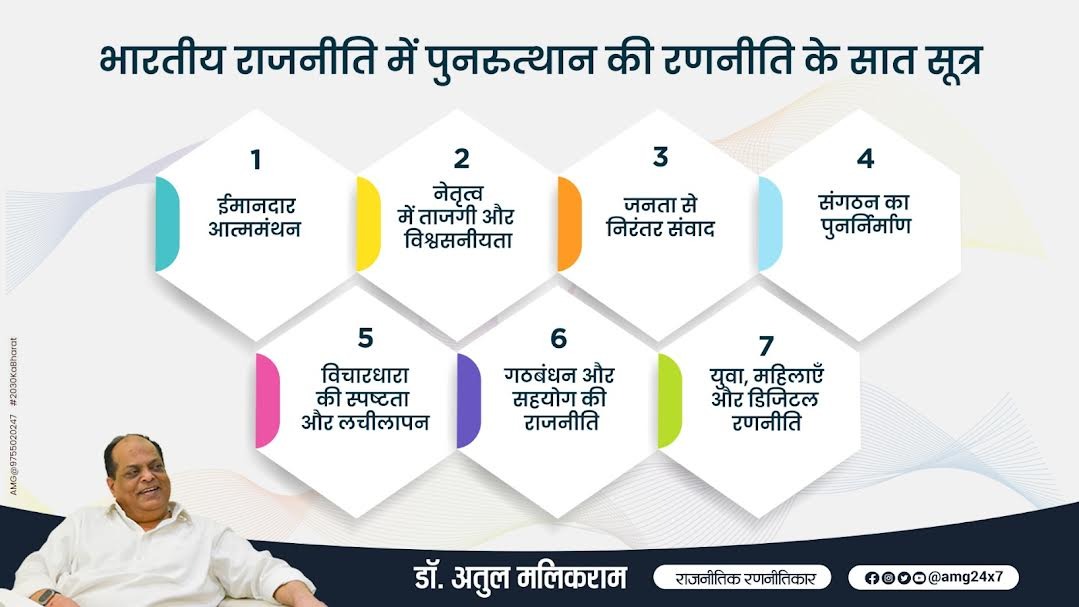
Honest Introspection
For any defeated party, sincere introspection is indispensable. After the Congress’s historic defeat in 2014, many wrote it off entirely. However, the party quietly began identifying its weaknesses and worked at three levels—leadership, organisation, and messaging. This process is never easy, but without it, revival is impossible. Understanding and accepting public dissatisfaction lays the foundation for meaningful change.
Fresh and Credible Leadership
In politics, trust matters more than faces. When leadership loses touch with the public, renewal becomes essential. West Bengal Chief Minister Mamata Banerjee stands as a powerful example. Through grassroots mobilisation, emotional connection, and relentless ground-level politics, she led the Trinamool Congress to power, challenging decades-old Left dominance. Fresh leadership injects new energy and signals that change is reflected not just in words, but in action.
Continuous Public Engagement
Politics is the art of communication—but not one-way communication. The Aam Aadmi Party demonstrated that listening to people is the most effective strategy. From neighbourhood meetings to service-oriented governance, the party showed that dialogue is not merely about speeches, but about solutions. Defeat can only be transformed into victory by stepping out of closed rooms and engaging directly with citizens.

Rebuilding the Organisation
No political party can survive long without a strong organisational backbone. Party workers are its true pillars. The Bharatiya Janata Party’s organisational strength is a well-known example, while the Congress has also made recent efforts to rebuild its structure. A defeated party must restore worker morale, involve them in decision-making, and launch sustained grassroots campaigns to reconnect with the electorate.
Ideological Clarity with Flexibility
Ideology is the soul of a political party. Losing touch with it risks losing identity altogether. At the same time, ideology must be adapted to contemporary realities. The decline of CPI(M) in West Bengal and its continued relevance in Kerala illustrate the importance of this balance. Core principles must remain intact, but their articulation must reflect the demands of the times.
Coalitions and Cooperative Politics
The current political era is no longer defined by single-party dominance, but by collective politics. Strategic alliances can often turn defeat into victory. However, coalitions should not be reduced to seat-sharing arrangements; they must be built on shared agendas and mutual respect. Recent parliamentary and assembly elections have shown that alliances without trust are rarely sustainable.
Youth, Women and Digital Strategy
Youth and women today form the axis of modern politics. They must be viewed not merely as vote banks, but as future leaders. Alongside this, digital technology is no longer optional—it is a necessity. Social media, data analytics, and targeted communication are integral to contemporary political strategy. Any party that distances itself from technology is, in effect, distancing itself from the future.
For political parties facing defeat, it is crucial to understand that victory does not hinge on a single decision. It emerges from a careful balance of introspection, organisation, leadership, communication, ideology, alliances, and technology. In Indian politics, resurgence is always possible—provided the lessons of defeat are learned with honesty and resolve.