Lucknow | January
Maryland State University confers Honorary PhD along with Gold Medal * Academicians and industry leaders from India and abroad attend the convocation ceremony in New Delhi

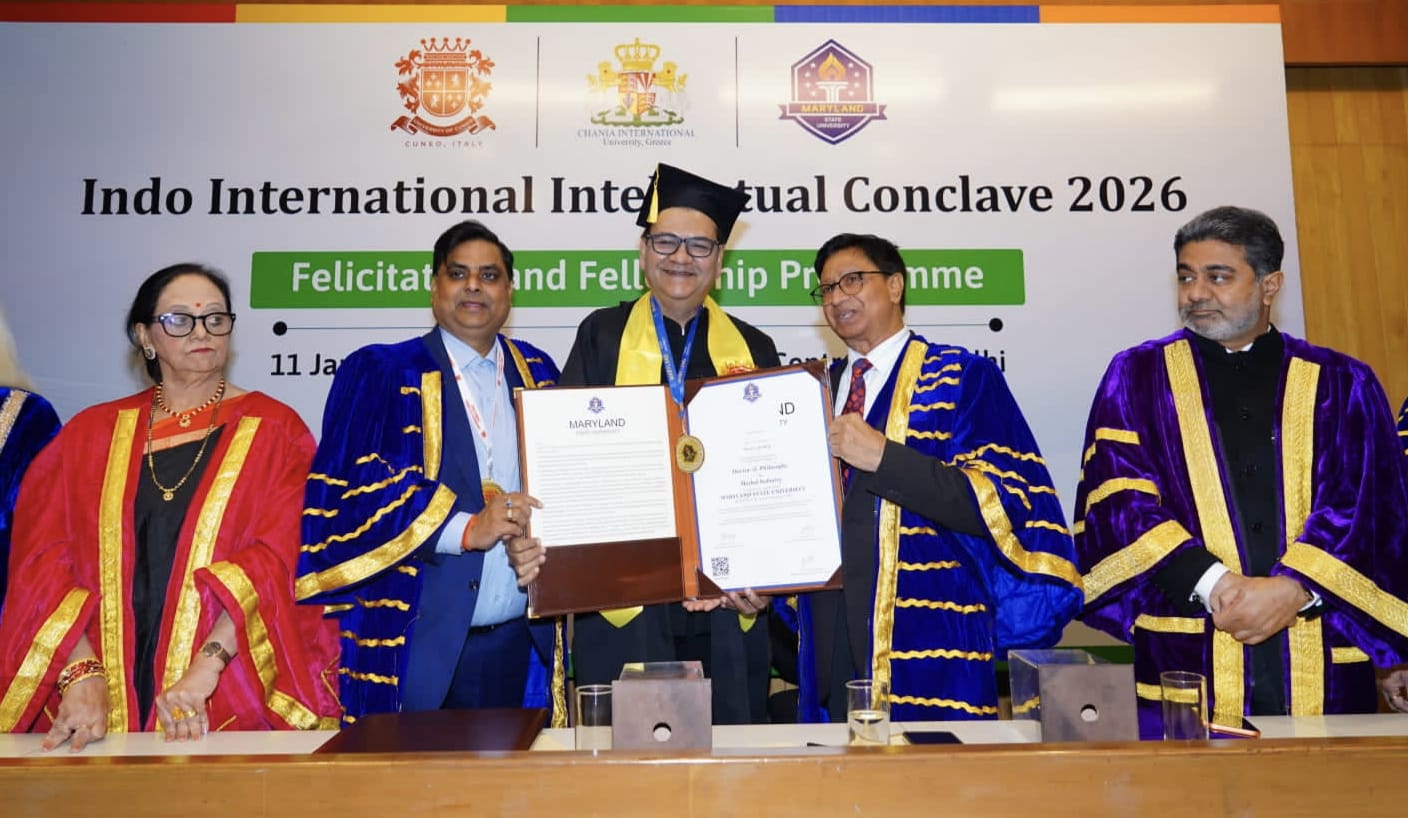
Renowned industrialist from Lucknow, Co-Founder & CEO of AMA Herbal Group of Companies, and former Co-Chairman of the Indian Industries Association, Mr. Yawar Ali Shah, has been conferred with an Honorary Doctorate of Philosophy (Honoris Causa PhD) along with a Gold Medal by Maryland State University for his historic global contributions to the herbal industry, natural dyeing, and sustainable technologies.
According to the confirmation letter issued by the Doctoral Monitoring Board of Maryland State University, this prestigious honour was awarded in recognition of Mr. Shah’s outstanding role in innovation within the herbal and natural dyeing industries, environmental conservation, rural employment generation, and international expansion.
The convocation ceremony was held on Sunday, January 11, 2026, at Gulmohar Hall, India Habitat Centre, New Delhi, in the presence of eminent academicians, scientists, and senior representatives from industry across India and overseas.
Mr. Yawar Ali Shah created history in 2003 by developing the world’s first herbal hair colour, followed in 2005 by the launch of the world’s first PPD-free natural hair colour under the brand Vegetal Bio, initially introduced in the United States. The product was subsequently launched in Dubai in 2006 and India in 2010. In India, it became the first herbal hair colour to be included in dermatologists’ prescription lists, making it the world’s first doctor-prescribed herbal hair colour. Today, brands such as Vegetal Bio and Safe Colour, developed under his leadership, are available in both Indian and international markets.
In the field of natural dyeing, AMA has achieved a historic technological breakthrough. While traditional indigo dyeing processes took nearly four hours, AMA successfully reduced the process time to just 40 seconds. AMA became the world’s first company to successfully apply natural indigo in industrial rope dyeing processes. Currently, 12 of the world’s top 20 denim manufacturers are AMA’s clients, and the company stands as the largest producer and exporter of natural indigo globally.
Driven by Mr. Shah’s “Best out of Waste” philosophy, innovative dyes were developed from pomegranate peels (khaki colour), waste black catechu from khair wood (brown dye), and residual mud left after shellac extraction from lac insects, resulting in orange and purple shades. These initiatives significantly reduced waste while creating new employment opportunities in rural areas. Additionally, the collection of forest produce such as hared, behead, and Majoo fruits has provided sustainable livelihoods to local women, contributing to their social and economic empowerment.
Mr. Yawar Ali Shah has also transformed indigo into a new cash crop in India. When he began work in this sector, indigo cultivation in North India was limited to just 70–80 acres, which has now expanded to approximately 15,000 acres. Each acre generates year-round employment for two people. Producing one kilogram of bio-indigo provides two days of employment for one person or one full day for two people.

Over the past three years, AMA has been actively developing indigo as a new cash crop in Uttar Pradesh, working alongside agricultural scientists to expand cultivation to 100 acres in pilot projects. Indigo cultivation yields around 20% higher income compared to menthe, and with AMA being the largest buyer, farmers do not need to worry about market access. Indigo is sown in February and harvested in June, a period when fields generally remain idle, making it highly attractive to farmers. Moreover, indigo improves soil fertility through nitrogen fixation, absorbs higher levels of carbon dioxide, and delivers both environmental and economic benefits.
In ancient times, natural sources such as plants, fruits, roots, insects, and minerals were used to dye fabrics. Examples include indigo, turmeric, ochre, and lac.
However, in the 19th century, with the invention of synthetic dyes, this traditional art form began to decline because synthetic dyes were cheaper, brighter, and more durable. But these dyes also led to increased environmental pollution and health problems. To address these issues and meet the growing demand for sustainable fashion, the art of natural dyeing began to be revived worldwide. AMA Herbal is a prime example of this. This ancient heritage is being preserved and adapted to modern needs.
Currently, various certifications are necessary to establish the credibility of natural dyes, such as:
Global Organic Textile Standard (GOTS)
OEKO-TEX
Bluesign
Cradle to Cradle
Organic/Natural Dye Certification
These certifications ensure that the dyes are completely natural, chemical-free, environmentally friendly, and that ethical trade practices are followed with the artisans. This allows for premium pricing of the products and facilitates global exports.
Mr. Shah has been representing India on the ISO TC-38 panel since 2015 and is also a panel member of BIS. He presented a research paper on “Energy-Efficient Dyeing with Natural Dyes” at ITMA Milan (Italy), which received international acclaim. Under his leadership, AMA Herbal Laboratories Pvt. Ltd., Vegetal Bioactivities Pvt. Ltd., and Vegetal Wellness Pvt. Ltd. are actively engaged in the fields of natural dyes, Ayurveda, dermatology, pharmaceuticals, and wellness.
Expressing his gratitude, Mr. Yawar Ali Shah stated,
“AMA continues to work relentlessly on natural and herbal solutions to improve human health, protect the environment, and strengthen the rural economy. This honour symbolizes global recognition of the entire Indian herbal industry.”