New Delhi: For decades, open water swimming in India was largely associated with endurance-driven expeditions—solitary, grueling journeys aimed at conquering challenges such as the English Channel or marathon sea swims. Legendary swimmers like Mihir Sen and Bula Choudhury etched their names into history by transforming these feats into symbols of courage and resolve. Routes such as Dharamtar to the Gateway of India became aspirational milestones for aspiring swimmers.
Over time, however, regulatory changes—such as age restrictions for English Channel attempts—curtailed opportunities for young talents, shifting many athletes away from the discipline. Maharashtra team manager Neha Sapte, who completed the Dharamtar–Gateway swim at just nine years of age before such rules were enforced, recalled how the changes altered her path. “Those rules pushed me towards shooting, and I’m glad I later represented India in that sport,” she said.
The narrative around open water swimming has now begun to change decisively. Since its inclusion as an Olympic sport at the 2008 Beijing Games, where 10 km circuit races are held in seas or rivers, the focus has steadily shifted from expedition-style swims to competitive racing.
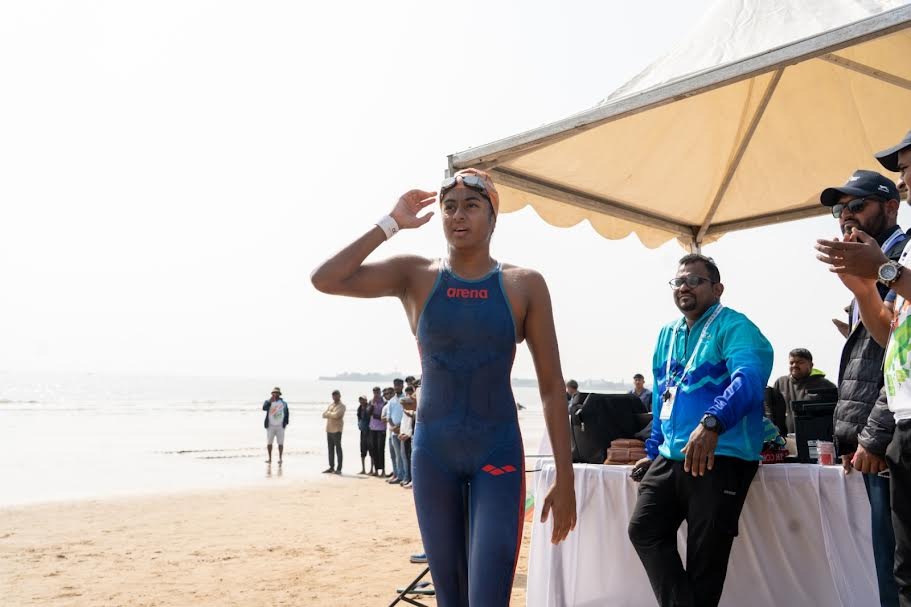
This transformation was on full display at the Khelo India Beach Games (KIBG) 2026, where Uttar Pradesh’s Anurag Singh and Karnataka’s Ashmita Chandra clinched gold medals in the men’s and women’s 10 km open water races respectively. Both athletes are already established names, having won medals at previous editions of the Khelo India Youth Games and University Games.
Anurag clocked 2:22:02 to top the men’s field, while Ashmita secured gold in 2:46:34 in the women’s race. Notably, both swimmers prepared largely in swimming pools, focusing intensely on endurance, often training two to three times a day and spending six to seven hours in the water.
The challenge of transitioning from pool swimming to open water is significant. While the longest competitive pool distance is 1500 metres, Olympic open water swimming recognises only 5 km and 10 km races. Ashmita, who has competed in four Open Water World Championships, explained the difference: “In the sea, apart from distance, waves and the course itself are major challenges. I mentally prepare for the worst conditions. Usually, within one lap you understand the tide, and then you focus on maintaining your pace.”

Organising such events also demands meticulous planning. According to KIBG 2026 competition manager Rahul Chiplunkar, organisers study tidal charts a month in advance and monitor them weekly to determine the safest race window. “We choose a time when tidal variation is minimal. Strong currents can make loop swimming extremely difficult,” he said, adding that swimmers must adapt their strokes, navigation skills, and race strategies to constantly shifting sea conditions.
Anurag admitted that mastering these technical aspects is still a work in progress for him. “I train in Delhi, where there’s no sea, so all my preparation was in the pool. Open water swimming is still a new discipline for me,” he said.
Chiplunkar, himself a former member of the 2016 Sea Hawk Relay team that swam 1,000 km from Mumbai to Mangaluru, believes the inclusion of open water swimming in the Khelo India Beach Games is driving rapid growth. “At the Diu Beach Games, there were about 40 participants. The first KIBG had 50, and this edition has 70 swimmers,” he noted.
With India’s long coastline and relatively calm waters in regions like Goa and Karnataka, experts believe the country has immense potential in this discipline. “Training in the sea is currently challenging due to permissions. If that issue is resolved, India can produce many more international-level open water swimmers,” Chiplunkar said.
As participation rises and competitive structures strengthen, open water swimming in India appears poised to move beyond its expeditionary past and establish itself as a mainstream, medal-driven sport on the global stage.