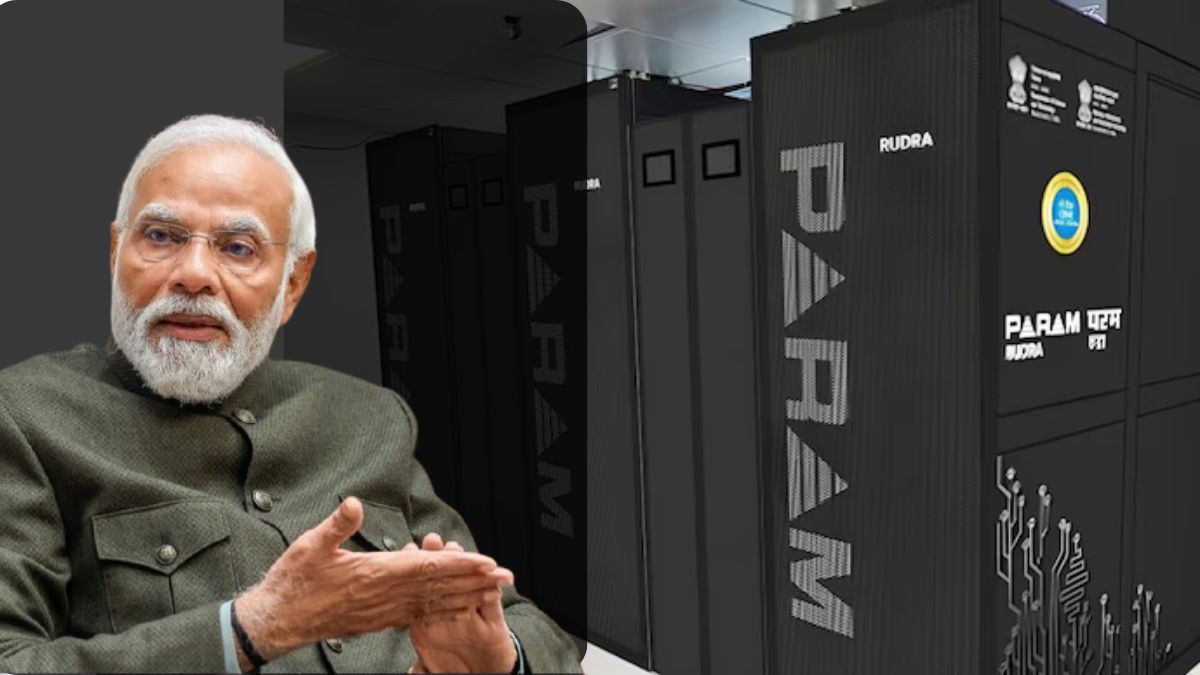
Mumbai: India has taken another major step in strengthening its high-performance computing ecosystem with the inauguration of the PARAM Rudra supercomputing facility at IIT-Bombay, following the recent commissioning of a similar system at IIT-Madras. The new facility reinforces the country’s push to build world-class, indigenous research infrastructure under the National Supercomputing Mission (NSM).
The facility was formally inaugurated on January 8, 2026, by Professor Abhay Karandikar, Secretary, Department of Science and Technology (DST), Government of India. Developed and deployed by the Centre for Development of Advanced Computing (C-DAC), PARAM Rudra will provide advanced computational capabilities to researchers, faculty members, and students, while also serving as a shared national resource.
With a peak computing capacity of three petaFLOPS, PARAM Rudra is designed to handle complex simulations, big data analytics, and high-end scientific workloads. Built under the “Build Approach” of the National Supercomputing Mission, the system uses indigenously designed Rudra servers, fully manufactured in India, reflecting the spirit of the Make in India initiative and growing technological self-reliance.
The supercomputer features an indigenous software stack and advanced direct contact liquid cooling technology, which improves energy efficiency and system performance while reducing operational costs and environmental impact. These innovations set new benchmarks for future supercomputing installations in the country.
Addressing the gathering, Professor Karandikar highlighted that over 200 faculty members and nearly 1,200 students at IIT-Bombay are expected to directly benefit from the facility. He added that PARAM Rudra would also support collaborative research projects involving academia, start-ups, and industry, enabling faster innovation across disciplines such as artificial intelligence, biotechnology, materials science, and advanced manufacturing.

Sunita Verma, Group Coordinator at the Ministry of Electronics and Information Technology (MeitY), described PARAM Rudra as a milestone in India’s indigenous supercomputing journey. She stressed the need for continued investment in high-performance computing hardware, software, microprocessors, and networking to achieve India’s long-term goal of exascale computing.
Providing an overview of the broader programme, Dr Hemant Darbari, Mission Director of the National Supercomputing Mission, noted that with PARAM Rudra’s addition, India now operates 38 supercomputers with a combined capacity of 44 petaFLOPS. He said the IIT-Bombay facility will particularly strengthen research institutions in the Mumbai region through shared access and collaborative projects.
The commissioning of PARAM Rudra is especially significant for strategic sectors such as aerospace, defence, and space, where large-scale simulations are critical for aircraft design, missile systems, materials research, and satellite missions. Indigenous supercomputing platforms reduce dependence on foreign resources and enhance national technological autonomy.
Overall, the inauguration of PARAM Rudra at IIT-Bombay marks a key milestone in India’s journey towards building a robust, self-reliant supercomputing ecosystem, positioning the country to tackle complex scientific challenges and advance its global standing in high-performance computing.