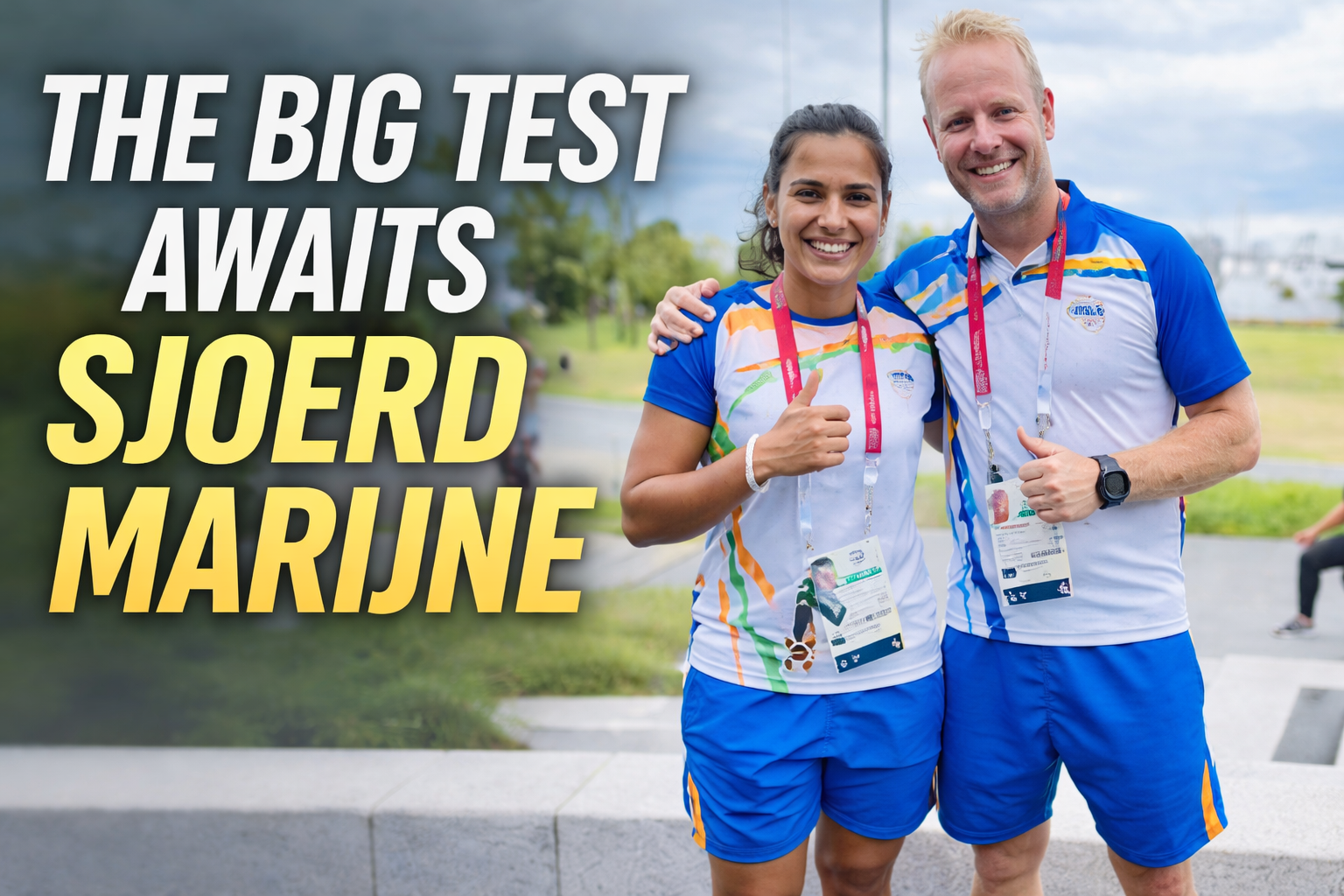
New Delhi: When Hockey India announced on January 2, 2026, that Sjoerd Marijne would return as chief coach of the Indian women’s hockey team, it immediately stirred memories, emotions and expectations. For Indian hockey fans, Marijne’s name is inseparable from the extraordinary Tokyo 2020 Olympic campaign, where the women’s team rewrote history with a fourth-place finish that came heartbreakingly close to a medal. For the players, administrators and followers of the sport, his reappointment marks not just a coaching change, but a decisive moment of reckoning.
This is not a routine comeback. This is Mission World Cup, and it may well be the most demanding assignment of Marijne’s career.
A team at a crossroads
Marijne returns at a time when Indian women’s hockey finds itself grappling with disappointment and uncertainty. The failure to qualify for the Paris 2024 Olympics, coupled with relegation from the FIH Pro League, has exposed cracks that go beyond results on the scoreboard. Confidence has dipped, morale has taken a hit, and questions are being asked about depth, planning and direction.
The Dutch coach will officially take charge on January 14, 2026, with the national training camp beginning on January 19. He replaces Harendra Singh, who stepped down in December 2025 citing personal reasons, following a tenure marked by mixed performances and mounting pressure. Backed strongly by senior players, Marijne’s reappointment signals Hockey India’s belief that familiarity, experience and proven success are the fastest routes to revival.
But familiarity alone will not be enough. The sport has evolved rapidly since Tokyo, and India’s rivals have not stood still.
The Tokyo legacy
To understand the weight of expectations, one must revisit Tokyo 2020. Entering the Olympics as underdogs, the Indian women’s team endured early setbacks, losing to the Netherlands, Germany and Great Britain in the group stage. Many wrote them off. What followed was a stunning turnaround that captivated the nation.
India defeated Australia 1–0 in the quarterfinals, a result that sent shockwaves through the hockey world. In the semifinals, they pushed Argentina, one of the tournament favourites, before falling short. The bronze-medal match against Great Britain became an instant classic—India fought back from 0–2 down, only to lose 3–4 in a match that left players and fans in tears.
Though they finished fourth, the campaign transformed Indian women’s hockey. Prime Minister Narendra Modi praised the team’s grit and skill, public interest surged, and the players became role models for a new generation.
At the heart of that transformation was Sjoerd Marijne.
The Marijne philosophy
Born in the Netherlands, a traditional powerhouse of world hockey, Marijne began his career as a player before transitioning into coaching. He first took charge of the Indian women’s team in 2017, during a period of transition. Results were inconsistent, and his initial stint ended amid controversy, including a brief and uneasy switch to the men’s team.
Yet, when he returned to guide the women again in 2020, the partnership clicked. Marijne brought with him a philosophy rooted in mental toughness, tactical clarity and player empowerment. He encouraged a “no-fear” approach, urging players to attack, press high and believe they belonged at the top level.
He also understood the Indian psyche. Blending Dutch precision with Indian flair, Marijne fostered an environment where players felt trusted and heard. Leaders such as Rani Rampal and goalkeeper Savita Punia have often credited him with instilling belief during the team’s darkest moments.
His methods extended beyond the pitch. Marijne emphasized preparation, adaptability and self-belief—qualities that would later be immortalized in his motivational talks and writings after the Olympics.
Post-Tokyo turbulence
Sustaining Tokyo’s momentum proved far more difficult than achieving it. After Marijne’s departure in 2021, the team struggled to find stability. Coaching changes brought shifts in philosophy—some emphasizing defensive rigidity, others focusing heavily on fitness—often at the expense of tactical cohesion.
There were moments of promise. India won bronze at the 2022 Commonwealth Games, and the gold medal at the 2023 Asian Games briefly rekindled optimism. However, deeper issues persisted. Defensive frailties, midfield inconsistencies and an aging core began to show against top-tier opponents.
The slide became more pronounced in the FIH Pro League, where India struggled for consistency and were eventually relegated. The nadir came at the Paris 2024 Olympic qualifiers, where India lost the bronze-medal playoff 0–1 to Japan, missing out on the Olympics after coming so close at Tokyo.
Critics pointed to coaching instability, tactical missteps and injuries at crucial moments. Fans expressed frustration on social media, lamenting missed opportunities and a sense of drift.

Why Marijne, again?
Marijne’s reappointment—his third stint—underscores Hockey India’s belief in his ability to deliver under pressure. At 51, he returns with what he describes as “fresh energy and a clear vision.” Officials see his familiarity with the players and the system as a crucial advantage, especially with a major tournament looming.
Senior players’ endorsement has been equally important. Many of the Tokyo core remain part of the setup, and their trust in Marijne’s leadership is seen as vital for rebuilding confidence quickly.
Yet, this return is not about nostalgia alone. It is a calculated gamble that experience and adaptability can bridge the gap between past glory and future success.
The immediate test: Hyderabad 2026
The 2026 Women’s FIH Hockey World Cup Qualifiers, scheduled from March 8 to 14 at the G.M.C. Balayogi Hockey Ground in Hyderabad, form the crucible of Mission World Cup. Eight teams—India, England, Scotland, Korea, Italy, Uruguay, Wales and Austria—will compete for a limited number of World Cup berths.
For India, currently hovering around ninth in the world rankings, this is a must-win event. Failure would mean missing another major global tournament, further stalling progress toward the 2028 Los Angeles Olympics.
The challenge will be formidable. England bring experience and tactical sophistication, Korea are known for their speed and counter-attacks, while Scotland and Wales offer physicality and discipline. Even lower-ranked teams like Italy and Uruguay pose upset risks if India underperforms.
Home advantage could prove decisive. Familiar conditions and vocal crowd support may lift the team, but March heat and humidity will test fitness and depth. Marijne has only weeks to assess form, plug defensive leaks and sharpen penalty-corner execution.
What must change
Marijne’s blueprint for revival will likely rest on his proven strengths: building cohesion, restoring belief and sharpening tactics. Expect a hybrid approach—retaining Tokyo’s aggressive pressing style while integrating modern elements such as data analysis, video breakdowns and individualized training plans.
Another key task will be succession planning. While veterans like Vandana Katariya remain influential, integrating younger players and Women’s Hockey India League standouts will be essential to address depth issues and future-proof the squad.
Mental resilience will be just as critical as tactics. After repeated setbacks, the squad has been described by observers as “dispirited.” Reigniting hunger and confidence may be Marijne’s toughest challenge.
Stakes beyond results
The implications of Mission World Cup extend far beyond qualification. Success in Hyderabad could restore faith among fans, attract sponsorships and strengthen grassroots pathways. A strong World Cup showing would reaffirm India’s place among the global elite and reignite Olympic ambitions.
Failure, however, would force deeper introspection about systemic issues—domestic development, coaching continuity and long-term planning. It could prolong what some fear may become a wilderness phase for Indian women’s hockey.
A defining chapter
As reactions pour in on platforms like X—ranging from enthusiastic welcomes to cautious optimism—the narrative is unmistakable. Sjoerd Marijne’s return is seen as unfinished business, a final attempt to convert promise into sustained success.
For Marijne, this stint will define his legacy in Indian hockey. Can he once again transform adversity into inspiration? Can he adapt his philosophy to a faster, more tactical modern game? And can he guide this team back to the world stage where it briefly shone so brightly?
With the Hyderabad qualifiers looming, the answers will come soon enough—on the turf, under pressure, where reputations are made or unmade. Mission World Cup has begun.