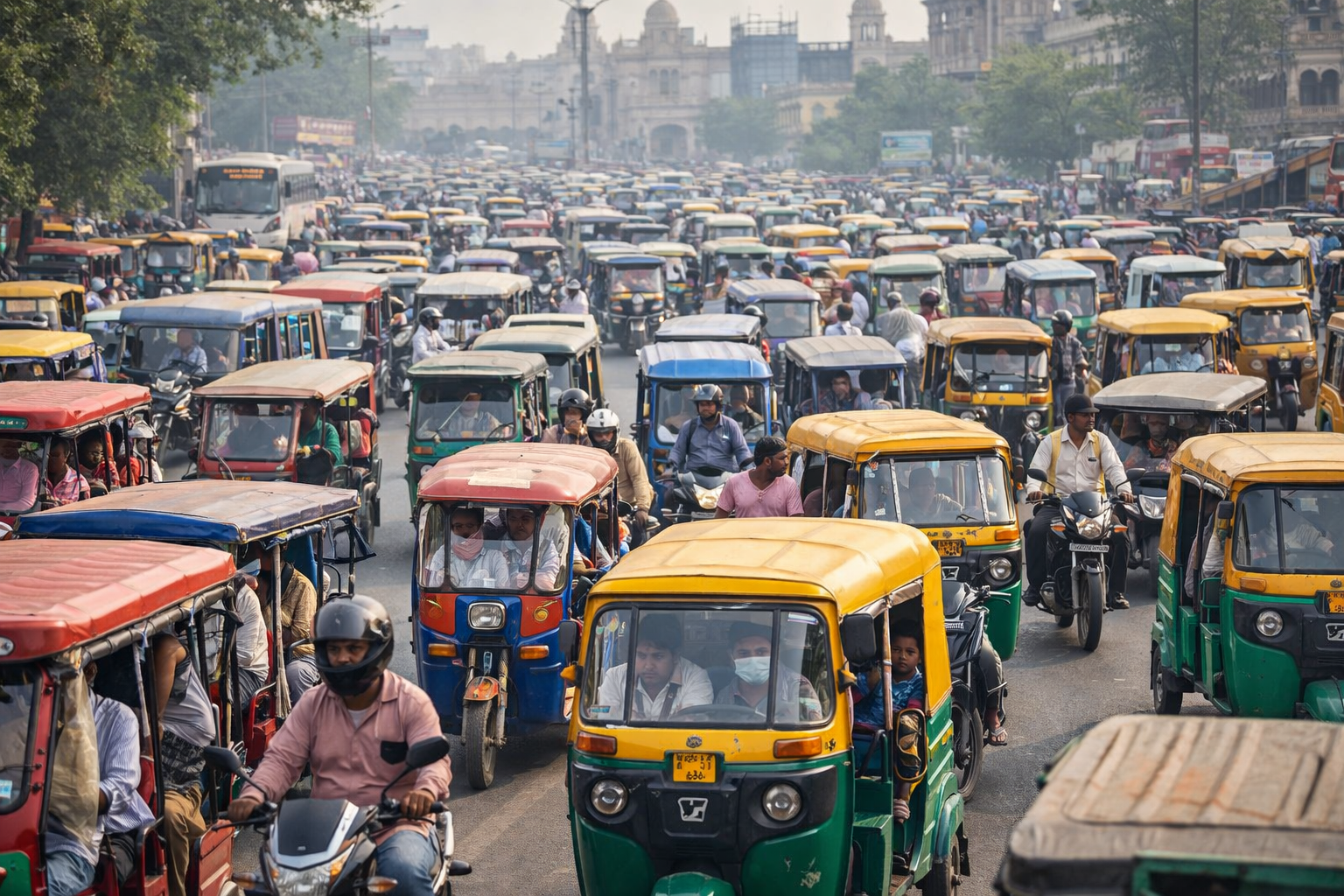
Lucknow: Lucknow, the city of nawabs and refined manners, is today battling a growing urban nightmare on its roads. What was once welcomed as an affordable and eco-friendly solution for last-mile connectivity—e-rickshaws and auto-rickshaws—has increasingly become synonymous with congestion, accidents and disorder. The unchecked rise of these three-wheelers has pushed the city’s traffic system to a breaking point, turning everyday commutes into tests of patience.
Vehicle numbers in Lucknow are increasing at a steep rate of 10–12 per cent every year, with the total fleet crossing 3.1 million. E-rickshaws, running into the tens of thousands, dominate this surge. While they remain a lifeline for short-distance travel, their unregulated spread has overwhelmed road infrastructure. Residents say travel times have nearly doubled since the COVID-19 period. Short trips such as Aminabad to Charbagh, which earlier took around 20 minutes, now take up to an hour due to daily jams at Hazratganj, Gomtinagar, Munshipulia and Alambagh.
The core issue lies in blatant violation of traffic norms. E-rickshaws are officially banned on 11 major arterial routes, including Hazratganj, Lohia Path, Polytechnic Crossing and the metro corridor from Amausi to Munshi Pulia. Yet, these restrictions are routinely ignored. E-rickshaws ply narrow lanes and main roads alike, often overloaded with passengers or goods, slowing down faster vehicles and creating ripple effects of congestion across large stretches.
Hazratganj, the city’s bustling commercial hub, highlights the scale of the problem. In a single day, police seized 51 e-rickshaws for violating route bans and fined 98 others. Auto-rickshaws, though fewer than their battery-powered counterparts, add to the chaos by competing for the same space, parking illegally near crossings and turning intersections into makeshift parking lots.
Enforcement efforts, though visible at times, remain inconsistent. A month-long drive by Lucknow Police led to the seizure of 224 e-rickshaws and autos and challaning of over 2,800 vehicles. However, officials admit that once such drives end, the vehicles return almost immediately. Police attribute this to manpower shortages, as personnel are often diverted for VIP movements, assembly sessions or fog-related highway duties. Recent checks also revealed more than 36,000 unregistered or unfit e-rickshaws and autos operating on city roads.
Reckless driving further worsens the situation. Incidents of e-rickshaws speeding, performing dangerous stunts or crashing into other vehicles underline the safety risks. In congested areas like Aminabad and Alambagh, the sheer volume of these vehicles turns narrow lanes into near-impassable corridors. Protests by e-rickshaw drivers against enforcement measures have also led to road blockades, bringing traffic to a standstill for hours and compounding commuter distress.

Public frustration is palpable. “My commute to office, which should take no more than 20 minutes, is routinely delayed due to traffic triggered by the unregulated movement of e-rickshaws,” says Naresh Shukla, a resident of Munshipulia. Another commuter recalled, “I was stuck near Ahimamau crossing for almost 45 minutes,” blaming diversions around Ekana Stadium that forced e-rickshaws onto alternative routes like Lohia Path.
Diversions during VIP visits, IPL matches and major political or official programmes further amplify the chaos. When key routes such as Lohia Path or Shaheed Path are closed, traffic is pushed onto secondary roads ill-equipped for heavy volumes. E-rickshaws and autos swarm these routes, stopping abruptly for passengers and worsening bottlenecks near railway crossings and underpasses. During one major snarl in Hazratganj, commuters reported being stuck for up to two hours on stretches that normally take just 20 minutes, with the impact felt across Alambagh, Mahanagar and Gomti Nagar.
There are occasional signs of relief. “For the last couple of days, we are seeing some relief on the roads… battery-operated rickshaws were a cause of concern as they were a hindrance to smooth flow of traffic,” noted Sudhir, a businessman, after a recent crackdown reduced the number of illegal e-rickshaws.
Drivers argue that they are also victims of poor planning, pointing to stagnant road infrastructure that has failed to keep pace with rapid motorisation. Yet many commuters, increasingly switching to motorcycles to avoid gridlocks, place the blame squarely on poor regulation and overdependence on three-wheelers. Public transport options offer limited respite, with buses infrequent and poorly maintained, and the metro yet to reach key areas like Old Lucknow.
Urban experts believe only comprehensive reforms can restore order—clear zoning of e-rickshaws, strict enforcement of route bans, dedicated lanes and parking, improved registration and fitness checks, and stronger traffic policing. Without such measures, Lucknow’s roads will continue to be battlegrounds where affordability clashes with order, leaving commuters trapped in perpetual limbo.