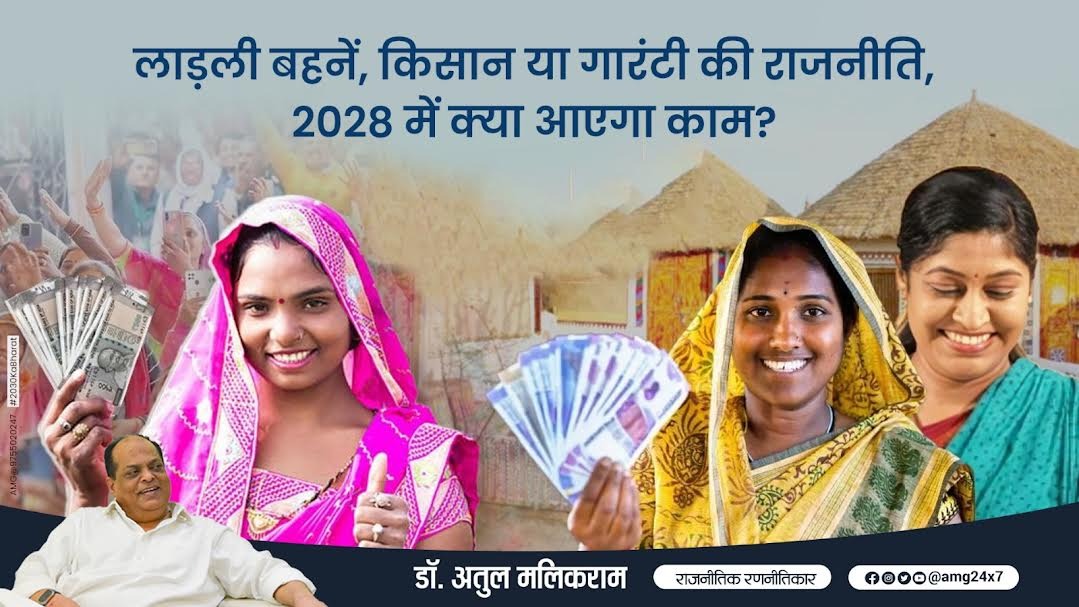
By Dr Atul Malikram, Political Strategist
As Indian politics increasingly moves into an era dominated by beneficiary-centric schemes and guarantee-based promises, the nature of electoral discourse has undergone a significant shift. Elections are no longer decided solely by ideology, organisational strength or oratory skills; instead, they now hinge on a more direct question—who is delivering tangible, consistent and trustworthy benefits to the everyday life of citizens. Madhya Pradesh has emerged as one of the most vivid examples of this transformation.

In the 2023 Assembly elections, schemes such as the Shivraj Singh Chouhan government’s Ladli Behna Yojana and farmer welfare initiatives altered the political narrative of the state. As the 2028 Assembly election gradually approaches, the debate has intensified over whether these same schemes will once again prove decisive, or whether the Congress party’s guarantee-driven politics can create a new political moment.
Beneficiary-oriented politics is not new to Madhya Pradesh, but Shivraj Singh Chouhan elevated it to an unprecedented scale. The Ladli Behna Yojana did more than provide financial assistance; it fostered a sense of dignity, security and political awareness among women. Monthly direct transfers into bank accounts led to visible changes in household decision-making and strengthened women’s role in electoral behaviour. This impact was clearly reflected in 2023, when a large section of women voters rallied firmly behind the BJP.
Similarly, farmer-centric schemes—including income support, irrigation projects, crop insurance, electricity subsidies and debt-related relief—brought stability to the rural economy. Their effects were not confined to policy documents but were visible in villages and farmlands. Farmers perceived the government as responsive and timely in addressing their concerns, making these schemes powerful due to their immediate and measurable benefits.

On the other side stands the Congress party’s politics of guarantees, which has gained momentum nationally. Rahul Gandhi’s “justice guarantees,” promising annual financial support for women, employment assurances for youth and farm loan waivers, appeal strongly to issues of social inequality. Congress has attempted to project this model in Madhya Pradesh as well. However, the key challenge it faces remains credibility, particularly as the party continues to search for a stable political base in the state.
The 2028 election will essentially be a test of trust. The strength of existing beneficiary schemes lies in their continuity and visibility—they are already embedded in people’s lives. In contrast, guarantee-based politics rests on future promises. Indian voters are increasingly valuing lived experience over assurances. If guarantees fail in implementation or remain incomplete after elections, the political cost could be significant.
That said, elections cannot be won on legacy schemes alone. By 2028, issues such as inflation, unemployment, water scarcity, climate change, education and healthcare are expected to gain prominence. The party that successfully links beneficiary welfare with these emerging concerns is likely to gain an advantage. Today’s youth and women voters are more aware; beyond financial aid, they seek dignity, opportunity and long-term security.
In conclusion, beneficiary schemes have become a foundational pillar of electoral politics in Madhya Pradesh. Ladli Behna and farmer welfare initiatives are no longer mere campaign tools but instruments of socio-economic transformation. Guarantee-based politics is new and appealing, but its success will ultimately depend on credibility and effective execution. The 2028 verdict will reveal which model resonates more deeply with the electorate.







 ---------------------------------------------------------------------------------------------------