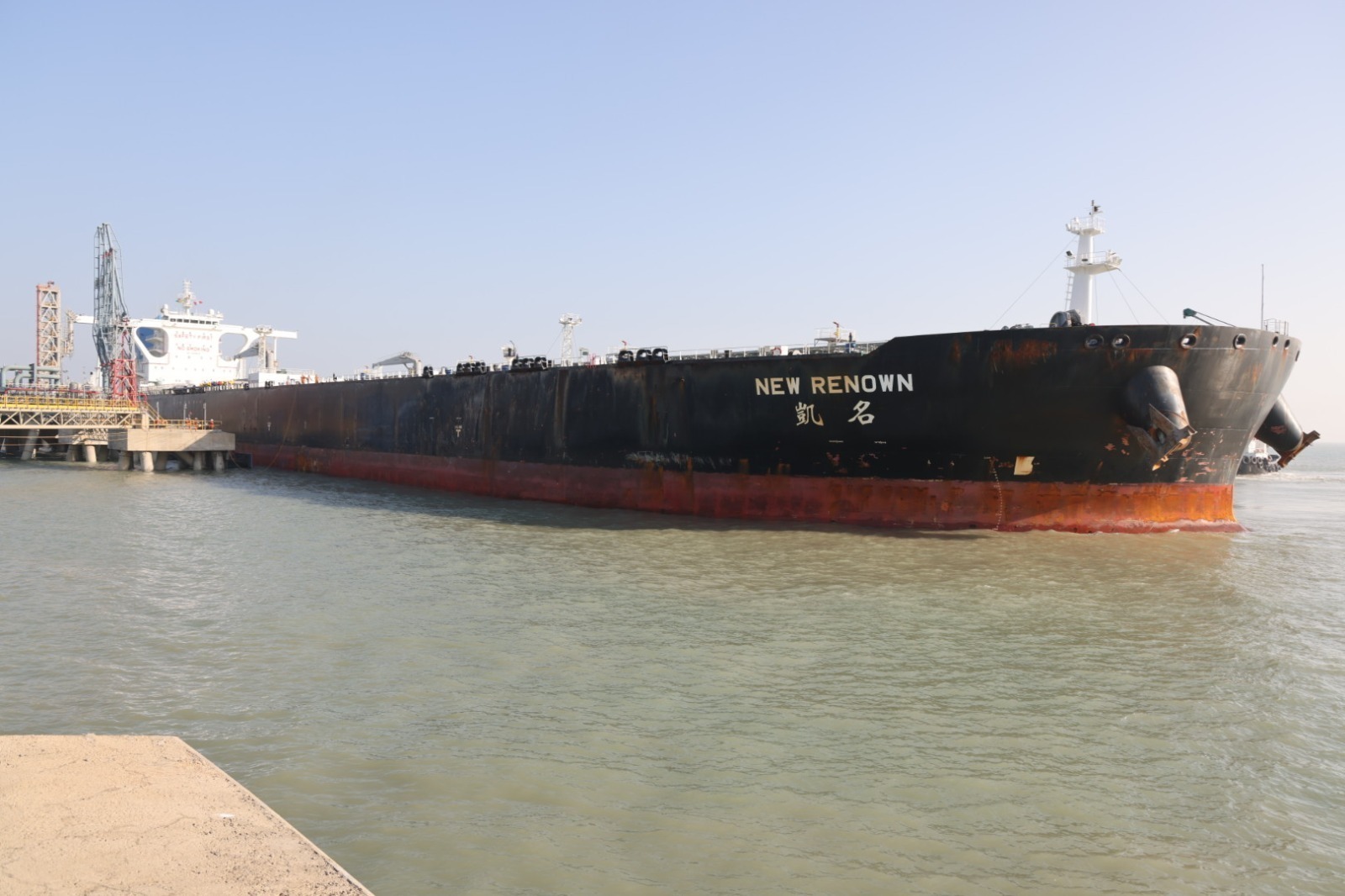
Mundra: India’s maritime and energy infrastructure has marked a decisive milestone at the very beginning of the year with the arrival of the country’s first fully loaded Very Large Crude Carrier (VLCC) directly at a jetty at Mundra Port. The massive tanker, MT New Renown, carrying around 330,000 cubic metres of crude oil, berthed successfully at Mundra, placing India for the first time on the global map of ports capable of handling fully laden VLCCs at a direct jetty.
The achievement is being seen as historic, as until now India had relied on offshore Single Point Mooring (SPM) systems or lightering operations to manage crude oil vessels of this size. With Mundra’s new capability, this dependence will significantly reduce, making crude handling safer, faster and more cost-effective. The ability to berth fully loaded VLCCs at maximum displacement directly at a jetty represents a structural transformation in India’s crude oil logistics ecosystem.

The berthing of MT New Renown was completed under challenging marine conditions marked by strong winds, powerful currents and demanding sea states. The successful execution of this complex operation highlighted the technical expertise, meticulous planning and operational excellence of Adani Ports and Special Economic Zone Ltd.’s (APSEZ) marine team and port management. As a result, Mundra has emerged not only as India’s most advanced port but also as a globally significant hub for high-capacity crude handling.
Mundra’s VLCC jetty now joins a select group of global ports equipped with sufficient depth and robust infrastructure to handle vessels with a draft of 21.6 metres and a maximum displacement of up to 360,000 metric tonnes directly at the berth. The 400-metre-long jetty features a berthing pocket depth of 25 metres and can accommodate vessels up to 333 metres in length. It is fitted with two 20-inch crude oil loading arms capable of discharging between 10,000 and 12,000 cubic metres of crude per hour. An advanced fender system, along with four breasting dolphins and six mooring dolphins equipped with 150-tonne SWL hooks, ensures maximum safety for ultra-large vessels.

Strategically, this development holds major significance for India’s energy security. The VLCC jetty at Mundra is directly connected via a 489-kilometre crude oil pipeline to HPCL’s Barmer refinery in Rajasthan—one of the country’s most critical refining assets. This direct linkage will enhance efficiency in large-scale crude imports, strengthen supply chains and boost economic activity across Gujarat and Rajasthan.
Adani’s Mundra Port is already India’s largest commercial port. Located on the Gulf of Kutch, the deep-water, all-weather port serves as a key maritime gateway for northern and western India. With 27 operational berths and two single point moorings, Mundra handles a diverse range of cargo including dry bulk, break-bulk, project cargo, liquids, containers, automobiles and crude oil. It is also capable of accommodating Capesize vessels, VLCCs, ULCCs and ultra-large container vessels.
In FY 2024–25, Mundra became the first Indian port to handle over 200 million metric tonnes of cargo in a single year. Its recognition in the World Bank’s Container Port Performance Index for 2024 and 2025 has further strengthened its global standing, underlining Mundra’s growing role as a critical pillar of India’s maritime and energy infrastructure.




 ---------------------------------------------------------------------------------------------------