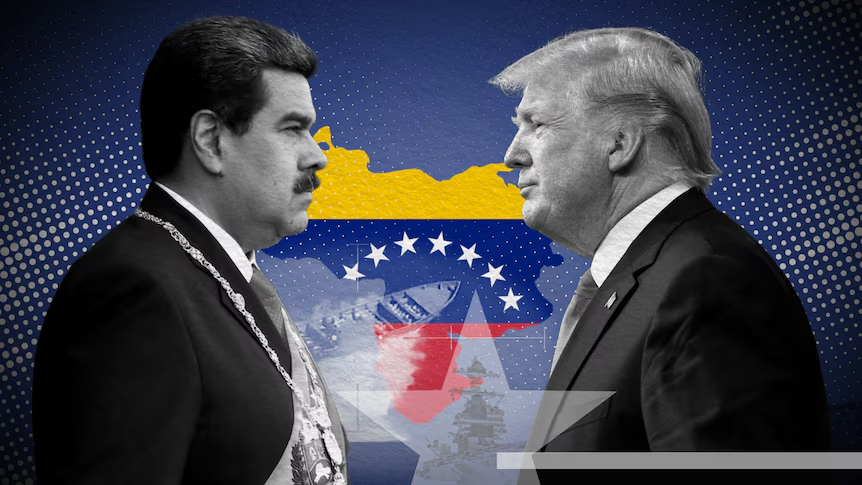
Venezuela: Venezuela, once counted among the richest nations in the world, today stands as a stark example of economic collapse. The recent U.S. military action and the arrest of President Nicolás Maduro have once again pushed the South American country into global headlines. But Venezuela’s decline did not happen overnight—it is the result of years of economic mismanagement, political choices, and geopolitical conflict.
Ironically, Venezuela possesses the largest proven oil reserves in the world, even more than Saudi Arabia, accounting for nearly 20 percent of global reserves—around 303 billion barrels. Yet, despite this vast wealth, the country produces less than 1 percent of global oil output today. Over the past decade, Venezuela has reportedly lost nearly 80 percent of its GDP, triggering mass migration as millions flee poverty, inflation, and shortages.

Oil Wealth, Policy Failure
A key reason for Venezuela’s downfall lies in the nationalisation of its oil industry. Policies initiated under former president Hugo Chávez and continued by Maduro led to the exit of major international companies, including U.S. energy giants. As investment dried up and infrastructure deteriorated, oil production collapsed. This not only crippled government revenues but also deepened tensions with Washington.
Beyond oil, Venezuela is rich in natural gas (the world’s sixth-largest reserve), gold, iron ore, bauxite, diamonds, and strategic minerals such as thorium, coltan, and rare earth elements—resources crucial to modern technology. Yet these assets remain largely untapped due to instability, sanctions, and lack of investor confidence.
Geopolitics and U.S. Intervention
The United States has long viewed Venezuela as strategically critical. Former U.S. President Donald Trump made no secret of his interest in the country’s energy and mineral wealth. The speed and manner in which Maduro was removed and taken to the U.S. shocked observers and raised serious questions about international law and sovereignty.
Analysts argue that Washington’s actions are rooted in a revived interpretation of the Monroe Doctrine, sometimes dubbed the “Don-roe Doctrine,” aimed at reasserting U.S. dominance in the Western Hemisphere. Venezuela, long within America’s geopolitical orbit, has become a focal point in efforts to curb the influence of Russia and China in Latin America.

Lessons from History
History offers sobering parallels. U.S. interventions in Iraq, Afghanistan, Vietnam, Cuba, and Nicaragua were often justified in the name of democracy but produced prolonged instability and unintended consequences. Critics warn that Venezuela could follow a similar path, with regime change failing to bring immediate stability or prosperity.
There is also a broader global concern: if such actions are normalised, how can the international community object to interventions elsewhere—be it Russia in Ukraine or a potential Chinese move on Taiwan?
A Cautionary Tale
Venezuela’s tragedy is not rooted in a lack of resources, but in poor governance, ideological rigidity, corruption, and external pressure. Had its immense wealth been managed with pragmatic economic policies, the country could have matched the prosperity of advanced economies.
Today, Venezuela serves as a cautionary tale for resource-rich nations: natural wealth alone does not guarantee prosperity. Without sound institutions, inclusive policies, and respect for sovereignty, even the richest countries can be pushed to the brink of collapse.







 ---------------------------------------------------------------------------------------------------