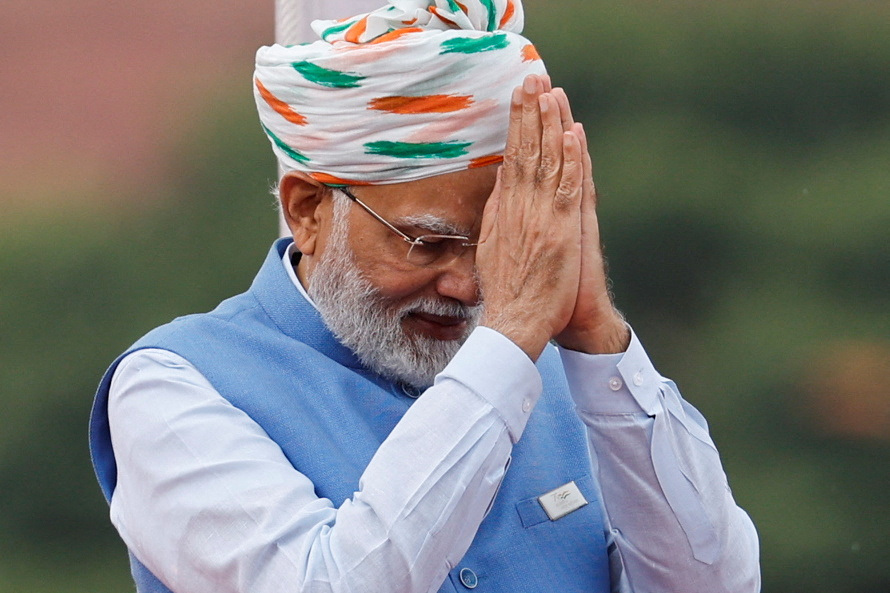
New Delhi: Prime Minister Narendra Modi has described the Somnath Temple as an eternal symbol of India’s civilisational strength, spiritual resilience, and unbroken faith, as the nation marks 1,000 years since the first attack on the sacred shrine in 1026. In a detailed reflective article, the Prime Minister said Somnath is not merely a temple, but a living expression of India’s soul and collective self-respect.
“Somnath—these words alone fill our hearts and minds with pride and devotion,” the Prime Minister wrote, noting that the temple, located at Prabhas Patan on Gujarat’s western coast, holds a unique place among the twelve Jyotirlingas of Lord Shiva, being mentioned first in the Dwadash Jyotirlinga Stotram. This, he said, reflects its unparalleled spiritual and civilisational importance.

Quoting ancient scriptures, the Prime Minister highlighted the belief that the darshan of the Somnath Jyotirlinga liberates devotees from sins and fulfills righteous aspirations, ultimately leading the soul toward salvation.
Recalling history, PM Modi noted that despite being a revered centre of devotion for millions, Somnath became a target of foreign invaders driven by destruction, with the first major assault carried out by Mahmud of Ghazni in January 1026. He described the attack as one of the greatest tragedies in human history, aimed at demolishing a powerful symbol of faith and civilisation.
Yet, the Prime Minister emphasised that Somnath’s story is not one of destruction, but of resurgence. “Even after a thousand years, Somnath stands today with the same grandeur, sending a powerful message to the world,” he wrote. He noted that repeated efforts were made over centuries to rebuild the temple, culminating in its present structure, completed on May 11, 1951. Coincidentally, 2026 also marks 75 years of the temple’s reconstruction, an event inaugurated in the presence of then President Dr. Rajendra Prasad.
PM Modi recalled how leaders like Sardar Vallabhbhai Patel took it upon themselves to rebuild Somnath after Independence, despite opposition and hesitation from some quarters. He also acknowledged the significant role played by K.M. Munshi, whose work “Somnath: The Shrine Eternal” captured the immortal spirit of the temple.
The Prime Minister referenced great personalities such as Devi Ahilyabai Holkar, who ensured continued worship at Somnath, and Swami Vivekananda, who, after visiting the temple in the 1890s, spoke passionately about India’s temples as living repositories of national consciousness and resilience.

Highlighting India’s philosophical core, PM Modi wrote that while Somnath’s physical structure was destroyed multiple times, its consciousness remained immortal, echoing the Upanishadic belief: “Weapons cannot cut the soul, fire cannot burn it.”
Drawing parallels with modern India, the Prime Minister said that the same values of faith, perseverance, and collective resolve continue to guide the nation today. India, he said, is now viewed globally as a land of hope, innovation, culture, yoga, Ayurveda, and solutions to global challenges.
“As Somnath rose again and again from its ruins, so too can India reclaim its ancient prosperity and lead the world with its civilisational wisdom,” PM Modi wrote, calling upon citizens to draw inspiration from the shrine’s legacy in building a developed and confident India.
Concluding his message, the Prime Minister said that while the invaders of the past have faded into history, Somnath continues to shine as a beacon of faith, creation, and hope for millions, reminding the world that hatred may destroy, but faith has the power to create and endure.
“Jai Somnath!”